AC Comes On When Heating? That’s Normal — Until It Isn’t
I’ve had this question a hundred times: “Why’s my AC light on when I’m trying to heat the car?” And no — your HVAC system isn’t broken. In fact, it’s doing exactly what it’s supposed to.
Modern automatic climate control systems don’t just manage temperature. They’re fighting fog. And the best way to stop a windshield from fogging? Dry the air. That means running the AC — even in winter.
Here’s how it works: cold, humid air comes in through the vents. The system pulls moisture out using the evaporator (that’s the AC part), then reheats it with the heater core. You get warm, dry air — no fogging. So if it’s 38°F outside with high humidity and the AC kicks on briefly? That’s not a glitch. That’s engineering.
But — and this is where things go sideways — if the AC runs constantly in cold, dry weather, or if your windshield fogs up even in AUTO mode, something’s wrong. And more often than not, it’s the humidity sensor.
When the AC Won’t Shut Off — What’s Really Going On
Let’s cut through the noise: if your compressor is running nonstop below 40°F, your humidity sensor is likely stuck reading “wet” when it’s dry. That tells the system, “Hey, we need dehumidification!” — so it keeps the AC on, even though you’re trying to heat.
What you end up with? Cold, clammy air blowing through the vents. Not what you want in January.
On the flip side, if the sensor fails low — or dies completely — it never sees rising humidity. So no AC, no dehumidification, and your windshield fogs up the second two people get in the car. You’re stuck flipping to defrost manually every time.
Either way, the symptom traces back to one thing: the sensor lying to the climate control module.
Diagnosing the Humidity Sensor — Step by Step
Before you start swapping parts, rule out the usual suspects. I’ve seen too many shops replace a $150 sensor only to find out the ambient air temp sensor was reading 20 degrees low — tricking the whole system.
| Symptom | Likely Cause | Common Mimics | How I Confirm It |
|---|---|---|---|
| AC runs constantly in winter | Sensor stuck high; module logic error | Low refrigerant; bad ambient temp sensor |
Pull live data. If the sensor reads 70%+ in a dry cabin, it’s faulty. I compare it to a handheld psychrometer — anything over 15% off and I’m replacing it. Command the compressor OFF via scan tool. If it disengages, the system responds — so the issue is upstream (sensor or logic), not a stuck relay. |
| Windshield fogs in AUTO | Sensor not detecting humidity rise; algorithm failure | Clogged drain; failed recirc door actuator |
Breathe gently toward the sensor (usually behind the mirror). Live data should jump 10–15% in seconds. No change? Dead sensor. Check the evaporator drain. If it’s clogged, water pools and evaporates into the cabin — fooling the system into thinking humidity is high. Seen it on 2018–2022 Camrys more than once. |
| DTC for humidity sensor | Sensor internal failure (capacitive element or IC) | Wiring damage; corroded connector; module fault |
Disconnect the harness. Test for 5V reference and ground at the connector. No power? Check fuses and wiring. Probe the signal wire. Flat 0V or 5V? Sensor’s dead. Fluctuating but wrong? It’s drifted — time to replace. |
Why These Sensors Fail — And Where They Hide
Most humidity sensors use a capacitive element. It’s sensitive. And it’s usually mounted behind the rearview mirror or in the upper dash — right where people spray their “shine” products.
Silicone-based dressings? UV protectants? Aerosol cleaners? They’ll coat the sensor. I’ve pulled units that looked like they’d been dipped in Armor All — no exaggeration. The dielectric properties change, and the sensor starts reading high. Permanently.
Then there’s age. After 5–7 years of thermal cycling, the MEMS inside can drift. It won’t fail outright, but it’ll read 15–20% high all the time. That’s enough to keep the AC running in winter.
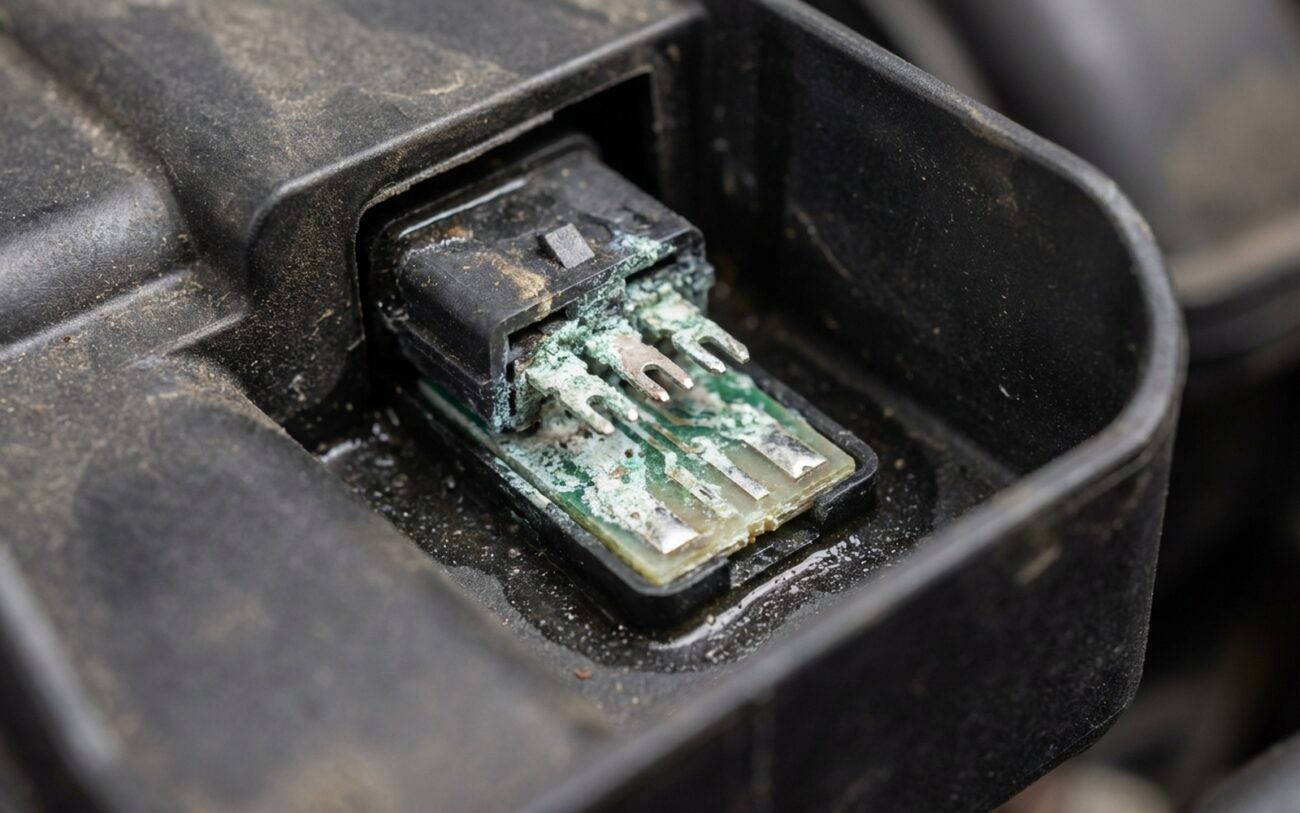
And don’t forget moisture ingress. If the housing seal degrades, condensation gets in. Corrosion follows. I’ve seen sensors with green corrosion on the PCB — game over.
Quick tip:
On many Hondas and Acuras, the sensor is built into the auto-dimming mirror assembly. Replacing it means buying the whole mirror — $400+. But you can often source just the sensor module from a junkyard unit and swap it. Saves hundreds.
Fixing It — What Actually Works
Replace the Sensor — If It’s Accessible [DIY-FEASIBLE]
Integrated Assembly Replacement Professional Only
Climate Control Module Swap Professional Only
There’s a shortcut: use the ECON button. Press it, and the AC stays off. [TEMPORARY] It stops the cold air and saves fuel. But you lose automatic defogging. You’ll be flipping to defrost every time the windshield fogs — which defeats the whole point of having an automatic system. I only recommend this if you’re waiting on parts or trying to stretch the life of an older car.
Did It Work? Here’s How to Know
Don’t just start the car and say, “Looks good.” Test it.
Connect a scan tool. In a normal cabin, the humidity reading should be 30–70%. Breathe toward the sensor — the value should jump within seconds. If it doesn’t move, the sensor’s not talking.
Then, test drive on a cold morning. Set to AUTO at 72°F. The AC should stay off unless humidity rises — like after a few passengers get in. Windshield stays clear? Good. AC kicks on briefly when you open the doors? Even better. That’s the system working as intended.
For final validation, compare the scan tool reading to a standalone psychrometer. If they’re within 5–10%, you’re golden.
What’s This Gonna Cost?
| Repair Type | DIY Cost (Parts) | Shop Cost (Est.) | Success Rate | Secondary Risk if Failed |
|---|---|---|---|---|
| Standalone Sensor Replacement | $50 – $150 | $200 – $400 | High (>95%) if calibration not required | Skip calibration and the system may not recognize the new sensor or operate inefficiently. |
| Integrated Assembly Replacement | $100 – $300 | $350 – $600 | High | Improper trim removal risks broken clips or damaged wiring harnesses. |
| Climate Control Module Replacement/Reprogram | $400 – $800+ | $600 – $1200+ | Moderate-High | Incorrect programming can disable HVAC functions or require re-flashing. |
Real talk: if the repair costs more than 25% of your car’s value, think hard. Spending $1,200 to fix climate logic on a $5,000 Corolla isn’t smart. In those cases, the ECON button becomes your best friend. You give up convenience, but you keep driving. I’ve done it myself — on my uncle’s old Accord. Sometimes, good enough is good enough.
Prevention Is Cheap
Stop spraying protectants near the dash top. I don’t care if it says “safe for all surfaces.” If it’s aerosol and silicone-based, it’ll kill that sensor. Wipe the dash with a damp cloth. If you must use a protectant, apply it to the cloth first.
And check your system early in the season. Cold, damp morning. Start the car. AUTO mode. Watch the AC light. If it comes on and stays on in a dry cabin, you’ve got drift. Catch it now — not in January when you’re late for work and can’t see out the windshield.
