No, the MAF sensor isn’t jamming your recirculation door—let’s kill that myth
I’ve heard this one a hundred times: “My car idles rough and the air won’t switch to fresh—must be the MAF, right?” Wrong. The MAF sensor doesn’t touch the HVAC system. Not even close. It measures incoming air mass so the ECM can meter fuel. That’s it. The recirculation door? That’s run by a tiny actuator, usually on the passenger side of the plenum, taking commands from the climate control module. Two separate systems. Different circuits. Different power sources. Different failure modes.
If both problems showed up at once, it’s coincidence. Maybe a recent car wash, maybe a power surge, maybe just age catching up. But blaming the MAF for a stuck door is like blaming your oil filter for a dead radio. Doesn’t compute.
The real culprits for recirc failure? Failed actuator (common), stripped gear inside the motor (especially on GM and Toyota), or a broken door linkage. I’ve pulled HVAC boxes apart and found doors snapped at the pivot—no warning, just clunk and it’s stuck. If you’re stuck on recirc, start there. Not at the MAF.
What a failing MAF actually does—and how it kills performance
When the MAF goes bad, it lies to the ECM. And the engine pays the price.
I’ve seen it a thousand times: cold start’s rough, idle surges between 600 and 1100 RPM, throttle feels like you’re driving through sand. That’s classic MAF failure. The ECM thinks there’s less air coming in than there really is—so it cuts fuel. Or worse, it thinks there’s too much air and dumps extra fuel, fouling plugs and choking the cat.
On a 2012–2015 F-150 with the 3.5L EcoBoost, I see this weekly. Customer says, “It hesitates when I step on it.” Pull the scanner—LTFT is +18%, MAF reading jumps from 3.2 to 8.7 g/s at idle for no reason. That’s not a fuel pump. That’s a dirty or failing MAF.
And here’s what most people miss: long-term rich conditions don’t just hurt mileage. Unburned fuel washes down cylinder walls, dilutes oil, and accelerates ring wear. I’ve done compression tests on 80k-mile engines that read like 180k—piston slap by 100k. All because of a $120 sensor nobody bothered to diagnose properly.
And the catalytic converter? It’s not designed to handle constant rich exhaust. Over time, it overheats, melts the substrate, and turns into a restriction. Now you’re looking at $1,200 in repairs because you ignored a $150 fix.
How to test the MAF—without guessing
You can’t just swap parts and hope. Too many things mimic a bad MAF.
Vacuum leaks are the big one. A cracked PCV hose or loose intake boot lets in unmetered air. The MAF doesn’t see it, but the engine breathes it—so mixture goes lean, idle hunts, ECM throws a fit. Looks identical to MAF failure. But unplug the MAF on a vacuum leak, and the idle gets worse. Unplug it on a bad MAF, and the idle smooths out—ECM defaults to pre-programmed fuel maps.
That’s your first field test: engine running, idle rough, unplug the MAF. If it smooths out? MAF’s the problem. If it dies or gets worse? Look at vacuum, fuel pressure, or ignition.
Next, get live data. You need a scan tool that reads MAF g/s, STFT, LTFT. At idle, most 4-cylinders should read 2–5 g/s. V6s: 4–7 g/s. If it’s bouncing around more than ±0.5 g/s, something’s wrong. If it’s dead steady at 1.2 g/s on a V6? That’s too low—likely contamination or internal failure.
Check fuel trims. LTFT over +10% at steady cruise? MAF’s under-reporting airflow. LTFT below –10%? It’s over-reporting. Either way, the sensor’s lying.
And don’t skip the basics: inspect the connector. I’ve had more than one case where the issue was a bent pin or corrosion in the harness—fixed with a contact cleaner and a heat gun. Saves you from buying a new sensor.
| Symptom | Likely MAF-Related Cause | Common Mimicking Issues | Definitive Test or Diagnostic Step |
|---|---|---|---|
| Erratic Idle | Dirt or oil contamination on sensing element | Vacuum leak, faulty idle air control (IAC) valve, EGR issues |
Unplug MAF while idling. If idle smooths, suspect MAF. Confirm with stable MAF g/s reading at idle (2–7 g/s typical).
|
| Power Loss Under Acceleration | Inaccurate MAF signal causing incorrect fuel trim | Clogged fuel filter, weak fuel pump, ignition misfire |
Log MAF data during wide-open throttle (WOT) pull. Should rise smoothly to engine-specific maximum. Check LTFT at cruise; values beyond ±10% suggest sensor drift.
|
| DTCs P0101, P0102, P0103 | Internal sensor failure or signal deviation | Wiring damage, poor ground, PCM communication fault |
Test for 5V reference at connector (key on, engine off). Check signal and ground circuits with multimeter. Wiggle harness while monitoring MAF data for intermittents.
|
| Stuck Recirculation Mode | Not caused by MAF failure | Failed blend door actuator, broken HVAC door, control module fault |
Use scan tool to command recirculation function. If door responds, issue is likely in switch or input circuit. If unresponsive, inspect actuator and door linkage.
|
Why MAFs fail—spoiler: it’s probably your air filter
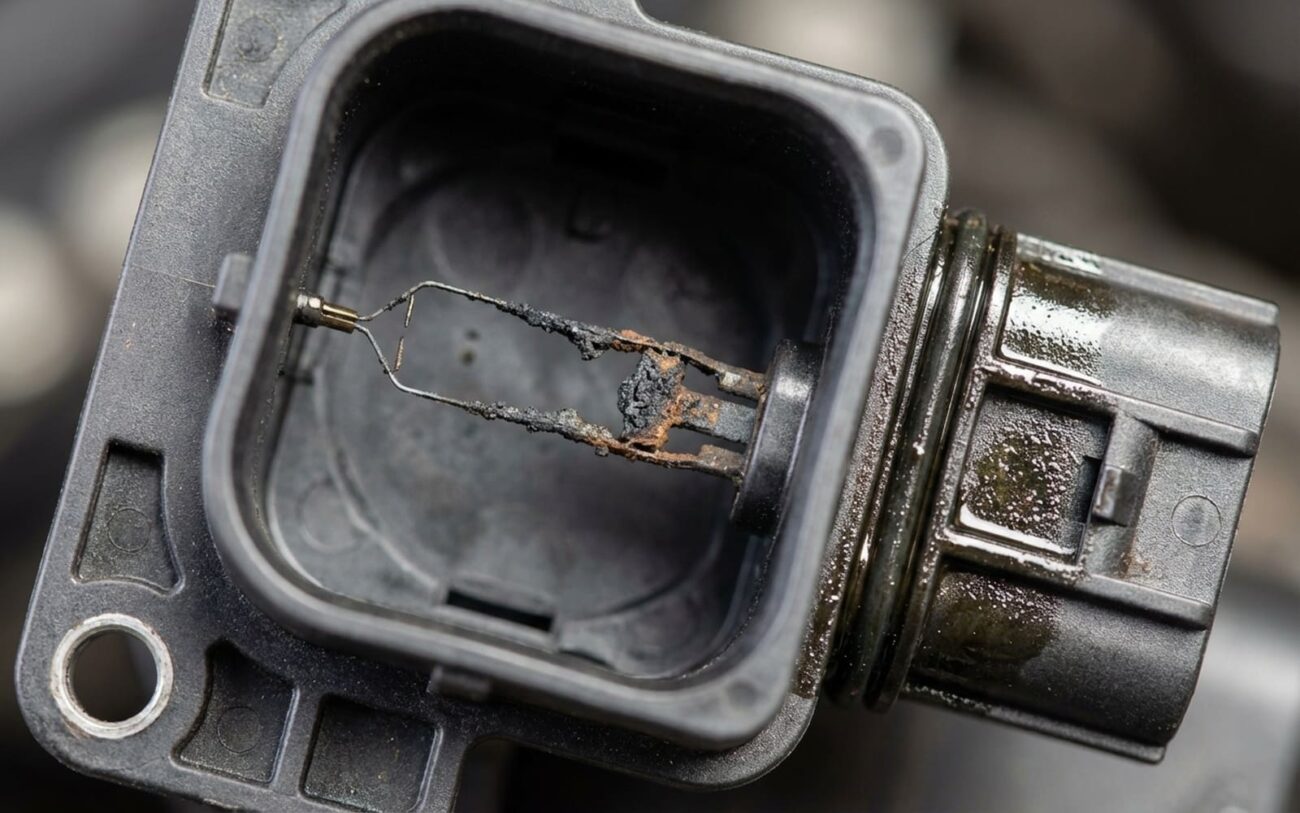
I’ll say it straight: oiled air filters destroy MAF sensors. I don’t care if it’s K&N, aFe, or some eBay knockoff. If it’s oiled, and you over-applied it, you’re coating that delicate sensing wire in oil mist every time you drive.
The wire’s designed to cool at a specific rate based on airflow. Oil changes its thermal conductivity. Now it’s reading 10% low. ECM adds fuel. You’re running rich. And it gets worse over time.
I’ve tested this in the shop. Clean MAF reads 4.2 g/s at idle. Same sensor, lightly oiled, reads 3.7. That’s enough to trigger LTFT corrections and set a P0101 after a few drive cycles.
And no, “I only used a little oil” doesn’t matter. If you can see a wet shine on the filter media, it’s too much. The filter should feel tacky, not greasy.
Other causes? Age, sure. Thermal cycling, vibration, moisture—over 150k miles, solder joints crack, circuitry degrades. But contamination’s the killer. I’d say 70% of the failed MAFs I pull are dirty, not broken.
Fix it right: clean, replace, or limp?
If it’s just dirty, cleaning might work. But you’ve got to do it right.
Use only MAF-specific cleaner—CRC, NAPA, or OEM. No brake cleaner. No carb spray. No compressed air. Those can damage the wire or leave residue.
Remove the sensor (usually two Torx T15 or T20 screws), unplug it, hold it by the housing. Spray the element from 6–8 inches. Let it dry—10 minutes, no wiping. Reinstall with a new O-ring (they harden and leak). Torque to spec—usually 6–8 Nm. Over-tighten, and you crack the housing. Then you’ve got an unmetered air leak on top of everything else.
If cleaning doesn’t help, or you’ve got codes like P0102 (low input), replace it. And don’t cheap out. I’ve tested aftermarket MAFs that read 15% high out of the box. Spend the extra $50 for OEM or a known-good brand like Bosch or Denso.
And if you’re stranded? Unplug the MAF. ECM goes into limp mode, uses MAP sensor and pre-programmed tables. You’ll get home. But don’t drive like that for days. Fuel trims go wild, cat temps spike. It’s a band-aid, not a fix.
Did it work? Here’s how to know
Clear the codes, but don’t assume it’s fixed. Drive it through a full readiness cycle—cold start, idle, cruise, decel, repeat.
Check MAF readings again. At idle, should be stable. At 2500 RPM steady, should hold within ±0.3 g/s. If it’s still bouncing, you’ve got an air leak or a bad replacement.
Monitor LTFT at highway speed. If it settles between –5% and +5%, you’re golden. If it’s still +12%, something’s wrong—maybe the O2 sensors, maybe the fuel pressure, maybe the new MAF is faulty.
And do a WOT pull. MAF signal should ramp up smoothly with RPM. No flat spots. No sudden drops. If it hesitates, check for vacuum leaks again—especially around the throttle body gasket.
Is it worth fixing?
Here’s my rule: if the repair costs more than 30% of the car’s value, step back. Especially if it’s over 150k miles.
MAF replacement: $100–$400 DIY, $250–$600 at a shop. Cleaning: $15 and 20 minutes. Success rate? Cleaning works about 40% of the time—if contamination is the only issue. Replacement? 95%, assuming you diagnosed it right.
But if you’re throwing parts at it without testing, you’re just wasting money. I’ve seen guys replace MAF, coils, O2 sensors, and still have the same idle. Turned out to be a split intake manifold gasket. Always test first.
How to keep it from happening again
Use a dry paper filter. OEM, Wix, Mann—doesn’t matter, as long as it’s not oiled. If you insist on reusable, follow the oil instructions to the letter. And inspect it every oil change. If it’s dark and greasy, you’ve over-oiled it.
Check intake hoses. A loose clamp after the MAF lets in unmetered air. ECM can’t compensate forever. Fuel trims go wild. Same effect as a bad sensor.
And scan your car every few months. Watch LTFT. If it’s creeping up, you’ve got an early warning. Maybe the MAF’s starting to drift. Maybe the filter’s clogged. Either way, you catch it before it turns into a drivability nightmare.
Simple stuff. But it saves engines. And wallets.
