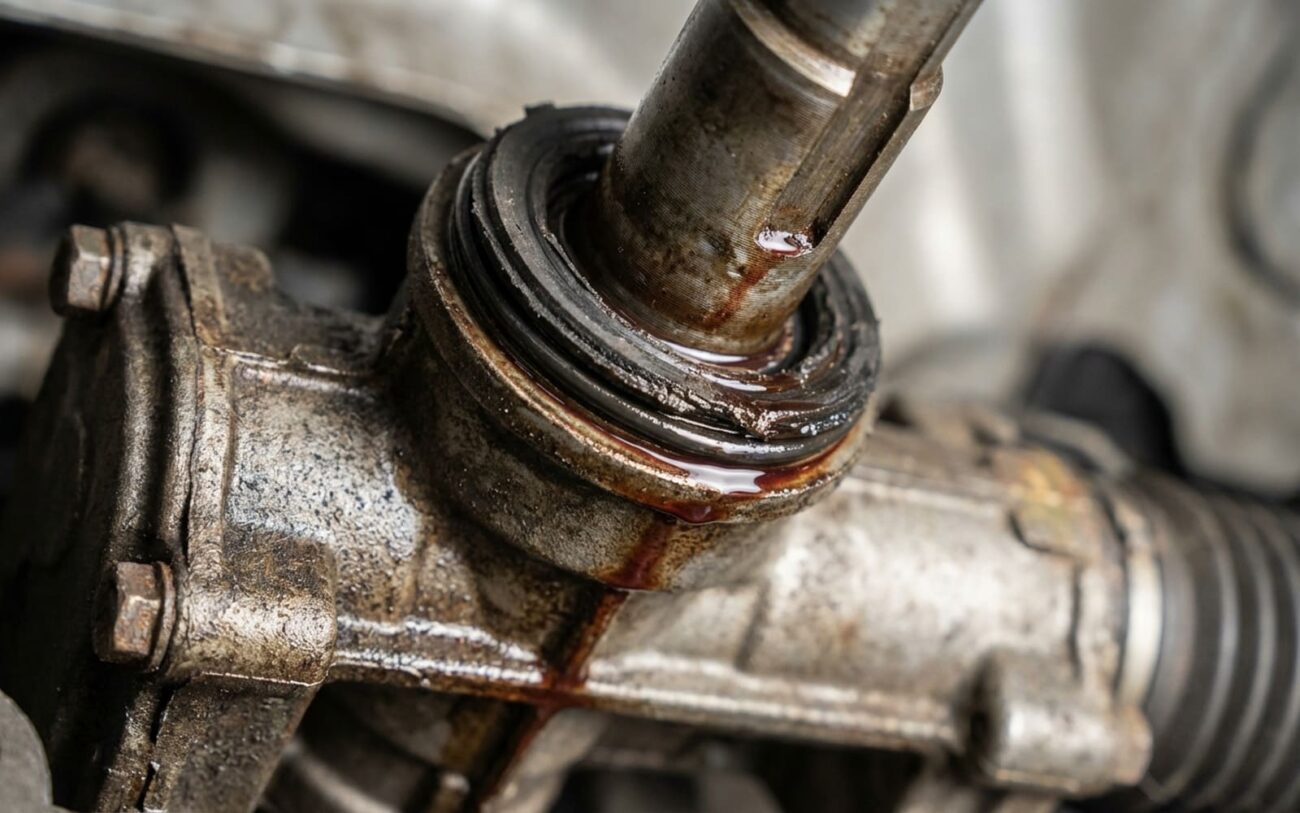
Alright, let’s talk about that puddle on your driver’s side floor. If you’re driving an older Mercedes—think W210 or W211 chassis—and you’re seeing power steering fluid, especially right under the steering column, you’ve found yourself a known issue. And trust me, this isn’t some random drip. It’s almost always that distinct green Pentosin CHF 11S, and it’s a dead giveaway you’ve got an internal hydraulic problem.
Unlike most power steering leaks that happen under the hood—at the pump, a hose, or the steering rack itself—this one shows up inside the cabin. That fluid traces its way up the steering column shaft, and that’s a big red flag pointing straight to a failed internal seal.
Here’s why you can’t ignore it: This isn’t just a messy floor. That fluid is coming from your power steering system. Keep driving, and the reservoir will run low. Once it drops below critical, your power steering pump starts sucking air – that’s called cavitation. And trust me, a cavitating pump dies a quick, expensive death. We’re talking another $500 to $1,000 on top of your existing repair. Even worse, if the system runs dry, you lose power steering assist entirely. That’s a serious safety hazard, especially at speed.
Don’t Jump to Conclusions: Confirming the Leak
Now, before you start tearing into the steering column, we need to be 100% sure this is where the leak is actually coming from. I’ve seen too many guys chase a phantom leak. There are a couple of common external leaks that can fool you, making it look like the fluid is coming from inside the column.
- Steering Gear Input Shaft Seal: The steering rack (or gear) has an input shaft seal where the column connects. If this seal fails, fluid can wick up the shaft and drip down into the cabin, mimicking an internal column leak. It’s a classic capillary effect.
- High-Pressure Hose at the Firewall: Sometimes, the power steering pressure hose, where it passes through the firewall, can develop a leak. Again, gravity and capillary action can guide that fluid right into your footwell.
- Overfilled Reservoir: This one’s simple, but it happens. If someone overfilled the power steering reservoir, especially with Pentosin CHF 11S, excess fluid can be forced up the column tube during thermal expansion, particularly after a hard drive. It looks like a leak, but it’s just too much fluid.
So, how do you know for sure? My go-to method is a UV dye kit designed for hydraulic systems. It’s cheap, and it works. Add the dye to your power steering reservoir, then fire up the engine. Turn the steering wheel fully left and right a few times to circulate that fluid through the whole system. Then, grab your UV flashlight.
Think of it like this
It’s like a leaky pipe inside your wall. You don’t see the pipe, just the puddle on the floor. The dye shows you the exact path the water took.
If that glowing trail leads from the steering gear input shaft or the firewall bulkhead, then your leak is external. But if the brightest fluorescence is right at the base of the steering column, inside the cabin, above the floor pan? Then you’ve got a confirmed internal leak, and that’s what we’re really here to talk about.
Quick Check List:
-
Fluid on carpet, under column: Likely internal column seal. Definitive Test: UV dye.
-
Fluid on column shaft (visible): Could be worn dynamic shaft seal OR simply an overfilled reservoir. Definitive Test: Check reservoir level, then UV dye.
-
Whining noise from dash: This isn’t the column itself, but a symptom of low fluid from any leak. Definitive Test: Refill and bleed. If noise stops, it was low fluid.
The Core Problem: That Internal Column Leak
Once you’ve ruled out all those external possibilities, the failure is almost certainly deep inside the steering column’s hydraulic guts. On these W210 and W211 models, the steering column actually has a rotary hydraulic valve built right into it. This valve is what directs pressurized fluid from the pump to give you power assist when you turn the wheel.
The critical part here is a dynamic shaft seal within this valve. Its job is to keep that high-pressure Pentosin fluid contained within the hydraulic circuit, preventing it from migrating into the dry column housing and, eventually, onto your carpet. After 15 or 20 years, with all the thermal cycling and constant movement, that rubber seal just hardens up and starts to seep. It’s a known wear item, and Mercedes-Benz documentation even mentions it.
My Take on Factory Info:
Mercedes knew this seal was going to be a problem eventually. It’s not a design flaw, really, just a component with a finite lifespan in a tough environment. That seal is constantly moving, constantly under pressure, and constantly exposed to heat. It’s going to give up the ghost eventually.
It’s vital to understand that this isn’t your power steering pump failing, or a cracked high-pressure hose, or even a worn intermediate shaft coupler. This is a failure within the column’s hydraulic core. And unlike some steering rack input seals that you might be able to replace, this internal rotary valve assembly is generally not serviceable in any conventional sense.
The Real Fix: What You Need to Do
This is Not a DIY for the Faint of Heart.
Look, disassembling a steering column involves the SRS (Airbag) system, high-pressure hydraulics, and precision components. One slip-up can lead to play in the column, persistent SRS warnings, or, worst-case, an airbag deployment failure. If you’re not a seasoned pro, leave this to the experts. Seriously.
Now, there are a couple of scenarios, but only one real, lasting fix:
The Rare Case: Telescoping O-Ring Repair Professional Only
The Only Real Fix: Full Assembly Replacement Non-Serviceable Component
The “Don’t Even Think About It” Option: Stop-Leak Additives Recipe for Disaster
Post-Repair: Trust, But Verify
So, you’ve done the work, or had it done. Don’t just assume everything’s good to go. You need to validate that repair under real-world conditions. Here’s my checklist for making sure that leak is truly gone and nothing else was messed up in the process:
My Validation Checklist
-
No Seepage: After at least three full heat cycles (driving the car, letting it cool completely, repeat), check the base of the column for any visible seepage. Bone dry is the only acceptable answer.
-
Stable Fluid Level: Monitor the fluid level in the reservoir. It should remain stable, between the MIN and MAX marks, over at least 100 miles of driving. Any drop means you still have a leak somewhere.
-
UV Check: Wipe down the area around the column base thoroughly. Then, recheck with your UV flashlight. You want to make sure you’re not seeing residual dye from the diagnostic stage.
-
Steering Feel & Diagnostics: Confirm the steering feels smooth, with no binding or unusual noises. And don’t forget to connect a scan tool to check for any new SRS or steering angle sensor faults. Mistakes happen, and it’s better to catch them early.
The Hard Truth: Cost & Your Options
Let’s be blunt: this isn’t a cheap fix. A new or remanufactured steering column assembly is a significant investment. Here’s what you’re generally looking at:
- Column Assembly Replacement (Parts Only): Expect to pay anywhere from $800 to $1,500 for the part itself, depending on whether you go new OEM or quality remanufactured.
- Shop Cost (Parts & Labor): In a professional shop, with labor, you’re usually looking at $1,800 to $2,800. This includes the part, the specialized labor (remember that SRS warning!), and a proper system bleed. The success rate for this approach, when done correctly, is well over 98%.
- Attempted Seal Repair: As I said before, this is a dead end. There’s no reliable way to replace that internal rotary valve seal. Any attempt to disassemble it usually destroys non-serviceable components, leaving you right back at square one, but with more broken parts. The success rate is practically zero, and you’re just adding costs.
The numbers speak for themselves. Trying to “fix” the internal seal is just not practical. As a rule of thumb, I always tell my customers: if the total repair cost starts to creep above 40% of your vehicle’s current market value, it’s time to seriously consider if the investment makes sense. I’ll help you run those numbers before we ever authorize the work.
Prevention & Staying Ahead
My #1 Tip: Use ONLY Genuine Pentosin CHF 11S
This isn’t just a suggestion; it’s critical. Always use genuine Mercedes-Benz approved fluid (part number A0009898903). Off-brand fluids, or even “compatible” ones, just don’t cut it. They break down faster, accelerate seal aging, and can cause all sorts of headaches. This isn’t just about system compatibility; it’s about preserving the integrity of every rubber component in that sensitive hydraulic system.
And beyond that, just keep an eye on things. Check your power steering fluid level monthly. If you see it dropping and there are no visible leaks under the hood, then you need to check the carpet under your steering column for any dampness. Catching this early won’t save you from eventually replacing the column, but it will save you from running the pump dry and adding another $600 or more to the bill. Proactive checks are key to keeping these cars running right.
