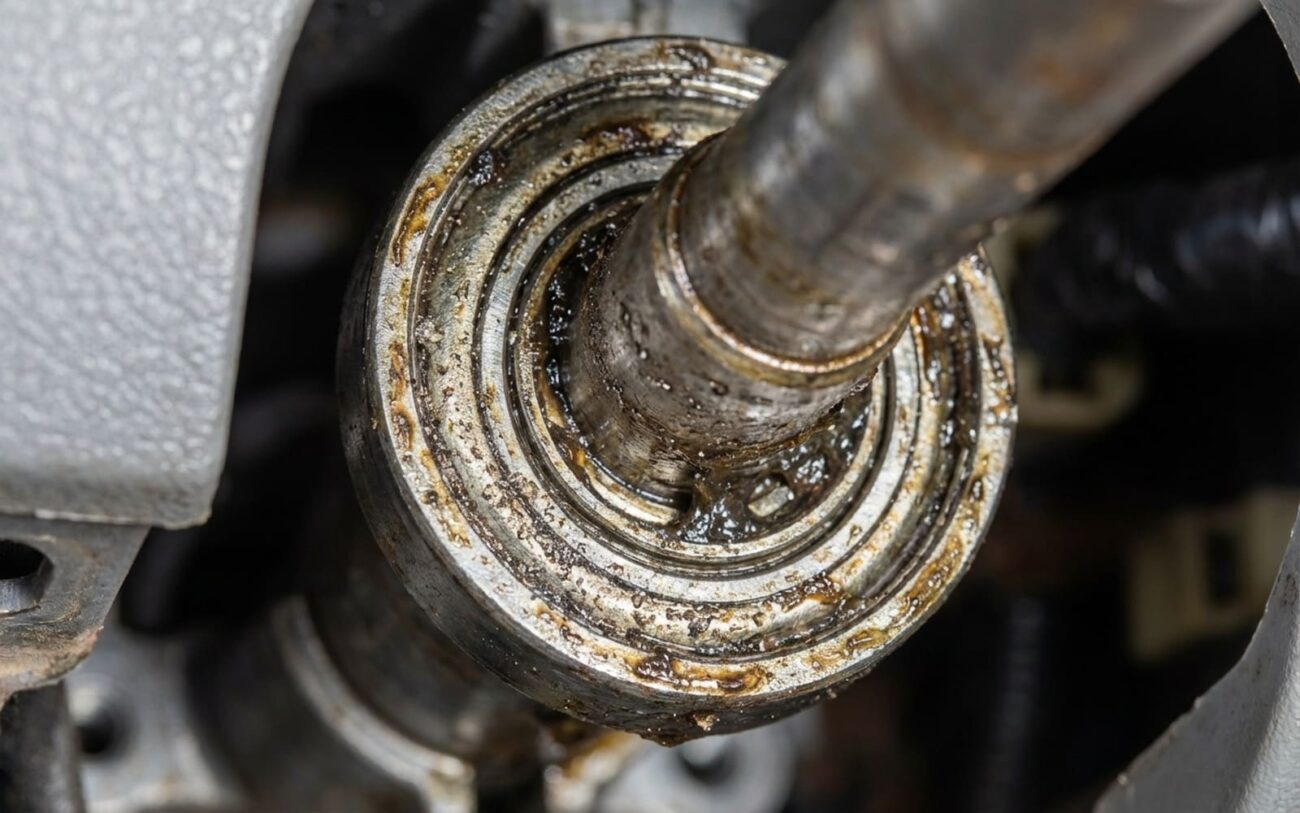
If you’re hearing a nasty, gritty grinding noise right behind your steering wheel – especially when you’re making slow, tight turns like pulling into a parking spot – and you can actually feel that roughness right through the wheel, then in my 25+ years, I can tell you it’s almost certainly a failing steering column bearing. This isn’t one of those subtle issues that hangs around forever; it usually starts small and gets worse fast. The sound? Think low-frequency growl, almost metal-on-metal, and it’s coming from inside the cabin, not out by the wheels or under the hood. You’ll often notice it most as you turn the wheel from one lock to the other, particularly as it passes through the center.
Sometimes you might even get a distinct clunk or pop when you change steering direction. That usually points to too much play in the bearing. In more advanced cases, the wheel might actually catch or bind a bit as you turn it, giving you that ‘notchy’ feeling. That’s a bad sign – it means the bearing race itself has likely started to pit (what we call brinelling) or even flake apart (spalling). Now, other things can cause similar symptoms – an intermediate shaft or even the steering rack – but the key here is location. If that noise and feel are centered right in the column, directly tied to your hand movements, then the problem is upstream of the firewall, right where you’re holding it.
Safety Warning: Look, I can’t stress this enough: a worn steering column bearing isn’t just an annoyance you can put off. This is a serious safety issue. If you let it go, that bearing cage can literally come apart, and the steering shaft can seize up. When that happens, you’re looking at a sudden, complete loss of steering control. And trust me, you do not want that at 60 MPH.
How I Pinpoint It: The Diagnostic Process
Steering noises can trick you. A grinding feeling could be the column bearing, sure, but it could also be a dry intermediate shaft U-joint, a worn steering coupler, or even something in the rack itself. The only way I know to be certain is to isolate the components. Here’s how I approach it:
The Gritty Grind: If you’re hearing that gritty, grinding noise from the lower dash area, it’s usually direct metal-on-metal contact from worn bearing balls or a chewed-up race. Common culprits that mimic this are a dry intermediate shaft U-joint or a worn input bearing on the steering gear.
My Go-To Test: Disconnect the intermediate shaft from the steering column, usually down near the firewall. Make sure the engine is off. Now, turn the steering wheel lock-to-lock. If that grinding noise is still there, coming from inside the column, then you’ve found your problem. The column bearing is the culprit. If the noise goes away, then you’re looking further down the line.
The Clunk or Pop: When you get a clunk or pop, especially when you’re changing steering direction, that tells me there’s excessive radial play in the bearing. It’s letting the shaft move around too much against its housing. Things like loose rack mounts, worn tie rod ends, or a degraded flexible coupler can feel similar.
My Test: Get an assistant to sit in the driver’s seat. With the engine off, have them rock the steering wheel gently, back and forth, just enough to reproduce the clunk. You need to be under the dash, feeling the column right near where it goes through the firewall. If you can feel that clunk internally in the column itself, then it’s the bearing.
The Notchy or Binding Feel: That ‘catch’ or ‘notch’ you feel, especially when the wheel passes through the center position? That’s typically brinelling or spalling on the bearing race – basically, physical indentations or flaking metal. A binding intermediate shaft or even a failing power steering control valve can sometimes feel similar.
My Test: Again, do the intermediate shaft disconnect test (engine off). If that binding or notchy feel persists with no hydraulic assist influencing it, then the bearing is definitely at fault.
And a quick note: don’t confuse hydraulic noises with bearing issues. A failing power steering pump or air in the system usually gives you a whine or squeal, especially under load. That’s a different animal entirely from the mechanical grind of a bearing. If you’re chasing hydraulic noise, you’re looking at different problems, like a fluid leak or a bad pump.
Why Bearings Fail
So, why do these bearings give up the ghost? I always tell folks to think about the bearing assembly itself, not just everything around it.
First off, it’s usually just normal wear and tear. Seriously, think about how many times you turn that wheel. Over 100,000 miles, that’s thousands upon thousands of cycles. Even the best-sealed bearings, designed for high quality, are going to degrade eventually. Especially with all the temperature swings and vibrations a car experiences.
The second big factor I see is contamination. There’s a rubber seal at the base of the column where it passes through the firewall. That seal is supposed to keep the nasties out. But when it cracks or tears – and it does, especially on older or high-mileage vehicles – road salt, moisture, and plain old dirt get in there. Once that stuff’s inside, it acts like a grinding paste, just chewing up the bearing components. I see this problem a lot more in places with harsh winters, where they use a lot of road salt.
Think of it like a precision watch gear: once road grit gets inside, it turns from a smooth mechanism into a piece of sandpaper. It’s just going to wear out.
Just to be super clear, this isn’t the same as a worn intermediate shaft U-joint or a leaking rack input shaft seal. Those are separate components, further down the line. If you confuse them, you’re going to misdiagnose it and waste a lot of time and money. The column bearing is part of the upper steering column assembly, before the intermediate shaft even starts.
Fixing It Right: Repair Options
Alright, you’ve diagnosed it. Now, how do we fix it? First, let me be absolutely clear: This is NOT a DIY job for the average weekend warrior. You’re working right next to your airbag system, the clockspring (that’s your SIR coil), and other critical steering components. One wrong move, and you could disable your airbag, cause steering instability, or even deploy the airbag accidentally. Seriously, if you’re not an experienced tech, take this to a professional.
Now, for the actual repair, you generally have two paths, depending on your vehicle:
1. Bearing Cartridge Replacement (If Your Car Allows It)
On some vehicles, especially older ones, you can actually replace just the bearing cartridge. This involves pulling the steering wheel, carefully disabling the SRS system (critical step!), and then compressing the lock plate. When you do this, always, always use an OEM-grade replacement bearing and fresh shear bolts. Torque specs are super important here – typically, steering wheel nuts are around 35–45 Nm, and the column bolts are usually 20–28 Nm. Don’t guess, look it up for your specific vehicle.
2. Full Steering Column Assembly Replacement (More Common Now)
On a lot of modern vehicles, especially anything built after, say, 2015, the lower bearing is often pressed into a one-piece column jacket. You simply can’t take it apart to replace just the bearing. In these cases, the only real solution is to replace the entire steering column assembly. This often means you’ll have to transfer your ignition lock cylinder and, critically, perform electronic programming to get it to talk to your car’s immobilizer system. It’s a bigger job, and it’s not cheap.
One more critical warning: Do not try to spray grease or penetrating oil into the column. It’s a temporary ‘fix’ at best, and it won’t actually repair a worn bearing. What it will do is seep into your clockspring, causing electrical faults or, even worse, an airbag failure. Don’t do it.
How to Verify the Repair Was Successful
Once the repair is done, don’t just assume everything’s good to go. You need to test it thoroughly. Here’s my checklist:
- First, with the engine off, rotate that steering wheel from lock-to-lock. It should feel smooth as silk, with absolutely no binding or grinding left.
- Next, get under there and grab the steering shaft down at the base, near the firewall. Try to wiggle it. You should feel zero noticeable radial play. If there’s any movement, something’s still loose or not right.
- Then, start the car. Make sure that SRS (airbag) warning light comes on briefly and then turns off after a few seconds. If it stays on, you’ve got an airbag system fault that needs addressing immediately.
- Finally, check all your steering-mounted controls: the horn, cruise control buttons, media controls. Make sure everything works as it should. You don’t want to find out your horn doesn’t work when you really need it.
Cost, Risk, and Making the Call
Let’s talk about the hard numbers – what this repair is likely to cost you, the risks involved, and when it makes sense to actually do it.
For a bearing cartridge replacement, if your vehicle allows it, you’re looking at parts in the range of $50–$150. If you take it to a shop, expect to pay anywhere from $400–$800 total. The success rate is usually high, over 95%, but the main risks are clockspring misalignment or other SRS faults if not done correctly.
If you need a full steering column assembly, the parts alone will run you $300–$800, and a shop repair could easily hit $1,000–$2,000 or even more, especially with programming. The success rate is almost 100% if done right, but the risks here are usually immobilizer sync failures or other electronic calibration headaches.
Here’s a rule of thumb I’ve used for years: the ‘40% Rule.’ If the total repair cost is going to exceed 40% of what your vehicle is actually worth (its private-party value), then replacing the entire column might be the smarter long-term move. Even if a simple bearing replacement is technically possible, sometimes it’s just not worth sinking that much money into an older car when a bigger, more permanent fix is available.
