Turn signals flashing like a strobe light? I’ve seen it a thousand times. Most people assume it’s a bulb—pull the old one, pop in a new one, done. But on modern Mercedes, BMWs, and even newer domestics, that’s rarely the fix. The real issue is usually buried in the electronics: a module misreading load, a ground gone bad, or a CAN bus message that never made it through. And if you’re chasing this blind, you’ll waste hours—and money—on parts that aren’t faulty.
Hyperflash Isn’t Always a Bulb Problem
Let’s clear this up: hyperflash—the dash blinking twice as fast as normal—is the car’s way of saying, “Something’s wrong with the circuit.” But “wrong” doesn’t mean “open.” Older cars used thermal flashers that physically timed the blink based on current draw. No load? Faster blink. Simple.
Modern vehicles don’t use that. They’ve got modules—Front SAM on Mercedes, FRM on BMWs—that actively monitor each turn signal circuit. If the expected current doesn’t match what’s measured, the system throws a fit. But here’s the kicker: the module can fail internally and still power the lights just fine. So you’ll see the outside bulbs working perfectly, but the dash is going nuts. That’s not a bulb issue. That’s the module lying to the cluster.
Real Talk:
If the lights flash at the right speed and all bulbs are lit, but the dash blinks fast—stop replacing bulbs. You’re wasting time. The detection system is broken, not the lights.
Symptom First, Diagnosis Second
Before you touch a tool, watch the behavior. I make every customer in my shop demonstrate it while I stand at the rear or side of the car. What you see tells you where to look.
| Symptom | Likely Culprit | Common Mimics | Definitive Test |
|---|---|---|---|
| Dash hyperflashes, but exterior lamps work normally | Faulty Front Signal Acquisition Module (FSAM) or internal circuit failure | Instrument cluster fault, BDC communication error |
Use an oscilloscope to check the FSAM output signal with known-good bulbs. A clean signal from the module rules it out. |
| One side flashes faster than the other | Failed FSAM on the affected side or side-specific CAN issue | Corroded ground connection, damaged wiring harness |
Swap left and right FSAMs (if identical). If the problem follows the module, it’s confirmed. |
| All turn signals dead or erratic | Multiple FSAM failures or CAN bus communication fault | Failed main body control module, power supply issue |
Scan for “No Communication” codes. Check CAN bus voltage (typically 2.5–3.5V on high line, 1.5–2.5V on low line) with a multimeter or oscilloscope. |
I can’t stress this enough: if you’re not pulling codes from the FRM or SAM, you’re guessing. On BMWs, a “bulb out” warning with no actual bulb failure almost always points to the FRM’s internal drivers. And on W211 E-Classes? The front signal modules in the fenders—they get soaked, crack solder, and start acting up after five years. Seen it on dozens.
Why These Modules Die (And It’s Not Just Age)
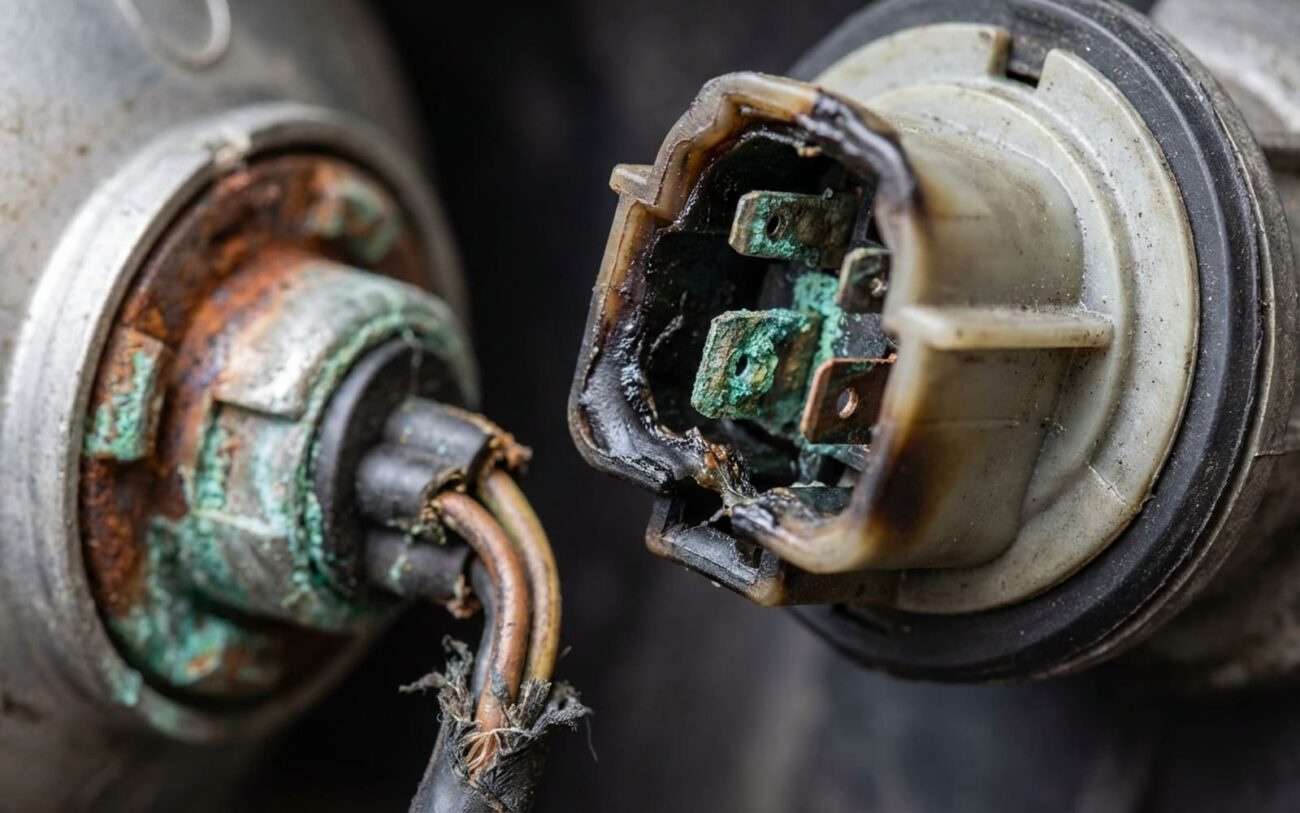
These aren’t relays. They’re solid-state, load-sensing circuits packed into a box mounted where? In the front wheel well. Right where road salt, gravel, and puddles live. So when I pull one of these out and crack it open, here’s what I usually find: hairline cracks in solder joints from thermal cycling, or white corrosion on the ground pins from moisture ingress.
The thermal stress is real. Engine heat soaks the module all day. Then you park, it cools down. Next morning, cold start. That expansion and contraction over years? It breaks microscopic solder bonds—especially on heavy components like drivers and regulators. And when it does, you get intermittent faults: hyperflash when hot, fine when cold. I’ve had customers tell me, “It only does it after I’ve been driving 20 minutes.” That’s not a coincidence.
Moisture is just as bad. I’ve seen connectors not fully seated, missing seals, or wheel well liners ripped off—leaving the module exposed. Water gets in, sits on the board, and creates leakage paths. The module thinks there’s a short or low load, so it throws a bulb fault. But the bulbs are fine. The circuit is fine. The module is lying.
How I Fix It (And What I Don’t Do)
Replace & Code the Module Professional Only
Send It Out for PCB Repair Professional Only
Temporary Fixes (And What to Avoid)
Did It Actually Work? Test Like a Pro
You replaced it. You coded it. Now what? Don’t just turn the key and walk away. I run a full functional check: left signal, right signal, hazard lights. Watch ten full cycles. All lamps—front, rear, side markers—must flash in sync. No lag, no stutter.
Then I scan. Clear codes, cycle ignition, rescan. Zero active faults. If “bulb monitoring” or “communication error” comes back, something’s still off. Maybe the module didn’t take the coding. Maybe there’s a wiring issue you missed.
Finally, I check live data. On BMW ISTA, I can see “Turn Signal Left: ON/OFF” toggling in real time. If it’s sluggish or missing, the signal isn’t getting through cleanly. That’s not a bulb problem. That’s a system-level fault—and you’re not done.
Cost vs. Value: Is It Worth It?
Specialist PCB Repair
DIY: $100–$300 (shipping + repair). Shop: $200–$400. Success Rate: ~85%. Risk: Module may be beyond repair; risk of needing full replacement if repair fails.
Standalone FSAM Replacement
DIY: $150–$500 (part only). Shop: $400–$800 (parts + programming). Success Rate: ~98%. Risk: Incorrect coding can cause CAN bus errors or disable other functions.
Integrated Module Replacement
DIY: $500–$1500 (part). Shop: $800–$2000 (parts + labor + programming). Success Rate: ~99%. Risk: High cost; often not economical for older vehicles.
How to Keep It From Happening Again
Prevention beats repair every time. Keep the wheel well liners intact. I don’t care if it’s “just a flap of plastic”—that flap keeps water out of the FSAM. And when you’re changing bulbs, take ten seconds to apply dielectric grease to the socket. Not to fix a bad connection, but to seal it.
And if you get a bulb-out warning, don’t ignore it. A broken filament can arc and draw erratic current, stressing the module’s driver circuit over time. I’ve seen good modules fail prematurely because a single bulb was left dead for months.
Moisture kills modules. It’s that simple. And it’s not just turn signals—same thing happens with blower motors, seat control modules, even infotainment units after a spill. Keep connectors tight, seals dry, and modules protected. It’s not rocket science. But it’ll save you a world of trouble.
