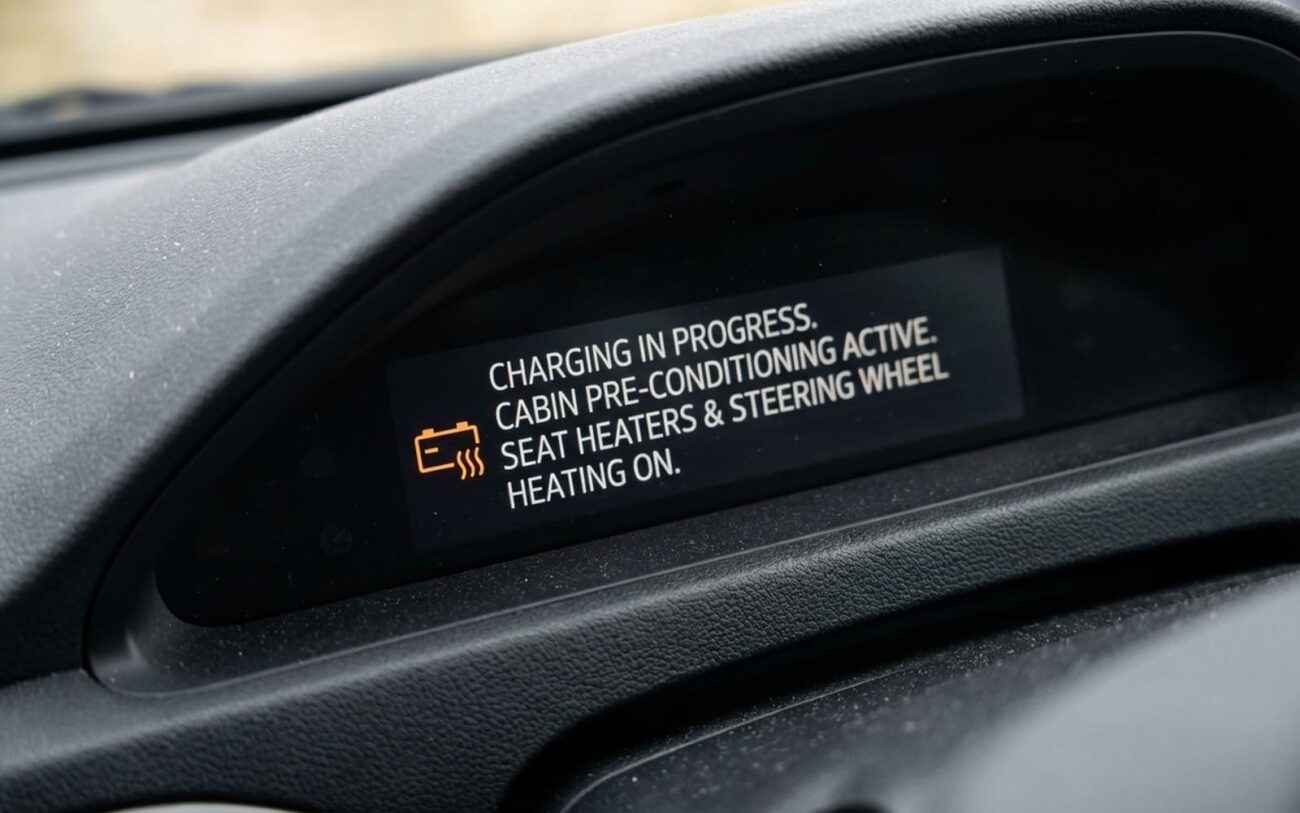
You plug in your EV on a cold morning and—without touching a thing—the seat heaters come on. No warning. No input from you. And you’re thinking: “Is this a short? Did something fail?” I’ve seen this exact look on dozens of faces in my shop over the last five years. That panic? It’s misplaced. What you’re seeing isn’t a fault. It’s your car doing its job—protecting the battery and making sure it can charge properly.
Symptom: Heaters Turn On Automatically During Charging
This happens almost exclusively when the battery is cold—think below 5°C (41°F), especially in freezing conditions. The lithium-ion pack can’t accept high charge rates when it’s cold. Internal resistance goes up, efficiency drops, and fast charging becomes impossible. So the BMS—Battery Management System—kicks in with a workaround.
Instead of just idling, it uses existing high-wattage loads like seat or steering wheel heaters to draw power from the grid. That energy doesn’t just vanish—it turns into heat. And since most EVs share a thermal loop between the cabin climate system and the battery coolant, that heat helps warm the battery indirectly.
Yes, really. Your seat heater is being used as a battery preheater. It’s not a design flaw. It’s a clever, cost-effective thermal strategy. I’ve seen it on Tesla Model 3/Y, Hyundai Ioniq 5, Kia EV6, and Ford Mustang Mach-E. All different brands. All using the same principle.
You might get a message like “Battery Preconditioning” or “Heating for Faster Charging.” That’s your confirmation. But even if you don’t—if the car stays silent—it doesn’t mean something’s wrong. Some models don’t notify the driver. (Annoying? Yes. Wrong? No.)
Is It Normal or Is Something Broken?
Most of the time, this is 100% normal. But I’ll be straight with you—there are rare cases where actual faults mimic this behavior. And if you skip diagnostics, you might miss it.
The most common imposter? A failed ambient temperature sensor. If it’s reading -20°C when it’s actually 10°C, the BMS thinks the battery is cold and starts preconditioning—even when it’s not needed.
Less common but possible: a welded relay in the heater circuit or a short in the control wiring. That’d cause the heater to stay on regardless of logic. But again—this is rare. I’ve seen it twice in the last three years. Both were on high-mileage Teslas with rodent damage.
So how do you tell the difference?
Step 1: Check the Data
Forget guessing. You need real numbers. Pull out a professional scan tool—OBD2 code readers won’t cut it. You need J2534-compliant or OEM-level access to read CAN bus signals.
Look at two things:
- Battery Coolant Inlet Temperature – Is it actually cold?
- Cabin Ambient Air Temperature – Does it match the outside conditions?
If both are low and the heaters are on during charging? Normal operation. If the cabin sensor says it’s 25°C but the heaters are running? That sensor is lying to the BMS.
Step 2: Command the Heaters Off
Use the scan tool’s actuator control function. Tell the seat heaters to shut down. If they turn off? The control logic is intact. The BMS turned them on for a reason.
If they stay on? Now you’ve got a hardware fault—likely a stuck relay or shorted circuit. That needs repair.
| Symptom | Normal Behavior (BTMS) | Possible Fault Mimic | Definitive Test |
|---|---|---|---|
| Heaters activate only when charging in cold weather | Yes – standard load-based heating | Faulty ambient temp sensor |
Compare cabin ambient temp vs. battery coolant temp. Mismatch indicates sensor fault. |
| Heaters run during charging regardless of temperature | Possible – aggressive calibration | Stuck relay or shorted wiring |
Actuator test: Command OFF. No response = hardware fault. |
| No notification of battery heating | Yes – some models operate silently | Infotainment module fault |
Log BMS signals: Battery_Heater_Request and Seat_Heater_PWM_Command. Correlation confirms intent. |
Why This Design Exists
Manufacturers do this because it works—and it saves money. Adding a dedicated battery heater means more parts, more wiring, more coolant lines, more failure points. But seat heaters? They’re already there. High-voltage. PWM-controlled. Easy to command.
So instead of building a new system, they repurpose what’s already installed. The BMS pulses the seat heater circuits at a specific duty cycle to draw a controlled load—say, 1–2 kW—and that energy becomes heat. It’s not 100% efficient, but it’s good enough.
And yes, Tesla has documented this. In service bulletins for Model 3 and Y, they explicitly state that cabin heating elements may activate during Supercharging to assist with battery preconditioning. It’s not a secret. It’s in the manual—if you bother to read it.
What You Should (and Shouldn’t) Do About It
Educate Yourself – It’s Free and Fixes 90% of Cases
Software Update – For Overly Sensitive Systems
Do Not Disable It – Seriously
Validation After Action
If a software update is done, validation is simple. Check the BMS software version via scan tool. Confirm it matches the latest calibration. Then, during a cold charge, verify the heaters only activate when truly needed—say, below -10°C instead of 0°C.
For the education path? Validation is just peace of mind. You know what’s happening. You trust the system. That’s the goal.
Cost, Risk, and the Smart Choice
| Approach | DIY Cost | Shop Cost | Success Rate | Risk if Failed |
|---|---|---|---|---|
| Owner Education | $0 | $0 | 100% | None |
| Software Update (under warranty) | N/A | $0 | High | None if done correctly |
| Software Update (out of warranty) | N/A | 0.5 – 1.5 hrs labor | High | Improper flash may require module recovery |
| Attempt to Disable Function | N/A | N/A | Low | Battery degradation, voided warranty, HV fault |
The math is obvious. Start with free knowledge. Only spend money if the behavior is excessive. And whatever you do, don’t tamper with the system. This isn’t a bug. It’s a feature—one that protects your most expensive component.
Prevention and Smart Charging
You can reduce these events by working with the car, not against it. Use scheduled departure. Set it to warm the cabin and battery while still on your Level 2 charger. That way, when you head out for a fast charge, the battery’s already in the sweet spot.
Also, check your energy flow screen during charging. Teslas, Fords, Hyundais—they all show where power is going. You’ll see a split: some to the battery, some to climate. That’s normal. That’s the system investing in longevity.
Bottom line: this isn’t a flaw. It’s smart thermal management. And once you get it, you’ll stop worrying and start appreciating it—especially on a cold winter morning when your car charges at full speed.
