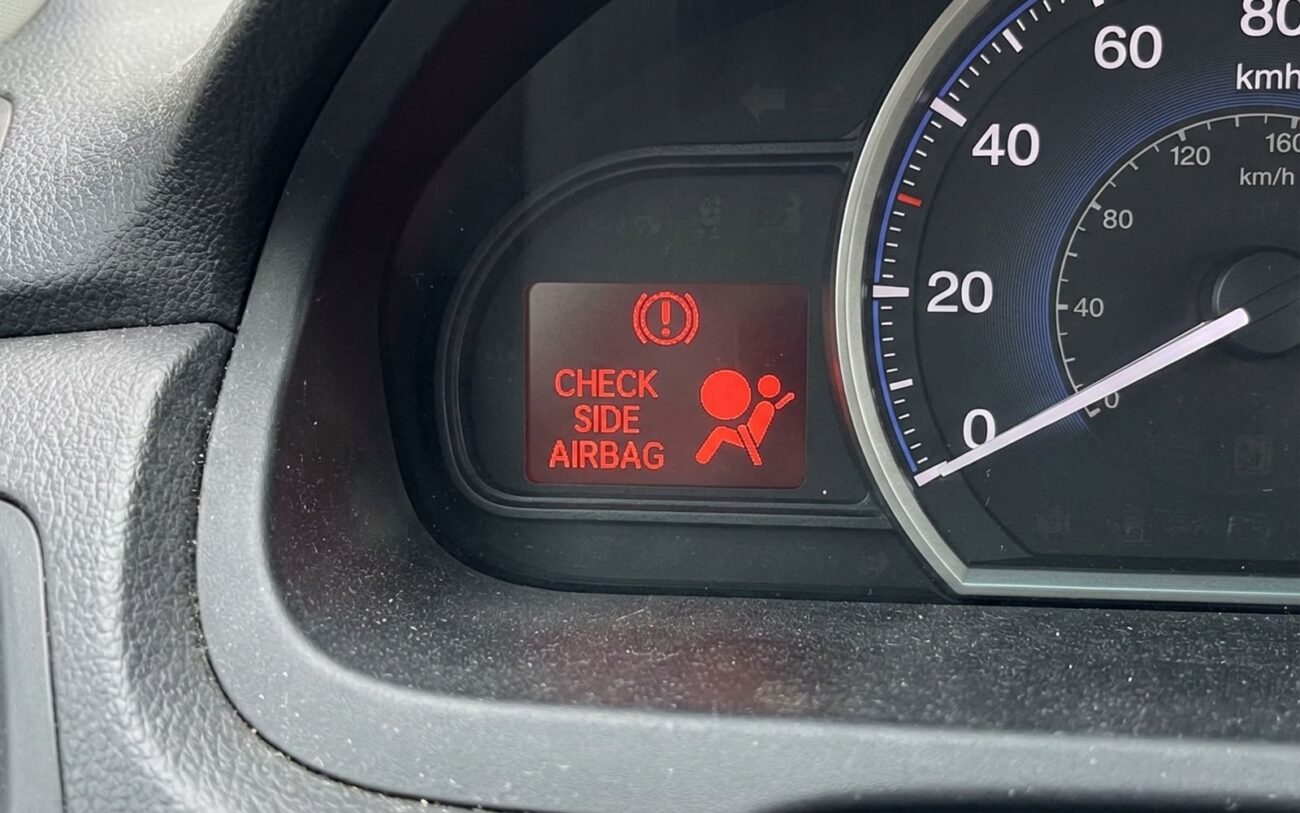
That “Too Sensitive” Side Airbag Probably Worked Right
I’ve had this conversation more times than I can count: customer walks in after a tap in the parking lot, door’s dented, airbag blew, and they’re furious. “It barely hit!” they say. “Why did it go off?”
Here’s the reality: your side airbag didn’t overreact. It did exactly what it was supposed to.
Frontal crashes? The crumple zones buy time. The force spreads out over milliseconds. But side impacts? You’ve got maybe six inches between the intruder and your ribs. A door, a B-pillar, and a thin side rail. That’s it. No buffer. No give.
So side sensors don’t care much about delta-V. They care about intrusion speed. If the door moves inward fast—say, from a shopping cart corner or a bumper hitting just right—the sensor sees that as a life-threatening event. It triggers. That’s not oversensitivity. That’s the system doing its job when the margin for error is zero.
When You Should Actually Worry
Not every deployment is justified. And not every non-deployment means failure. But you can’t judge by the dent. You need to look at the data.
I break it down into three real-world scenarios:
- Airbag goes off in a light bump — more often than not, this is correct. If the sensor saw rapid deformation, it did its job. Especially on narrow-object impacts (like a tow hitch catching your door). I’ve seen 5 mph impacts trigger deployment because the force was focused like a punch, not a shove.
- No airbag in a hard hit — now we’ve got a problem. Either the impact didn’t hit the sensor’s zone (common on rear quarter impacts), or something’s dead: sensor, wiring, or the SDM itself. This one keeps me up at night. A silent failure is worse than a false alarm.
- Airbag goes off for no reason — pothole, slamming the door, or just sitting in the driveway? That’s a system failure. And it’s dangerous. Not just because it could injure someone, but because now you’re driving with a system that can’t be trusted.
You can’t diagnose this with a $30 OBD2 scanner. You need OEM-level access to the SDM or ORC. That module stores the crash event: G-force, timing, sensor inputs, pre-impact conditions. Without that data, you’re just guessing—and guessing with airbags is how people get hurt.
| Symptom | Likely Cause in Sensing System | Common External Mimics or Misdiagnoses | Definitive Test to Confirm Source |
|---|---|---|---|
| Deployment in low-speed side impact | Correct response to high intrusion force and sensor activation within calibrated threshold. | Faulty safing sensor, corroded connector at sensor or SDM, damaged module housing. |
Scan SDM/ORC for stored crash data. Confirm non-zero delta-V and valid side impact sensor signal. Check for active or history DTCs in sensor circuits. |
| No deployment in moderate/high-speed impact | Failed Side Impact Sensor (SIS), open wiring, SDM/ORC internal fault. | Impact occurred outside sensor coverage zone (e.g., rear quarter panel), customer overestimates severity. |
Retrieve crash data from SDM/ORC. Use OEM tool to review live sensor data during diagnostic tap test. Verify sensor mounting integrity and torque. |
| Unwarranted deployment (no collision) | Internal SDM/ORC failure, rare SIS self-failure (e.g., MEMS chip defect). | Wiring short due to rodent damage or prior repair, water intrusion, electrical surge. |
Download crash log via OEM tool. Look for implausible acceleration values. Perform full harness continuity and insulation resistance test per service manual. |
What Actually Fails? (Spoiler: Not the Sensor)
Most side impact sensors today are MEMS accelerometers—tiny, sealed chips that measure G-force in real time. They’re mounted in the B-pillar, floor rail, or roof rail. Solid tech. But in 25 years, I’ve replaced fewer than a dozen for internal failure.
The real enemies? Connectors and wiring.
Corrosion in the sensor plug—especially in salt-belt states or coastal areas—can cause intermittent signals or false triggers. I had a 2016 Camry last winter where the passenger-side SIS kept throwing codes. Pulled the connector, and the pins were green. Saltwater had wicking up from the door sill. Cleaned it, sealed it, problem gone.
Then there’s physical damage. I’ve seen harnesses pinched during door speaker installs, or cut when someone slapped on new floor mats without routing properly. And don’t get me started on jump-starts. A surge from a cheap booster pack can fry the SDM’s power regulator. I’ve seen it.
Quick clarification:
Some cars use mechanical intrusion switches in the doors—different from the electronic SIS. And while Takata recalls were huge, those were inflator issues, not sensor logic. Also, some manufacturers have SDM communication glitches (like CAN bus dropouts), but those usually just set a light—they don’t cause bad deployments.
How to Fix It—And Why You Shouldn’t DIY
This Is Not a DIY Job
I don’t say that lightly. But airbags are not “replace and go.” One wrong move—loose connector, bad torque, skipped programming—and you’re risking lives. Period.
Replace All Deployed Components Professional Only
Program & Initialize the Module Professional Only
Fix Wiring or Sensors (If No Deployment)
How to Know It’s Actually Fixed
Verification isn’t optional. I’ve seen too many shops “clear the code and call it good.” That’s not good enough.
Verification Steps
-
SRS light must come on for 6–8 seconds at startup, then go off. No flickering. No staying on.
-
No DTCs after a full ignition cycle. Clear them, drive, recheck.
-
SDM/ORC status must read “Ready” or “OK” in live data.
-
For new sensors: verify 0g at rest, then check response during a controlled tap test.
This all requires OEM or pro-grade scan tools. Generic OBD2 readers? Useless here. They can’t talk to the SDM. Skipping this step means you might drive out with a system that looks fine but won’t save your life when it counts.
What’s This Going to Cost?
Let’s be real: it’s expensive. But your safety isn’t negotiable.
| Repair Type | DIY Cost | Shop Cost | Success Rate (Proper Tools Used) | Secondary Risk if Improperly Performed |
|---|---|---|---|---|
| Side Impact Sensor (SIS) Replacement | Not Advised | $300 – $800 | 98% | Incorrect torque or alignment causes false readings. Damaged connector leads to intermittent fault. |
| SDM/ORC Replacement & Programming | Not Advised | $1,000 – $2,500 | 99% | Improper programming disables entire SRS system. Security mismatch locks module. |
| Full System Diagnosis (No Fault Found) | N/A | $150 – $300 | 100% | N/A – Diagnostic service only. |
Cost-Saving Tip
Aftermarket modules might save $200 up front, but I’ve seen them fail to calibrate or drop communication. And once the system’s compromised, you’re back at square one—with more labor and parts. Stick with OEM or known-quality reman.
Preventing Future Issues
After any side impact—even a small one—get it checked. A bent sensor bracket, even slightly, can throw off calibration. I’ve seen it cause false deployments months later.
Watch the SRS light. If it comes on, don’t ignore it. That’s not a suggestion. That’s the system telling you it’s off-line.
And if you’re working inside the cabin—installing amps, speakers, or new trim—disconnect the battery and wait 15 minutes. Then treat every yellow connector like it’s live. Because it is. Splicing into that harness or pinching a wire can create a latent fault. One day, it’ll bite you when you least expect it.
Bottom line: the airbag system doesn’t warn you when it’s failing. It waits until the moment it has to decide—live or get hurt. That’s why every detail matters. Every bolt. Every connector. Every scan tool readout. It’s not just a repair. It’s a responsibility.
