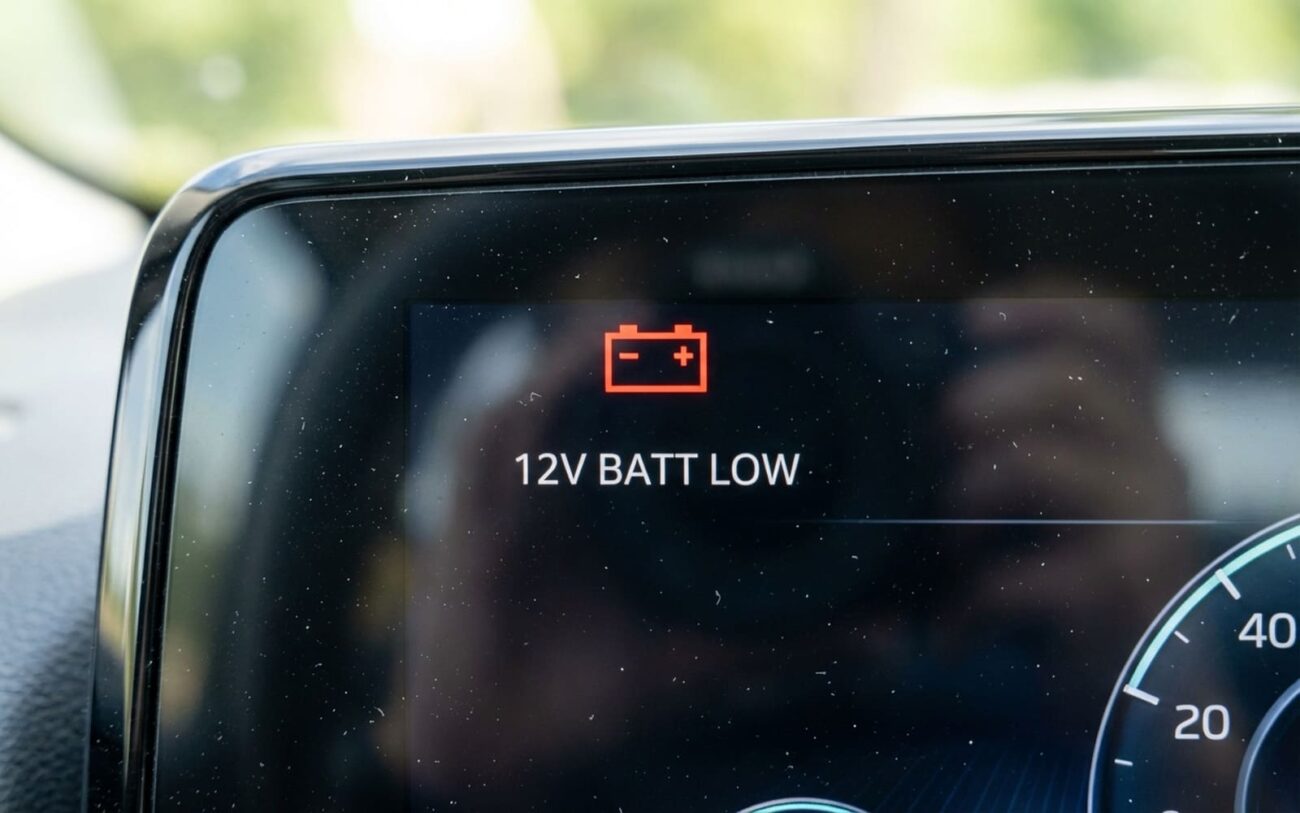
Alright, let’s talk about the 12-volt battery in your hybrid or EV. It’s not like the one in your old gas guzzler, and it often gets overlooked until the car won’t start. After 25 years turning wrenches, I’ve seen countless cases where a “dead 12V” is just the tip of a much bigger iceberg. Understanding how these systems work, and how to properly diagnose them, can save you a ton of headaches and money.
First Signs: What a Failing 12V Battery Looks Like
When a hybrid or EV rolls into my shop with a 12-volt battery problem, the most common symptom is simple: the car won’t start. You hit the power button, and instead of the “Ready” indicator, you get a dark dash, a Christmas tree of warning lights, or a direct message like “12V Battery Fault.” Sometimes, it’ll power up partially – radio on, dash lit – but just won’t engage the high-voltage system to actually move. In my experience, nine times out of ten, these cases start with a deeply discharged 12-volt battery, often reading below 10 volts when I test it. That’s a strong signal the battery itself is struggling, but it’s rarely the whole story.
Now, here’s the real red flag I always watch for: repeated battery replacements. In a conventional car, a good AGM battery should last you four to five years. In hybrids and EVs, two to three years is sadly pretty common due to the increased electrical demands. But if you’re swapping out that 12-volt battery every 12 to 18 months? That’s not normal wear and tear; that’s a symptom of a systemic problem. That kind of pattern tells me something in the charging system or the vehicle’s “sleep” cycle is killing the battery prematurely. I see this misdiagnosed constantly; shops just replace the battery, the car works for a month, and then it’s dead again.
Then there are the more subtle, intermittent issues. Maybe the infotainment screen flickers when you open the door, you hear a random chime for no apparent reason, or the power windows move sluggishly when the car first wakes up. These typically happen when the high-voltage system is off and the 12-volt battery is on its own. Once the car is in “Ready” mode and the DC-DC converter kicks in, everything runs fine. That’s a classic sign the 12-volt battery is struggling under load before it gets proper support from the main system. It usually points to high internal resistance, which comes from aging or sulfation.
And let me be straight with you: in a full EV, a dead 12-volt battery isn’t just an inconvenience – it can leave the car completely immobile. That little battery powers the control modules that activate the high-voltage contactors. No 12-volt power, no way to connect the big traction battery. You can’t even shift into neutral. Every deep discharge accelerates sulfation, permanently reducing the battery’s capacity. It’s a vicious cycle that only gets worse over time.
Beyond the Battery: Diagnosing the True Culprit
So, the car won’t start, and the 12-volt battery is dead. Is the battery actually faulty, or is something else draining it or failing to charge it? That’s the million-dollar question. A failed DC-DC converter – which is basically the alternator for hybrids and EVs – won’t recharge the 12-volt battery. A parasitic drain from a control module that refuses to “sleep” can slowly kill it overnight. You can’t just slap in a new battery and call it a day; you have to figure out why the old one failed.
At my shop, we use a pretty straightforward three-step process to get to the truth. First, we measure the resting voltage after the car has been off for at least an hour. Anything below 12.4V means it’s discharged, but not necessarily dead. Second, we run a conductance test with a professional battery analyzer to check its overall health and cold cranking amp (CCA) capacity. Third, we apply a controlled load to simulate startup conditions. If the battery fails any of these tests, then yes, the battery itself is likely the problem. If it passes, we start looking elsewhere.
For those recurring failures, we go a lot deeper. We always verify the replacement battery was the correct group size, capacity (in Ah), and chemistry – it’s almost always an AGM in modern hybrids and EVs. Then, with a good scan tool, we monitor the DC-DC converter output with the high-voltage system active. It should read a steady 13.5 to 14.8 volts. If it’s low or fluctuating, that’s our culprit. Finally, we perform a parasitic draw test. Using a low-amp clamp meter, we wait for all the control modules to go to sleep – sometimes that can take up to 30 minutes, depending on the vehicle. A healthy system should draw less than 50 milliamps. Anything more means a module is staying awake and slowly draining the battery.
| Symptom | Indicates 12V Battery Issue | Common External Causes (Mimics) | How I Confirm the Root Cause |
|---|---|---|---|
| Failure to start, low state of charge | Internal degradation (sulfation, plate corrosion, lost capacity) | DC-DC converter failure, parasitic drain |
Perform a 3-part battery test: 1. Resting voltage (should be ≥12.4V). 2. Conductance/CCA test. 3. Load test under simulated startup. If it fails all three, the battery’s toast. |
| Repeated battery replacements (within 2–3 years) | Accelerated aging from chronic partial charging | Incorrect battery spec, faulty DC-DC converter, software issues |
1. Confirm OEM battery specs were met. 2. Monitor DC-DC converter output (should be 13.5–14.8V). 3. Perform a parasitic draw test after full sleep cycle (should be <50mA). |
| Intermittent glitches (e.g., infotainment reboot) when HV system is off | High internal resistance under light load | Voltage drop in wiring, failing control module |
Test battery under load: with the HV system OFF, measure voltage at the terminals while operating the affected accessory. A drop below 9.6V indicates a weak battery. |
Why These 12V Batteries Fail So Often
Let’s say your tests confirm the 12-volt battery is indeed the failed component. The next question I always hear is, “Why did it die so soon in my hybrid or EV compared to a regular car?” The answer lies in how these vehicles use the battery differently. The biggest factor is chronic partial state-of-charge operation. In a gas car, the alternator runs whenever the engine is on, keeping the battery near full charge. In a hybrid, the engine cycles on and off, and the DC-DC converter only charges the 12-volt battery when the high-voltage system is active. That means the battery often sits at 70–80% charge for long periods – prime conditions for sulfation in lead-acid and AGM batteries. Sulfation forms hard lead sulfate crystals on the plates, reducing active material and permanently lowering capacity. It’s a killer.
Next up is micro-cycling. Every time you unlock the car, open a door, or press the power button, the 12-volt battery powers a surge of electronics: control modules, sensors, and the pre-charge circuit for the high-voltage system. That’s a small discharge. Then the DC-DC converter kicks in and recharges it. This cycle happens dozens of times a day – far more than in a conventional car. Over time, this constant charge-discharge wears out the battery’s internal structure, similar to stop-start systems but often more frequent and deeper.
Location also plays a role. Many hybrids and EVs place the 12-volt battery in the cabin or trunk to free up engine bay space. While this avoids direct engine heat, it exposes the battery to cabin temperatures, which can soar in summer. Prolonged heat increases water loss in AGM batteries and accelerates grid corrosion. And finally, there’s the chemistry mismatch. Most 12-volt systems still use AGM batteries, which weren’t truly designed for constant partial charging or high cycling. Lithium-ion would be better suited, but cost and integration challenges have slowed their widespread adoption.
It’s critical to understand this: a failed DC-DC converter isn’t a 12-volt battery failure – it’s a charging system fault. A parasitic drain from a module that won’t sleep isn’t a battery problem – it’s an electrical system issue. In both of those cases, the 12-volt battery is the victim, not the cause. You fix the victim, but the problem comes right back if you don’t address the attacker.
Getting It Fixed: Your Options
If this is your first 12-volt battery failure and your diagnostics confirm the battery itself is truly at fault, replacement is the right move. Here’s how I approach the different scenarios:
[DIY-FEASIBLE with safety protocols] DIY Possible
[PROFESSIONAL-ONLY for system diagnosis] Professional Only
[DIY-FEASIBLE ONLY if OEM offers a direct Li-ion replacement; otherwise PROFESSIONAL-ONLY]
[TEMPORARY / LAST-RESORT] Warning
Confirming the Fix: Don’t Just Assume It’s Done
After you’ve done the work, how do you know the repair actually worked? The pass criteria are pretty clear. For a simple battery replacement, a battery analyzer should show the new battery’s conductance or CCA at or near 100% of its rating. The car should start reliably and enter “Ready” mode immediately, even after sitting for 24 hours. You shouldn’t see any unusual voltage drops when you operate accessories like power windows or the infotainment system with the high-voltage system off.
If you fixed a system issue – like a parasitic drain or a DC-DC converter – the validation is stricter. A follow-up parasitic draw test absolutely must confirm the current drops below 50 milliamps after the full sleep cycle. With the hybrid system active, the DC-DC converter output needs to hold steady between 13.5 and 14.8 volts. Most importantly, the battery’s state of charge should stay above 80% after a few days of normal use. The tools for this validation are the same ones you used for diagnosis: a good digital multimeter, a low-amp clamp meter, and a capable scan tool.
Making the Call: Costs and Long-Term Value
Let’s talk numbers and long-term value. Repair costs can vary widely depending on what the root cause actually turns out to be.
| Repair Type | DIY Cost | Shop Cost | Success Rate | Secondary Risk if Failed |
|---|---|---|---|---|
| Standard AGM Battery Replacement | $200–$400 | $350–$600 | 100% (if no underlying issues) | Minimal, if no underlying issues exist. |
| Diagnosis & Repair of Parasitic Draw | N/A (specialized tools/knowledge) | $150–$500 (diagnosis) + repair | 90% | Draw may return if root cause isn’t fully resolved, killing the new battery. |
| Diagnosis & Replacement of DC-DC Converter | N/A (critical component, complex) | $800–$2000+ | 95% | High cost if misdiagnosed; critical component, can leave car stranded. |
You need to have a threshold in mind. If the total cost of diagnosing and repairing a chronic 12-volt issue starts to exceed, say, 40% of the car’s current market value, it’s really time to reconsider. These aren’t minor fixes. A $2,000 DC-DC converter job on a $5,000 hybrid isn’t economical for most owners. In cases like that, I often suggest evaluating total ownership costs and seriously considering whether the vehicle still makes sense long-term. Sometimes, it’s just time to move on.
Prevention & Monitoring: Keep Your 12V Healthy
Preventing 12-volt battery issues starts with understanding those root causes we just talked about. If you know your car will sit for more than a week, especially in extreme temperatures, use an AGM-rated battery maintainer. It’s the single most effective way to prevent deep discharge and sulfation. When it’s finally time to replace the battery, don’t go cheap. Always use an OEM-specified AGM battery with the correct cold cranking amps (CCA) and amp-hour (Ah) rating. The car’s power management system is calibrated for that exact load, and putting in the wrong one can cause more problems down the road.
My Top Tips for Early Detection & Maintenance
-
Check your 12-volt battery’s resting voltage monthly. Use a digital multimeter on the terminals about an hour after turning the car off. A healthy reading is 12.6 volts or higher.
-
If it’s consistently at 12.4V or below, that battery isn’t being charged properly or is losing capacity. That’s your cue for a professional check – don’t wait for it to die completely.
-
Ask your dealer or a trusted independent shop to check for available software updates. Manufacturers often release optimizations for DC-DC converter operation or power management. Sometimes, the fix is software, not hardware, and it can extend your battery’s life and prevent future headaches. For example, some Toyota hybrids have received updates specifically for this.
