Your BMW’s Marking Its Spot: The High-Pressure Power Steering Leak
Alright, let’s talk about a classic BMW issue I’ve seen countless times over the years: that tell-tale red or brownish fluid pooling under the front of your engine. Usually, it’s near the firewall or right under the power steering pump. And if your steering groans like an old man getting out of bed when you turn the wheel, well, you’ve got yourself a power steering leak.
On older BMWs, especially the E39 5-Series and E46 3-Series, the high-pressure power steering hose is notorious for giving up the ghost. This isn’t some random failure; it’s a wear item, pure and simple. Think of it like brake pads or tires. The hydraulic system runs hot, under serious pressure (we’re talking over 1,700 psi at times), and it’s crammed into an engine bay that vibrates constantly. That hose just degrades over time. I’ve replaced hundreds of these things. The good news? It’s usually a pretty straightforward diagnosis and fix – if you catch it before it takes out other, more expensive parts.
Pinpointing the Leak: Don’t Just Assume It’s the Hose
Before you go ordering parts, you absolutely have to confirm the source of that leak. Fluid migrates, it runs along lines, it drips from the lowest point. That can make it look like the high-pressure line is the culprit when the real problem is a pump seal, a worn O-ring, or even the steering rack itself. Misdiagnosis is common, and it’s always expensive. A proper visual inspection is your best friend here; it saves you time and money.
Here’s the approach I use: First, get under there and thoroughly clean the entire power steering area. I mean everything – the pump, the hose, all the fittings, and the steering rack. Brake cleaner works great. Let it dry completely. Then, start the engine and have someone sit in the driver’s seat. While they slowly turn the steering wheel lock-to-lock (don’t hold it at full lock!), you’re under the car with a good flashlight and an inspection mirror. You’re looking for the origin point of the leak, not just where the fluid has dripped.
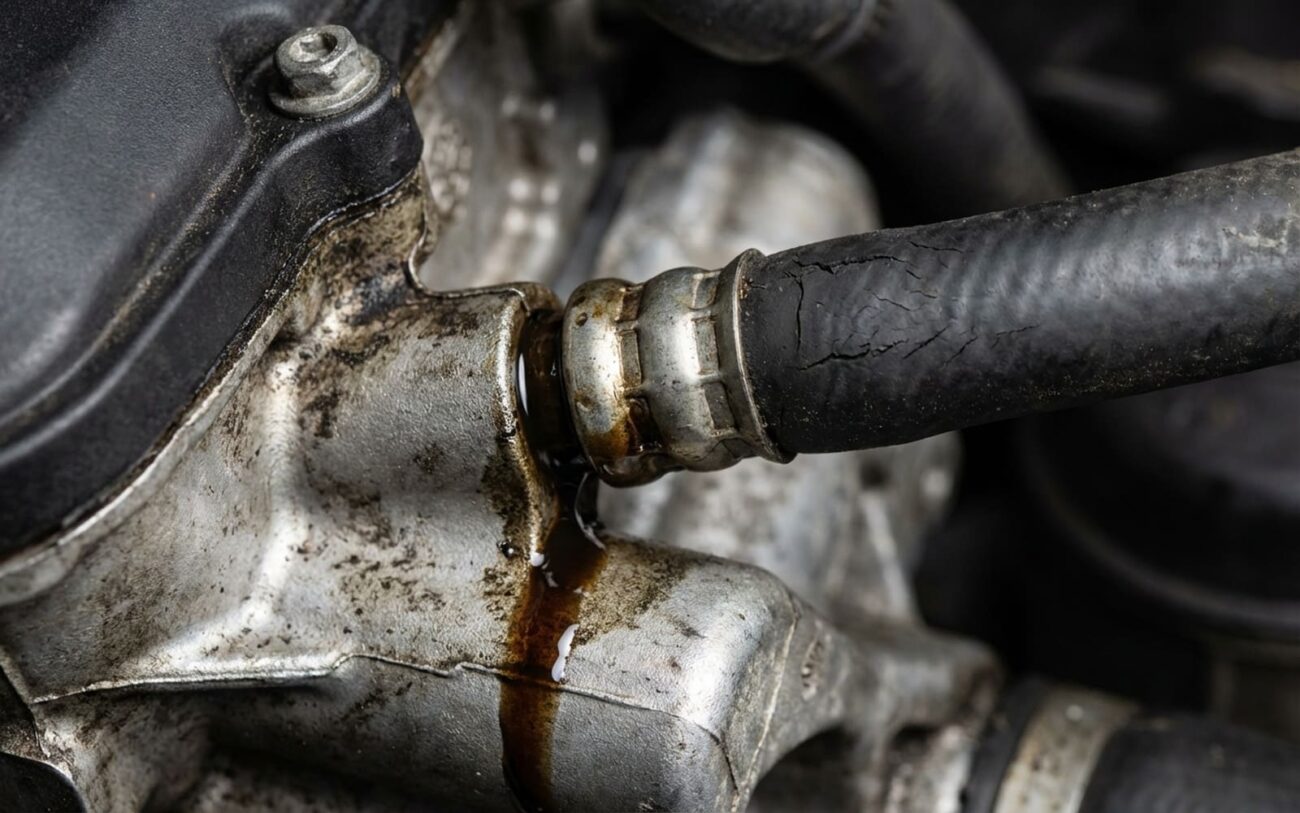
What I typically see is the high-pressure hose failing at the crimped metal fittings where the rubber hose meets the steel line. If you see fluid seeping from the very center of the pump pulley, that’s almost certainly the pump shaft seal. And if it’s dripping from the steering gear housing itself, especially near the input shaft, then you’ve got a bad rack seal – not a hose problem. This table breaks down what to look for:
| Symptom | Often the High-Pressure Hose | Common Mimics | My Definitive Test |
|---|---|---|---|
| Fluid leak at front of engine bay near pump | Failure at the crimped joint where the hose connects to the pump outlet. | Leaking O-ring on the pump outlet pipe or a failed pump shaft seal. |
Clean it all up. With the engine running, use a mirror to see if the fluid is coming from the hose fitting or right out of the center of the pump pulley. |
| Fluid leak near steering gear/firewall | A crack or weep at the crimp where the hose attaches to the steering rack. | Failed input shaft seal on the rack or a leaking flare fitting on the gear housing. |
Clean it up and watch closely while someone turns the wheel. If the leak is coming from the main body of the steering gear, that’s an internal rack seal, not the hose. |
| System groaning & fluid loss without visible external leak | Internal hose failure: fluid leaks into the outer braid, so you don’t see it externally. | Failing pump, air getting into the reservoir, low fluid level, or a return line leak. |
You’ll need a pressure test kit. A rapid pressure drop under static load usually points to an internal pump or rack failure. |
Why These Hoses Just Give Up
The high-pressure power steering hose fails because it’s caught in a perfect storm of chemical, mechanical, and environmental stress. This is common on BMWs with hydraulic power steering, and understanding why helps you prevent it from happening again.
Inside, that hose is constantly exposed to ATF-based fluid – usually Dexron III or BMW’s specific CHF-11S, depending on the model. These fluids are hygroscopic, meaning they absorb moisture over time. As moisture builds up, the fluid breaks down and forms acids. These acids literally eat away at the inner rubber liner of the hose, causing it to swell, soften, and eventually delaminate from the reinforcing steel braid. It’s like a high-pressure artery under constant flex; eventually, the wall fatigues and the connection points weep.
Externally, the conditions are brutal. The hose is mounted between two components that are constantly moving independently: the engine and the steering rack. Every bump in the road, every engine rev, creates micro-movements, putting immense stress on those crimped fittings. Over thousands of heat cycles and all those pressure surges, the metal crimp fatigues, cracks, and starts to weep fluid.
Heads up on Service Bulletins:
For certain model years, especially the E46 and early E39s, BMW actually issued service bulletins about premature hose failures. This was often due to material incompatibility with specific fluid formulations or just plain poor crimp quality from the factory. So, you’re not imagining things; it was a known weak point.
The Fix: It’s Replacement or Nothing
No Patching This One
If that high-pressure hose is leaking at a crimp, or if it’s got internal damage, there is no repair. Period. Don’t even think about re-crimping, patching it with tape, or using some kind of clamp. The pressures in these systems are way too high, and frankly, your safety is paramount. You replace it, or you risk losing steering. Simple as that.
So, assuming you’ve confirmed it’s the hose, here’s what you need to know for the replacement:
Tools & Getting Ready
Torque Specs & Installation
Bleeding the System Properly
Making Sure You Fixed It Right
Replacing the hose isn’t the end of the job; it’s step one. You need to validate that the repair holds and that you didn’t miss any secondary issues. First, run the car until the power steering system is good and warm. Cycle the steering several times, then shut it down. Get back under there and inspect every single fitting, crimp, and banjo connection. You should see absolutely zero seepage – no dampness, no oily sheen. If you see anything, you’ve got a problem.
Listen carefully during operation, too. A properly bled system should be quiet. If you hear groaning or whining, especially at full lock, that usually means there’s still air trapped in the system or, worse, the pump itself is damaged. If the noise persists after you’ve bled it properly (and I mean properly), you’re probably looking at internal pump wear, likely from running it low on fluid before the repair.
What’s This Going to Cost You?
Here’s a rough breakdown of what you’re looking at, depending on how you tackle this. Remember, catching it early is always cheaper.
| Repair Type | DIY Cost (Parts) | Shop Cost (Est.) | Success Rate | Secondary Risk |
|---|---|---|---|---|
| Hose Replacement | $80 – $200 | $300 – $600 | 99% | Undetected leak leads to pump cavitation. |
| Additive “Fix” | $15 – $30 | $50 – $100 | <30% | Swollen seals cause restricted flow or rack failure. |
Keeping It From Happening Again
You’ve fixed it once, now let’s talk about keeping it from becoming a recurring nightmare. A little preventative maintenance goes a long way with these hydraulic systems.
My Prevention Checklist
-
Use the Correct Fluid: This is non-negotiable. Check your reservoir cap. It’ll specify CHF-11S or Dexron. Mixing these fluids, or using the wrong type, will cause seals to swell and accelerate hose degradation.
-
Regular Flushes: I recommend a power steering fluid flush every 60,000 to 80,000 miles. This gets rid of those acidic byproducts and accumulated moisture that break down the rubber components. It’s cheap insurance.
-
Monthly Inspections: Just a quick look when you’re checking your oil. Look for any dampness or seepage at the hose crimps, any bulging in the rubber, or if the fluid in the reservoir looks dark and sludgy.
-
Proactive Replacement: On engines known for high heat, like the M54, I often suggest replacing the high-pressure hose around 100,000 miles, even if it’s not actively leaking. It’s a known weak point, and you’re buying peace of mind.
