That Power Steering Whine: It’s Probably Air, But Don’t Ignore It
Alright, let’s talk about that high-pitched squeal from your power steering. If you’ve just messed with the fluid—changed it, topped it off, or even just had a hose replaced—and now you hear that whine, especially when you turn the wheel all the way to either lock, I can tell you right now: it’s almost certainly air in the system. I’ve seen this a thousand times in my 25+ years in the shop.
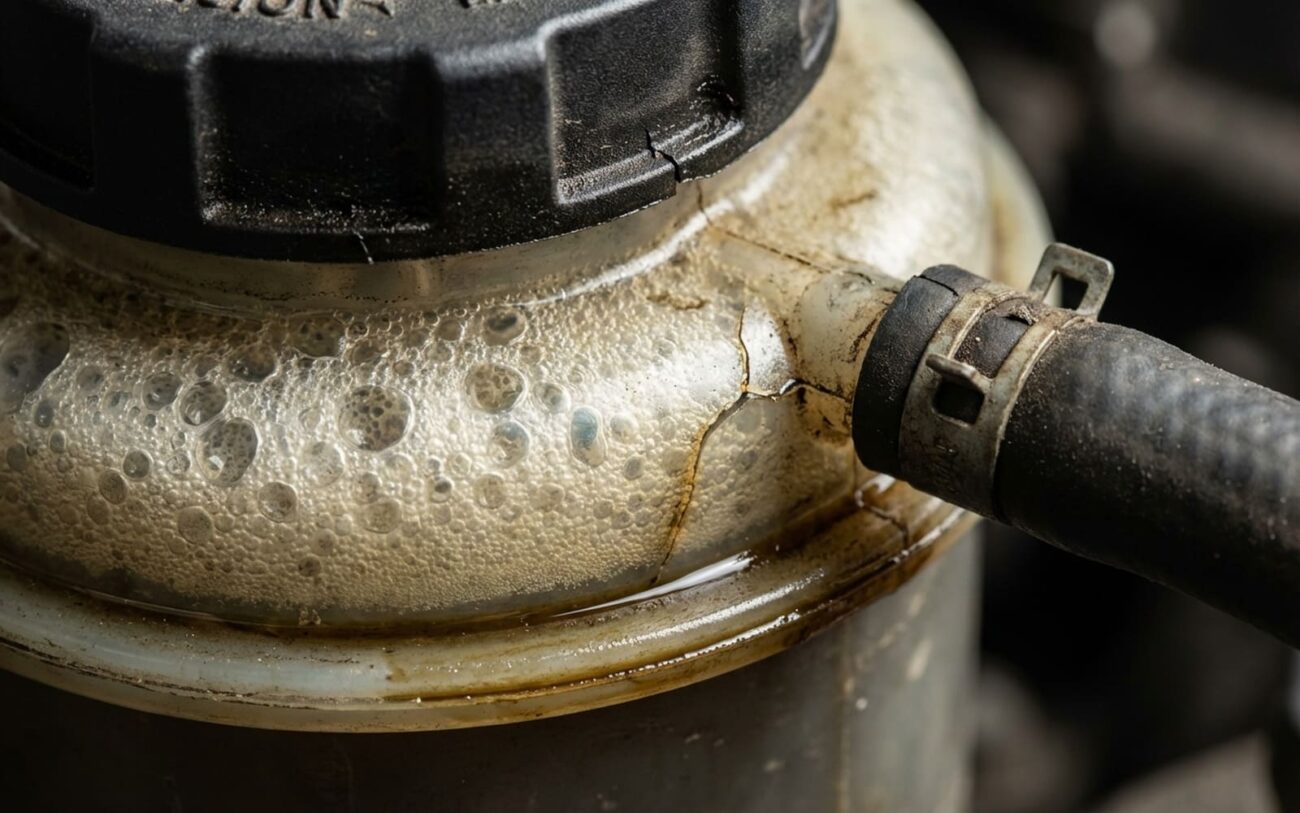
That noise isn’t just random. It’s the sound of tiny air bubbles getting compressed inside the power steering pump. The pump’s internal vanes are designed to move hydraulic fluid smoothly, but when air gets in there, those bubbles collapse under pressure. That’s called cavitation, and it creates noise and drastically reduces how well the fluid works. You’ll often see the evidence right in the reservoir: instead of clear, amber-colored fluid, it looks frothy, foamy, or milky. That’s not coolant (not yet, anyway)—it’s aerated fluid churning from trapped air. And trust me, that’s a problem.
My Take on Cavitation
“I’ve pulled apart power steering pumps that looked like they’d been sandblasted from the inside, all thanks to cavitation. Those collapsing bubbles create micro-implosions that literally erode the pump’s internal surfaces. This isn’t just a noise; it’s cumulative, destructive damage. Ignore it at your wallet’s peril.”
Differential Diagnosis: Is It Really Air, Or Something Worse?
While air is the most common culprit after a fluid change, you can’t just assume it’s bubbles. You need to rule out other issues. A failing power steering pump bearing, for example, will usually produce a constant whine that builds with engine RPM, not just when you turn the wheel. A loose or glazed drive belt, on the other hand, typically chirps or squeals sharply when you first start the engine or turn the wheel hard, but it won’t typically persist across all steering angles like an aeration whine will.
| Symptom I’m Seeing | My Primary Suspect | What Else Could It Be? | How I Confirm It |
|---|---|---|---|
| High-pitched squeal after fluid service, especially at full lock. | Air introduced during the fill or bleeding process. | Worn pump bearing, loose/damaged drive belt. |
First, check the belt tension. Then, watch the reservoir for foam or bubbles while slowly turning the wheel lock-to-lock with the engine running. If you see foam, it’s air. |
| Fluid in reservoir looks foamy, milky, or like a strawberry milkshake. | Air being churned into the fluid by the pump. | Coolant contamination from an internal rack or cooler failure (rare, but happens). |
Shut the engine off and let it sit for 30 minutes. Aerated fluid will usually clear up as the air rises. Coolant contamination, however, won’t dissipate; it’ll stay mixed or separated. |
| Poor assist, groaning noise, especially at low speeds or when turning. | Air pockets trapped in the steering gear (rack) or pump. | Internal wear in the steering gear, critically low fluid level (check this first!). |
A shop can perform a power steering pressure test. Air in the system will cause erratic pressure pulses. A worn pump, however, will show consistently low peak pressure. |
Root Causes: Why Air Gets In (It’s Usually Your Fault)
In my 25+ years turning wrenches, I’ve found the cause of power steering aeration is almost always procedural—meaning, it’s how the system was serviced—not a mechanical failure. The most frequent mistake? Starting the engine before properly priming the system. If that reservoir is low or empty, the pump will suck air from the lines the moment it spins up. Another common error I see is letting the fluid level drop below the minimum mark during the initial cycling after a fluid change.
The “Universal” Fluid Trap I See All The Time
This is a big one. Many “universal” power steering fluids just don’t match the OEM viscosity or, critically, their air-release characteristics. Some even foam up more easily, making proper bleeding nearly impossible. Always, and I mean always, consult your owner’s manual for the correct fluid specification. Using the wrong fluid is a common, avoidable mistake that creates more work down the line.
Beyond improper service, air can also get in through a suction-side leak. This is usually a loose hose clamp, a cracked reservoir, or a hardened O-ring on the pump’s inlet. These small leaks might not drip fluid, but they’ll pull air in under vacuum, especially when the pump is working hard.
My Go-To Fixes: From Simple Bleeds to Major Repairs
Simple Air Entrapment (The DIY Bleed) DIY-FEASIBLE
Persistent Suction-Side Leak DIAGNOSTIC DIY
Temporary Hose Clamp Fix TEMPORARY ONLY
Internal Rack Leak or Pump Failure PROFESSIONAL ONLY
Post-Repair Validation: How I Know It’s Really Fixed
Don’t just assume the job is done because the noise stopped right after bleeding. For a simple bleeding procedure, I consider the system “passed” if: there’s absolutely no squeal at any steering angle (cold or hot), and the reservoir fluid remains clear and bubble-free after 15–20 minutes of normal driving. If that noise returns or foam reappears, air is still getting in, or you didn’t get it all out.
For a suction leak repair, validation is a bit more involved. A successful fix means no visible dye under UV light (after a good clean-up of the area, of course) and no hissing detected with a stethoscope. In a professional shop, we can take it a step further by applying 18–20 inches of mercury vacuum to the suction side of the system. If that vacuum holds for at least one minute, you know the system is sealed up tight.
Cost, Risk, and Making the Right Call
Here’s a quick rundown of what you’re looking at, both if you tackle it yourself or bring it to a shop. These are rough numbers, of course, but they give you an idea of the investment and the potential headaches.
| Repair Type | DIY Cost (Parts Only) | Shop Cost (Parts & Labor) | My Typical Success Rate | Secondary Risk I Watch For |
|---|---|---|---|---|
| Bleeding Procedure | $20 (for fluid) | $100–150 | 95% | None, if done correctly. |
| Suction Hose/O-ring | $50–150 | $200–400 | 98% | Repeat air entry if the root cause (e.g., cracked reservoir) isn’t fully addressed. |
| Pump Replacement | $200–500 | $500–900 | 95% | Improper bleeding after install can lead to the same noise again. |
| Steering Rack Replacement | $400–1200 | $1000–2000+ | 95% | Alignment issues or new leaks if not installed perfectly. |
Prevention & Ongoing Monitoring: Keep It Healthy
Look, an ounce of prevention is worth a pound of cure, especially with power steering. Here’s what I tell all my customers to avoid these headaches:
-
Always use the exact fluid specified by the manufacturer—OEM or a proven equivalent. No “universal” guesswork.
-
Never, ever start the engine with the reservoir below the minimum line, especially after working on the system.
-
Prime the system manually: turn the wheel lock-to-lock 20 times with the engine off to get fluid moving before starting.
-
After any work, monitor for at least 100 miles. Check the fluid level cold the next morning to catch any slow leaks or persistent aeration.
And remember, steering feel is affected by more than just power steering fluid. If you notice uneven tire wear after recent work, make sure to inspect other components like control arms or bushings. Patterns like cupping or feathering on tires are strong indicators of suspension issues, which can sometimes be confused for steering problems. And before you assume anything major, always, always rule out incorrect tire pressure—it’s simple, free to check, and often overlooked.
