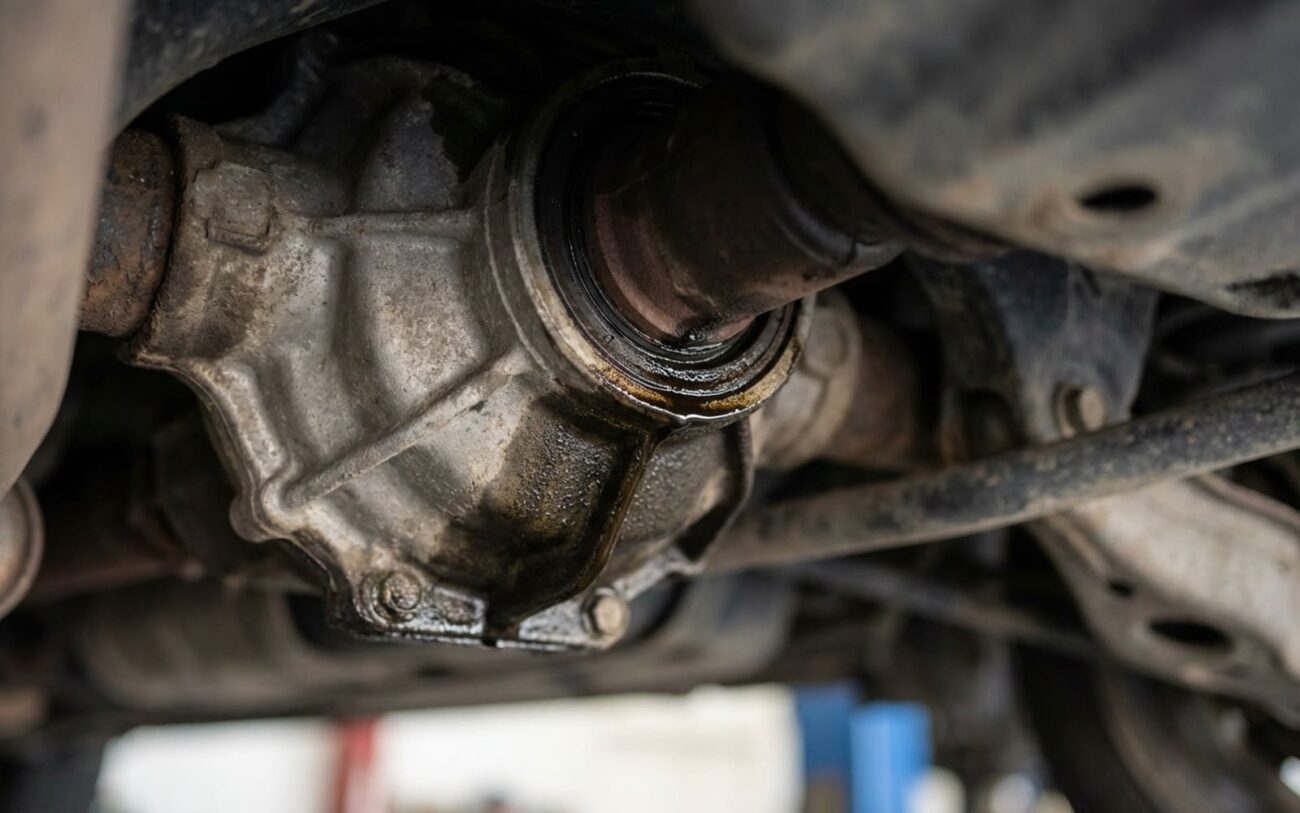
When a customer rolls into my shop saying, “the back end’s making noise,” my first thought is always, “Alright, let’s figure out what kind of noise.” After 25 years under cars, I can tell you, a differential isn’t some mysterious black box. It tells you exactly what’s wrong, if you know how to listen and feel. Most rear-end complaints fall into a few clear patterns. Knowing these patterns, and how to test for them, saves a ton of time and keeps you from throwing parts at a problem that isn’t even there.
Symptoms & How I Diagnose Them
Let’s break down the common complaints I hear and how I approach them in the bay. This isn’t just about identifying a symptom; it’s about separating the true differential failures from other issues that like to mimic them.
1. Binding, Shuddering, or Hopping in Turns (LSD Chatter)
If you feel a shuddering, binding, or hopping sensation during slow, tight turns—like pulling into a parking space or backing out of a driveway—that’s almost always a red flag for a failing limited-slip differential (LSD). The clutch packs inside are designed to allow controlled slip, but when they wear out, get contaminated, or the wrong fluid is used, they start to lock up prematurely. This makes the wheels fight each other, creating that telltale chatter.
I’ve seen this misdiagnosed as a bad CV joint more times than I can count. The difference? A bad CV joint usually clicks sharply with each rotation, especially when turning. LSD chatter, though, feels like a rhythmic vibration or a series of small “hops” you feel through the chassis. Also, don’t overlook mismatched tire sizes or uneven tire pressure; even a 3/32″ tread difference can force the differential to work like it’s broken, so check those first.
My Diagnostic Test:
Find an empty parking lot and perform slow figure-eight turns. If the shuddering intensifies, you’re almost certainly looking at an LSD problem. For a quick shop check, safely lift the rear wheels off the ground, put the transmission in neutral, and spin one wheel by hand. On a healthy limited-slip, the opposite wheel should turn in the same direction. If it resists, fights you, or turns slowly, those clutches are binding.
2. Gear Whine Proportional to Vehicle Speed
This is a high-pitched howl that rises and falls with your vehicle’s speed, not the engine’s RPM. That’s your ring and pinion gears talking to you. If the noise changes pitch noticeably under acceleration versus coasting—often getting louder on coast—it’s a strong indicator of gear wear or an incorrect setup. This is a common one, and it’s easy to confuse.
A failing wheel bearing also produces a whirring sound, but it tends to stay constant regardless of throttle input, just getting louder with speed. A transmission bearing, on the other hand, will track engine RPM. If the whine follows the gears you’re in, it’s not the differential. Letting a gear whine go is risky; I’ve seen teeth break off, which can lock up the axle and lead to a loss of control.
My Diagnostic Test:
Take the vehicle for a road test. Get it up to the speed where the whine is most noticeable. Then, briefly let off the throttle completely and coast. If the whine changes tone, gets louder, or disappears and then reappears when you get back on the gas, it’s the differential. If the noise stays pretty much the same, start looking at wheel bearings.
3. Clunk on Load Change
Hear a loud clunk when you shift between drive and reverse, or when you abruptly let off the throttle and then get back on it? That’s backlash—excessive clearance between gears. It usually points to worn ring and pinion gears or damaged spider gears inside the carrier. This is another one with common mimics.
The usual suspects that mimic this are worn driveshaft U-joints or loose suspension mounts. But if that clunk feels like it’s coming right from the center of the axle housing, and you can feel a rotational slack in the drivetrain, the problem is inside the differential. I’ve seen spider gear shafts shear clean off and punch through the housing from too much play—don’t ignore this one.
My Diagnostic Test:
Safely lift the vehicle. With the transmission in neutral, try to rotate the driveshaft by hand. You should feel a small amount of play—that’s normal backlash. But if you can rotate it a significant amount (say, more than an inch at the pinion yoke) before the wheels start to react, and you hear a distinct clunk from the differential housing, you’ve got excessive internal wear.
4. No Wheel Spin or Power Loss
This is usually a catastrophic failure. If you’re stuck in snow or mud and apply power, what happens? In a normal open differential, one wheel spins like crazy. If neither wheel turns, or the driveshaft turns but nothing else does, that’s a severe internal differential failure—something seized or broke inside, like a pinion gear or input shaft. If both wheels spin, but the car isn’t moving, and you hear grinding or snapping, you’ve likely broken an axle shaft or stripped a hub. That’s not a differential failure, but a component connected to it.
My Diagnostic Test:
This usually happens when you’re already stuck, so diagnosis is often simpler. If the driveshaft spins freely but the wheels don’t, and you’re sure the transmission is engaged, then the problem is either a seized differential or broken axle shafts. You’ll need to get it lifted safely to confirm. If you can rotate the driveshaft by hand and the differential input doesn’t turn, it’s seized. If it turns but the wheels don’t, you’re looking at axle shafts.
Differential Diagnosis Quick Reference
Here’s a quick summary of the symptoms, likely culprits, and how to confirm them, for when you’re under the car or on a test drive.
| Symptom | Likely in Differential | Common External Mimics | Definitive Test to Confirm Source |
|---|---|---|---|
| Binding in Turns | Worn or Contaminated LSD Clutch Packs | Binding CV Joints, Mismatched Tire Sizes or Pressures |
Perform slow figure-eight turns; LSD chatter intensifies. Lift rear: spin one wheel, opposite should turn in same direction on healthy LSD. |
| Gear Whine Proportional to Speed | Worn or Improperly Set Ring and Pinion Gears | Failing Wheel Bearing, Worn Transmission Output Bearing |
Note if noise changes on coast vs acceleration. Diff whine often intensifies on coast; wheel bearings stay constant. |
| Clunk on Load Change | Excessive Ring & Pinion Backlash, Worn Spider Gears | Worn U-Joints, Loose Driveshaft or Subframe Mounts |
Observe driveshaft/pinion yoke under load reversal. Excessive rotational movement before wheels react suggests internal gear wear. |
| No Wheel Spin with Power | Seized Differential Components, Broken Pinion Gear or Shaft | Broken Axle Shaft, Stripped Hub Splines |
Lift wheels and rotate driveshaft by hand. If it won’t turn, the diff is seized. If it turns but wheels don’t, check axles. |
What Actually Breaks Inside the “Pumpkin”
So, you’ve narrowed it down and you’re pretty sure the noise or feel is coming from inside that differential housing. What’s actually gone wrong? In my experience, it almost always boils down to one of four things. Knowing the root cause helps you fix it right the first time, not just patch symptoms.
1. Normal Wear and Material Fatigue
This is the most common culprit. Ring and pinion gears endure massive torque loads, cycle after cycle. Over time, that constant stress and friction cause the gear teeth to develop pitting, spalling, and eventually, they can crack or break off. In a limited-slip differential, the clutch packs wear out just like brake pads—especially if the fluid hasn’t been changed regularly or the wrong type was used. I’ve seen plenty of early 2000s Ford Mustang Cobras come in with LSD chatter, and it was almost always the factory fluid breaking down and glazing the clutches.
2. Improper Gear Setup
This is a big one, especially after a rebuild or gear swap. If the pinion depth is off by even a few thousandths of an inch, or the backlash is too tight or too loose, the gears simply won’t mesh correctly. This leads to rapid wear and that constant, aggravating howl. GM service documentation, for example, has noted that a whine under deceleration often indicates insufficient pinion bearing preload, allowing the gear to shift under load. This isn’t a failure of the gears themselves; it’s a failure of the technician who assembled it.
3. Contamination and Loss of Lubrication
Water is the enemy here. A failed axle seal, a cracked housing, or even a clogged differential breather vent can let moisture in. Water doesn’t lubricate; it corrodes. It mixes with the gear oil, turning it into a poor lubricant that accelerates wear. In an LSD, moisture causes the clutch packs to glaze or rust, killing their ability to slip smoothly. The leak itself isn’t the problem; it’s what the leak allows to happen inside that destroys the unit.
4. Impact Damage
This happens fast and hard. Aggressive launches with severe wheel hop, hitting a curb, or off-road rock strikes can shear the spider gear cross-shaft, crack the carrier, or even break ring gear bolts. There’s no gradual wear here; it’s catastrophic. Once you hear that loud bang, the damage is done, and usually, you’re not going anywhere.
Your Repair Options: From Simple to Severe
Alright, you’ve identified the problem. Now, what’s the fix? Your options range from fairly straightforward to a full-blown overhaul. Choose wisely, because some of these jobs are not for the faint of heart or the inexperienced.
Cover Gasket or Seal Repair DIY-FEASIBLE
LSD Clutch or Pinion Bearing Service Professional Only
Complete Assembly Replacement Severe Internal Damage
Friction Modifier Additive Temporary Fix / Diagnostic Aid
Making Sure the Fix Actually Worked
Look, nobody wants to do a job twice, especially one under the car. Validation isn’t just a nice-to-have; it’s essential, particularly with internal differential work.
For a simple cover gasket or seal repair, success means zero seepage after about 500 miles of mixed driving. Before you even start, clean the area spotless so any new leak stands out. For extra peace of mind, I often add UV dye to the gear oil and inspect it with a black light after a few days. Catches those tiny seeps before they become big problems.
For internal repairs, this is where it gets serious. A properly repaired differential should run quietly under all conditions—no whine on acceleration, no howl on coast, no rumble or vibration. I use a chassis ear or a mechanic’s stethoscope to pinpoint any lingering noises. After a good highway run, check the housing temperature with an infrared thermometer; anything under 200°F is usually good. The most important step, though, is to recheck the backlash and bearing preload after about a 50-mile break-in. If those settings have drifted, the initial setup wasn’t quite right, and you’re heading for another failure.
The Cost and the Tough Decision
Let’s talk money. Differential repairs can get expensive, fast. Sometimes, the numbers just don’t add up, and you have to make a tough call.
| Repair Type | DIY Cost (Parts) | Shop Cost (Est.) | Success Rate | Secondary Risk if Failed |
|---|---|---|---|---|
| Cover Gasket/Seal | $20 – $80 | $150 – $300 | 95%+ | Leak continues, leading to internal damage. |
| LSD Clutch Pack Service | $200 – $500 | $800 – $1500 | 85% | Incorrect preload causes rapid bearing failure. |
| Ring & Pinion Replacement | $400 – $800 | $1200 – $2500 | 80% | Wrong setup destroys new gears quickly. |
| Complete Assembly Replacement | $800 – $2500 | $1500 – $3500+ | 98%+ | Installation error (e.g., axle seal leak). |
My rule of thumb:
Here’s my personal rule of thumb, one I’ve shared with countless customers: If the estimated repair cost pushes past half of what your vehicle is actually worth (check Kelley Blue Book or NADA for a private-party value), it’s time to seriously weigh your options. A $3,000 differential job on a $5,000 car is a hard pill to swallow, and often, that money is better invested in a different vehicle. It’s a tough conversation, but it’s the honest truth.
Keeping It Healthy: Prevention and Monitoring
The best repair, as I always say, is the one you never have to do. Most differential failures are completely preventable with a little attention and basic maintenance.
-
Fluid Changes: First up, fluid changes. Don’t buy into “lifetime fluid” claims, especially if you tow, haul, or spend a lot of time in stop-and-go traffic. I recommend changing differential fluid every 30,000 to 50,000 miles. It’s cheap insurance compared to a rebuild.
-
Breather Vent: That little breather vent on top of the housing? It’s easy to forget, but if it clogs, pressure builds up and forces oil right past your seals. Check it during every oil change; make sure it’s clear.
-
Early Detection: And finally, be vigilant. Once a month, take a quick peek under the vehicle for any fresh, wet-looking leaks around the axle seals or the cover. Listen for new noises – any whirring when you turn, clunking when you lift off the throttle, or binding in a parking lot. These are your early warnings.
