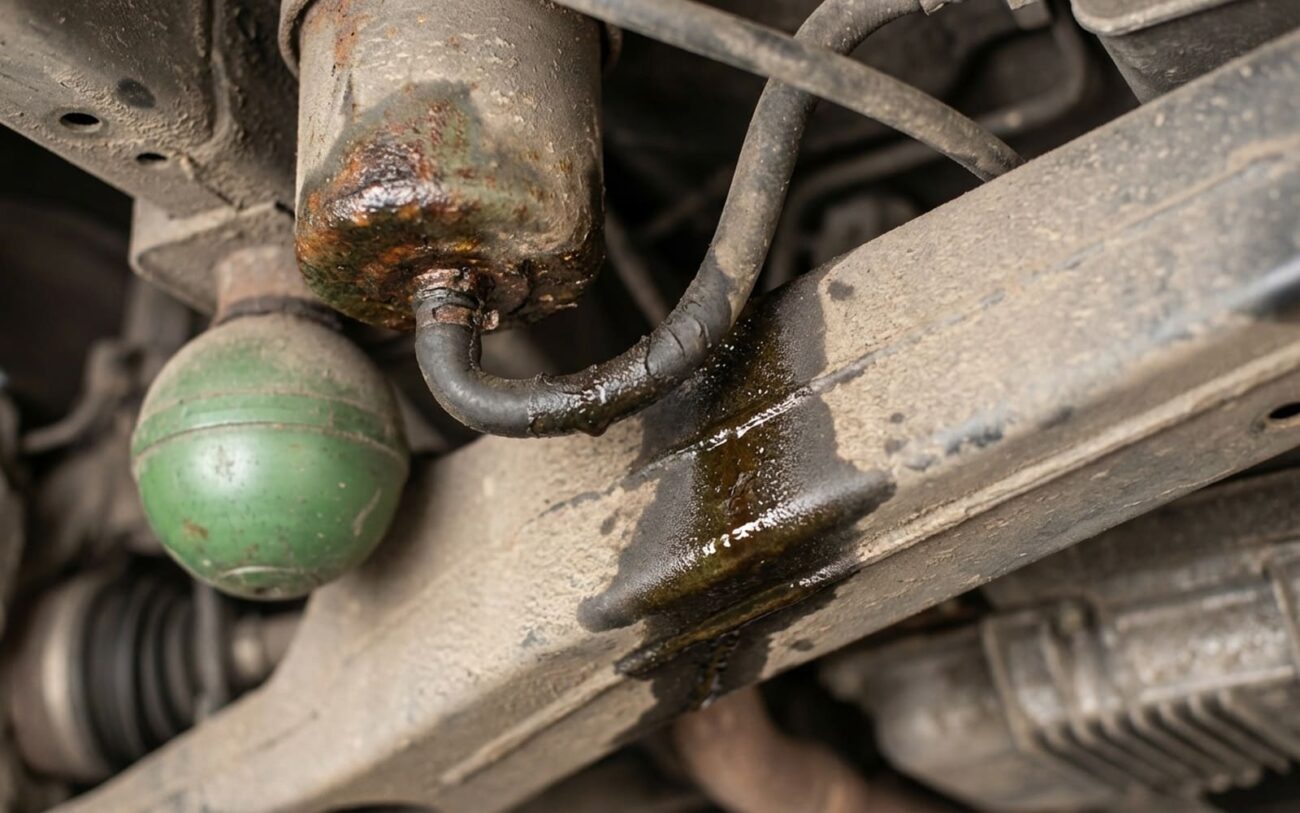
Alright, let’s talk hydropneumatic suspension systems. If you’ve got a Citroën or a Mercedes with ABC (Active Body Control) and it’s sitting low, refusing to lift, or just riding like a brick, your first thought might be, “Oh no, the pump’s dead!” After 25 years of turning wrenches on these cars, I can tell you that’s usually not the case. More often than not, the real culprit isn’t the pump at all. It’s almost always the pressure spheres.
What’s Going On: Recognizing the Symptoms
These spheres, they’re essentially hydraulic accumulators. Think of them like a shock absorber’s spring and oil combined. Inside, there’s a flexible rubber diaphragm separating high-pressure nitrogen gas from the hydraulic fluid. That nitrogen acts like an air spring, storing pressure and smoothing out the ride. When that nitrogen leaks out, you’re left riding on solid metal, and that’s where your problems start.
Here’s what I typically see in the shop:
1. A Single Corner Sagging or Not Lifting
If just one corner of your car is down and won’t come up, that’s a classic sign of a failed corner sphere. The diaphragm in that specific sphere has likely ruptured or lost all its nitrogen charge. The system can’t maintain pressure at that wheel, so it just sags.
2. The Whole Car Sits Low, and the Ride is Brutally Harsh
When the entire car is sitting uniformly low, and it feels like you’re driving over every pebble in the road – stiff, unforgiving, no give at all – that usually points to the main system pressure accumulator failing. This big sphere, often mounted near the pump or valve block, is the central pressure reservoir. If it goes, the whole system loses its ability to store pressure across the board. Yes, a completely dead pump or critically low fluid can mimic this, but in my experience, after 10-15 years, that main accumulator is usually the first thing to give up the ghost.
3. Excessive Bouncing After Bumps
You hit a bump, and the car just keeps oscillating up and down like a boat in choppy water. That’s a damping issue. In these systems, the spheres manage damping control. A sphere with low, but not completely zero, nitrogen pressure can’t regulate fluid flow effectively. The suspension loses its ability to absorb and control rebound, leading to that bouncy, uncontrolled feeling.
How I Diagnose It: Isolating the True Problem
Now, just because the symptoms scream “sphere!” doesn’t mean you should grab a new one right away. Misdiagnosis is common, especially when external leaks or other mechanical failures mimic a bad sphere. The key is to systematically rule out other components before you replace anything.
For a Sagging Corner:
If you’ve got a single corner down, don’t just assume the sphere. First, check for external hydraulic leaks around the strut or lines. Also, on older Citroëns, a seized height corrector linkage or a blocked electrovalve can cause this. My definitive test for a sphere? I perform the “sphere knock test.” Once it’s safely depressurized and removed, a failed sphere will feel light and hollow when you tap it. A good one will have a noticeable weight and a duller thud.
For a Low Car with a Hard Ride:
This is where you need to check the main system pressure. A failed hydraulic pump, a faulty pressure regulator, or critically low LDS fluid can all make the car sit low and feel stiff. But if the pump is running and the fluid level is good, I’m looking at the main accumulator. The best test here is to monitor system pressure retention. A healthy system, once shut down, should hold above 150 bar for several minutes. If it drops like a stone after you turn the engine off, your main accumulator is toast.
For Bouncing and Poor Damping:
If the car is just bouncy, but still lifts, you’re likely dealing with a sphere that’s lost some nitrogen, but not all of it. Other possibilities include worn damper valve orifices inside the strut itself, or even a failing ride height sensor confusing the system. To be sure, you need a dedicated sphere pressure tester. This tool lets you check the nitrogen charge against factory specifications. It’s the only way to definitively tell if a sphere is just weak, not completely dead.
Why Spheres Fail: The Root Cause
Spheres don’t just fail randomly; it’s predictable wear and tear. The primary cause is simply material fatigue. That flexible rubber diaphragm inside, separating the nitrogen from the hydraulic fluid, is constantly flexing with every bump and every height adjustment. Over thousands of pressure cycles, it weakens and eventually ruptures. It’s just physics.
I’ve seen this accelerated on some Citroën Xantia Activa systems. Those cars had an active anti-roll system that caused constant, high-frequency pressure adjustments. Their spheres often needed replacement much earlier – sometimes by 80,000 miles – compared to a standard Xantia.
Another killer is internal corrosion. If water gets into the hydraulic fluid – usually from a failed seal or, more commonly, from neglected fluid changes – it can cause rust on the steel interior of the sphere. This rust weakens the shell and degrades the diaphragm, making it even more prone to rupture.
Getting It Fixed: Resolution Pathways
Safety First: Depressurization is Mandatory
You absolutely, positively cannot attempt to remove a sphere while the system is under pressure. On older Citroëns, you can usually use the manual bleed screw. On newer systems, a diagnostic tool like Lexia or Diagbox is essential to safely release all hydraulic pressure. Skip this step, and you’re risking serious injury from high-pressure fluid.
Standard Sphere Replacement DIY Feasible
Complex Access Units Professional Only
Damaged Shell Replacement
After the Repair: Post-Repair Validation
Replacing the sphere isn’t the finish line; it’s just the start of verification. Once everything’s buttoned up, start the engine. The car should rise to its normal ride height within 30–45 seconds, maybe a little longer if the system was completely drained. The ride should immediately feel smooth and compliant, not stiff or bouncy. Finally, grab a bright light and perform a thorough leak inspection at every sealing interface, especially while cycling the suspension through its height range. You’re looking for any tell-tale green (LHM/LDS) or yellow (CHF 11S) fluid stains.
The Bottom Line: Costs, Risks, and Making the Call
When it comes to these repairs, you’ve got options, and they come with different price tags and risks. Here’s a quick breakdown of what I typically see:
| Repair Type | DIY Cost (Parts) | Shop Cost | Success Rate | Secondary Risk |
|---|---|---|---|---|
| Single Corner Sphere | $80 – $200 | $300 – $500 | 99% | Fluid leak post-install risks pump damage from dry running. |
| Full Set (6 Spheres) | $500 – $900 | $1,500 – $2,500 | 95% | Seized fittings during removal can significantly escalate costs. |
Keep in mind, those shop costs are for labor and parts. If you’re tackling it yourself, the main risk is damaging something else or not getting a proper seal, leading to leaks. On older cars, seized fittings are a real pain and can turn a simple job into a nightmare of broken lines and stripped threads.
Keeping It Healthy: Prevention & Monitoring
Maintenance Best Practices
-
Use ONLY the correct fluid. For Citroëns, it’s LHM+ or LDS. For Mercedes ABC, it’s CHF 11S. Using the wrong fluid, even for a short time, will swell seals and destroy those delicate diaphragms inside the spheres. I’ve seen it too many times.
-
Change your fluid and filter every 3–5 years or 60,000 miles. This is crucial. It prevents internal corrosion and keeps the system clean. Skipping this is a surefire way to shorten the life of your pump and spheres.
-
Listen to your pump. If you hear your hydraulic pump cycling (a distinct hum) every 5–10 seconds at idle, that’s a strong indicator of significant pressure loss. It means a sphere is likely on its way out, and the pump is working overtime to compensate.
-
Inspect sphere bases monthly. Take a quick look for any green or yellow fluid stains around the base of the spheres. These are early signs of a slow leak, and catching it early can save you a lot of grief.
