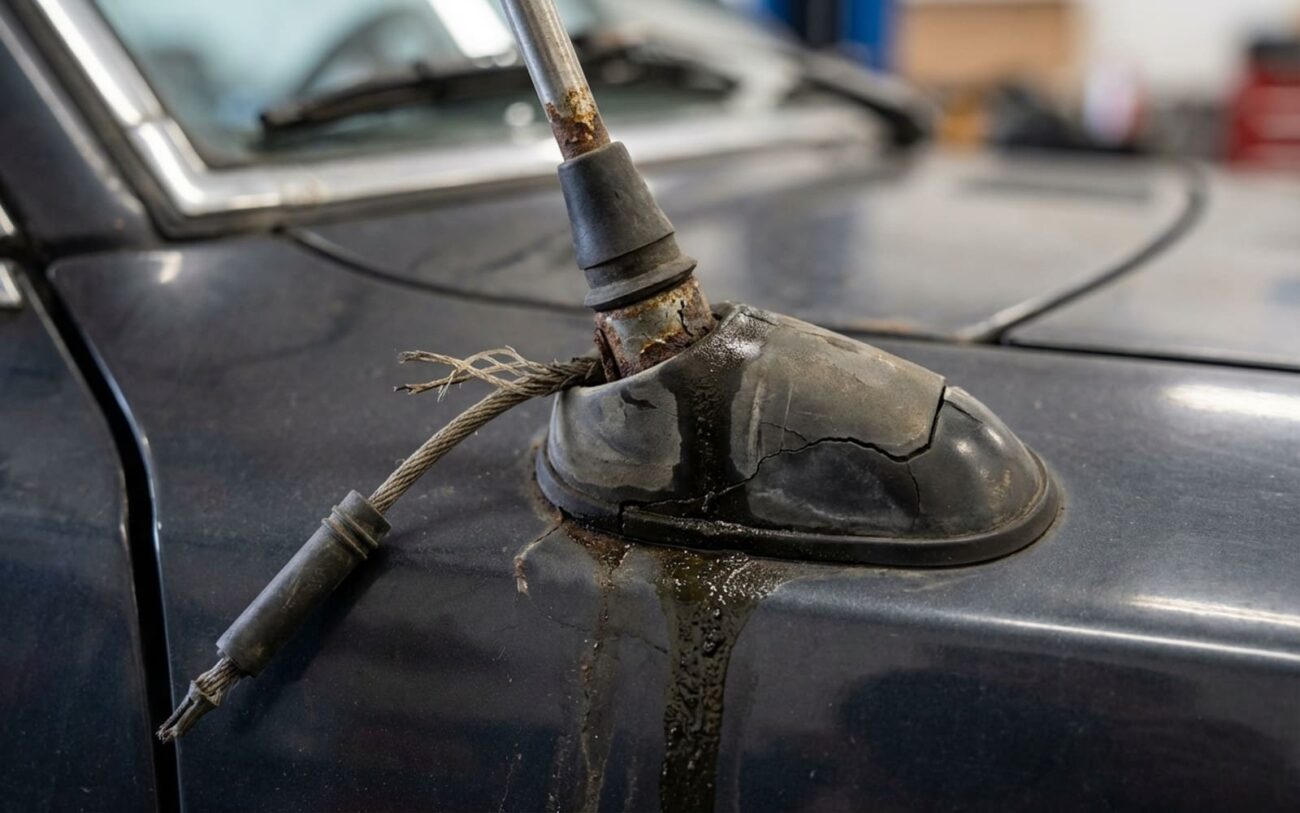
That grinding noise from your fender when you turn on the radio? Yeah, that’s not normal. I’ve heard it a thousand times in the shop — and every time, it’s the same story: the power antenna’s dying. But here’s the thing — you don’t have to yank it out and start over. Not yet. There’s a method to this madness, and if you follow it, you can save time, money, and a lot of frustration.
Grinding? That’s the Gear Stripping — Here’s What’s Actually Happening
When you flip the radio on and hear that angry whine or grind, but the mast doesn’t move — or only jerks halfway — the plastic drive gear inside the mast is toast. It’s not “worn.” It’s gone. These gears are made of acetal or nylon, and they’re supposed to last. But after 10, 15 years? They crack, strip, or just disintegrate. And when that happens, the motor spins, the gear flails, and you get that awful grinding sound as it chews up the steel drive cable.
And don’t let the motor keep running. I’ve seen guys leave it going for weeks — “It still works sometimes!” — and by the time they bring it in, the motor’s fried. Overheated. Burned windings. Sometimes the plastic housing is melted. At that point, you’re not just replacing a mast — you’re replacing the whole assembly, maybe even rewiring.
Is It the Mast, Motor, or Wiring? Let’s Diagnose It Right
First — don’t assume it’s the mast. I’ve had customers replace the whole thing only to find out the problem was a broken wire behind the rear speaker. So let’s walk through this like a pro.
Start simple: check the fuse. It’s usually in the interior panel, labeled “Antenna” or “Radio.” If it’s blown, replace it — but don’t stop there. A blown fuse can mean a short, and that short might be in the motor.
If the fuse is good, test for power at the motor connector when the radio turns on. Use a multimeter. You should see 12V and a solid ground. No power? Trace back to the relay — often near the radio or under the dash. And check the wiring near the trunk hinge. That’s a known weak spot. I’ve cut open harnesses on half a dozen Camrys and found two or three broken wires from repeated flexing.
Now, if the motor runs but the mast doesn’t move — that’s the mast. But to confirm, disconnect the mast from the motor (usually just a twist-off base) and apply 12V directly from the battery to the motor terminals. If it spins freely, the motor’s fine. The problem is inside the mast.
If the mast moves but binds at a certain point? Try extending it by hand. Clean the exposed sections first — soap, water, dry it. If it still binds, the drive cable is kinked or corroded. And if it feels gritty? That’s internal rust. No fixing that.
| Symptom | Likely Cause | How to Confirm |
|---|---|---|
| Motor runs, mast doesn’t move | Stripped drive gear or broken drive cable | Disconnect mast, power motor directly. If motor spins, mast is bad. |
| Mast binds mid-cycle | Kinked cable, bent section, or corrosion | Manually extend/retract after cleaning. Binding = internal damage. |
| No sound, no movement | Blown fuse, bad relay, broken wire | Check power and ground at motor connector with multimeter. |
Why These Things Die — And Which Cars Suffer Most
Three things kill power antennas: wear, water, and impact.
Wear — the plastic gear just gives out. I’ve pulled apart masts where the gear teeth are completely rounded off. It’s not a defect. It’s age. And on GM trucks from the late ’90s to early 2000s, I see this at least once a week.
Water gets in through the base seal or a cracked housing, and the steel drive cable starts to rust. Once it kinks, it’s done. I’ve seen cables snap clean in half from internal corrosion.
Impact — car washes, parking garages, kids leaning on it. The thin outer sections bend easily. And once they’re bent, they won’t telescope. I had a customer whose antenna got clipped by a forklift. Looked fine — but wouldn’t retract. Pulled it apart, and sure enough, the second section was buckled.
And watch out for older Chryslers — 2000s Dodge Intrepids, Chrysler 300s. They used a tiny nylon retainer clip inside the mast. That clip breaks, the cable slips, and the antenna goes up but won’t come down. Classic.
Can You Fix It — Or Just Replace It?
Straightening or Replacing Bent Sections DIY-FEASIBLE
If the mast’s just slightly bent, you can try straightening it by hand — gently. But if it’s kinked or buckled? No fix. Replace the whole mast. And don’t force it — you’ll damage the drive cable.
Replacing the Mast Assembly DIY-FEASIBLE TO PROFESSIONAL-ONLY
On older GMs or Fords with fender-mounted antennas? Easy. One nut, unplug, swap. But on a Lexus IS300 or an Acura TL? You’re pulling quarter panels, trim, maybe even a speaker. That’s shop territory. Always disconnect the battery first. And torque the base nut to 35–50 inch-pounds. Overtighten it, and you’ll crack the housing or dent the fender.
Stripped Gear or Broken Cable NON-REPAIRABLE → REPLACE
Forget rebuilding it. The mast is sealed, grease-packed, and not serviceable. You can’t open it without destroying it. And no — you won’t find replacement gears. Just buy a quality mast. I stick with OEM or reputable aftermarket like Standard Motor Products. Skip the $20 eBay units — their gears strip in six months.
Temporary Workaround TEMPORARY / LAST-RESORT
In a bind? Manually extend the mast, then pull the fuse. Radio works, motor’s safe. But — and this is big — if the mast doesn’t seal when extended, water gets in. I’ve seen trunks full of water from this. And if someone hits it? Gone. This isn’t a fix. It’s a stopgap.
After the Fix — Test It Right
Don’t just plug it in and call it good. Cycle the antenna up and down at least five times. It should extend fully, retract completely, and run smooth every time. No hesitation. No grinding. No partial movement.
Maintenance? Every few months, wipe it down with soapy water. Dry it. Then — and only then — hit it with a light coat of silicone lube. Not WD-40. Not grease. Silicone. And sparingly — too much attracts dirt.
And listen. If the motor sounds strained, or the mast wobbles, or there’s white crust at the base — that’s corrosion. Address it early. A small bend today becomes a $300 repair tomorrow.
Costs, Warranties, and When to Walk Away
DIY Mast Replacement
Parts only. Quality matters — don’t cheap out.
Shop Replacement
Labor + parts. Higher on imports or complex trims.
But here’s my rule: if the repair costs more than 40% of the car’s value, reconsider. A $400 fix on a $1,200 beater? Not worth it. In those cases, I install a fixed mast antenna — the kind that screws in and stays put. No motor, no drama. Reception’s fine, and it’s reliable.
Cost-Saving Tip
On older daily drivers, I skip the power antenna entirely. Bolt on a $30 fixed mast, run a new coax if needed, and call it done. The radio works, and you’re not chasing failures every winter.
