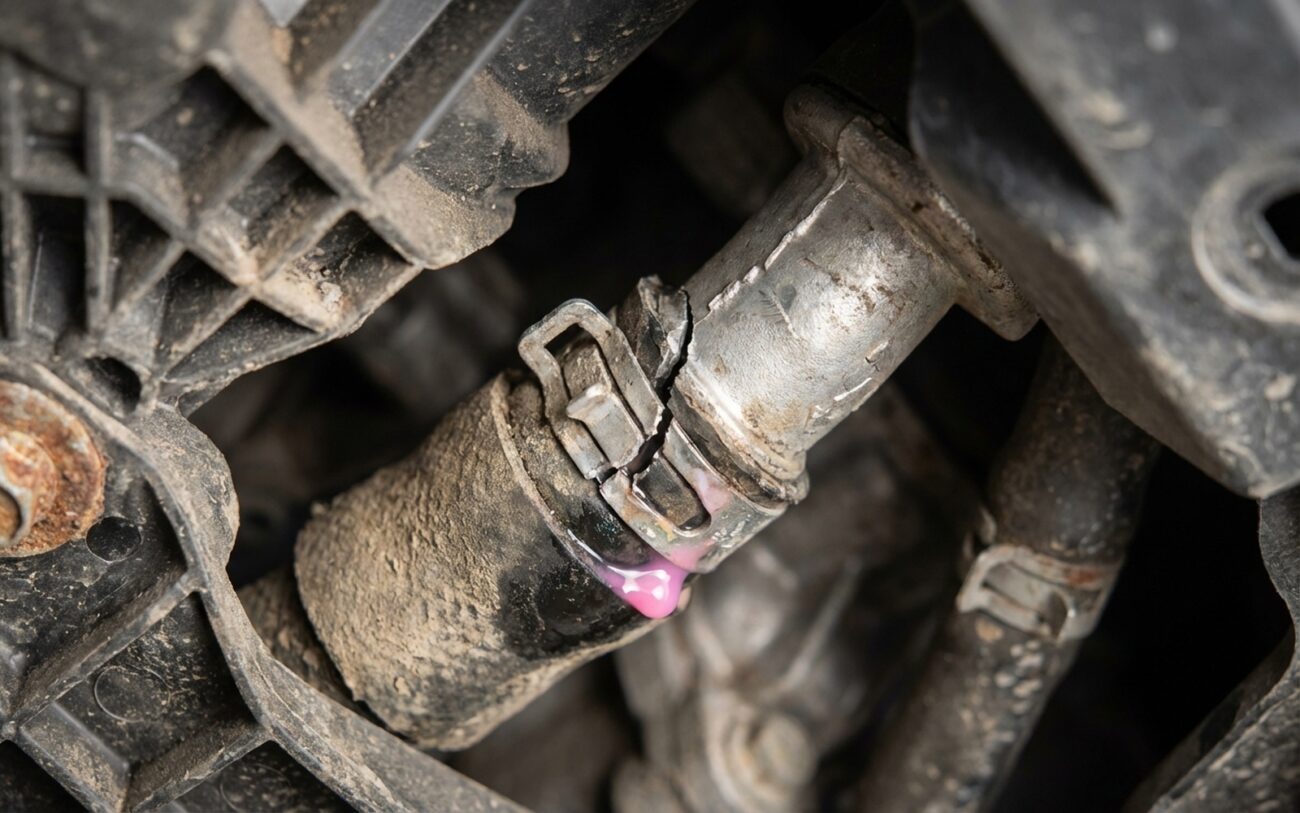
Alright, let’s talk about the Chevrolet Bolt EUV’s battery cooling system. If you’re reading this, you’re probably seeing some troubling signs, and believe me, I’ve diagnosed enough of these BEV3 platform vehicles to know that when the battery’s cooling plate starts to fail, it’s not a subtle issue. It’s a serious problem, and often, it means coolant is getting where it absolutely shouldn’t be – inside the sealed battery module itself.
What You’ll Actually See and Feel
There are a few clear red flags that tell me something’s wrong with the battery’s dedicated thermal management. You won’t get a gentle nudge; these are pretty direct warnings.
The Obvious Drip (or Lack Thereof)
First thing I always tell folks: look under the car. If you spot a puddle of pink or orange glycol coolant right under the center of the vehicle, where that big battery pack sits, that’s a huge sign. It’s not from your radiator or the drive unit – that’s the battery’s own loop. Now, it could be something simple like a loose hose or a bad O-ring on the outside of the pack. I’ve seen those. But here’s the kicker, the real clue that sends shivers down my spine: if you’re constantly topping off the coolant reservoir and can’t find a single external drip, that fluid isn’t just vanishing. It’s going inside the sealed battery module. And that, my friend, is a ticking clock.
Dashboard Warnings and Performance Hits
Then there’s what the car tells you. You’ll likely see a “Propulsion Power is Reduced” message pop up on your dash. This isn’t just a random glitch; it means the battery management system (BMS) has detected abnormal thermal conditions and is cutting power to protect the pack. When I hook up my scan tool, I almost always find a DTC like P1E00 (Battery Cooling System Malfunction), or other temperature-related codes for the coolant loop.
Another big indicator I look for with the scan tool is a large temperature delta – a difference of over 10°C (18°F) – between the coolant inlet and outlet sensors on the battery. Normally, that coolant should pick up heat pretty evenly as it flows through. A wide gap like that usually points to poor flow or internal bypassing, which often means a leak or a blockage inside the plate itself.
And let me be clear about something many owners don’t grasp: coolant inside the battery module isn’t just a leak; it’s a contamination event. Even low-conductivity HOAT coolant becomes a problem when it touches high-voltage bus bars, cell terminals, or insulation. Over time, I’ve seen it cause galvanic corrosion, tracking, and even micro-shorts that compromise cell integrity. Once that starts, no software update in the world will fix it. I’ve personally seen modules completely fail after just one undiagnosed coolant breach. Don’t wait for total failure – get it checked out early.
Pinpointing the Exact Problem: Internal vs. External
Before you jump to the worst-case scenario – a cracked cooling plate – we need to systematically rule out simpler, external issues. The goal here is to isolate the battery cooling loop and test it independently. Going straight for “the cooling plate is cracked” without proper diagnostics usually leads to wasted money and incorrect repairs.
Step 1: The Visual Check (Again)
Even if you didn’t see a puddle, I always start by thoroughly inspecting all external connections on the battery pack. That means checking quick-connect fittings, hoses, and any visible O-rings or seals around the coolant pump on the pack’s exterior. Sometimes, it’s just a degraded O-ring or a loose clamp. If I find something obvious, I fix it, top off the coolant, and re-check. If the coolant keeps disappearing or the symptoms persist, then we move on.
Step 2: The Pressure Test – Your Best Bet
In my experience, the pressure test is the most reliable first step to confirm an internal leak. You need to isolate the battery coolant loop from the rest of the vehicle’s thermal system. Then, I pressure test it to 15 psi and let it sit for at least 30 minutes. If that pressure drops without any visible external leak, you’ve almost certainly got an internal breach. I’ve seen too many shops miss internal leaks because they only looked for drips. Remember, the battery’s coolant loop is a sealed system. Any pressure loss without an external leak means the problem is inside the module.
Step 3: Advanced Diagnostics for Flow and Temperature Issues
If you’re getting that P1E00 code and a big temperature delta, we need to dig deeper into coolant flow. I use a GM scan tool to command the coolant pump to 100%. Then, I’ll use an ultrasonic flow meter on the inlet and outlet lines. No flow, or very little flow, tells me it’s either a failed pump (less common for internal leaks, but possible) or a severe blockage inside the cooling plate. If the flow seems good but the temperature delta is still high, I’ll test the accuracy of the temperature sensors themselves with a calibrated thermal probe in a heated coolant sample. Sometimes, it’s just a bad sensor giving you false data.
For absolute confirmation of an internal leak, especially if it’s subtle, a borescope inspection can sometimes reveal internal seepage at weld seams or other weak points within the module, though this requires specific access points and can be tricky.
It’s worth noting that GM has issued service bulletins for this failure pattern, especially on early-build Bolt EUVs. Any good technician will consult GM’s latest guidance before tearing things apart.
Why the Cooling Plate Itself Fails
So, how does a solid aluminum plate, a core part of the Bolt EUV’s liquid-cooled battery pack, develop a leak? It’s not magic; it’s a combination of engineering, materials, and how the vehicle is used over time. In my 25+ years, I’ve seen a few common culprits:
- Manufacturing Variability: The cooling plate is a die-cast aluminum component with intricate internal micro-channels. Sometimes, from the factory, there can be microscopic porosity in the casting. These weak spots might not leak initially but can worsen with thermal cycling. Similarly, the laser-welded seams where the plate connects to the manifold can develop tiny fissures if the weld wasn’t perfect. These are component-level defects, and I usually see them show up earlier in the vehicle’s life.
- Thermal Fatigue (The Big One): This is the most common long-term cause I encounter. Every time you DC fast charge, that battery generates a lot of heat, and the cooling plate has to absorb it quickly. Aluminum expands when hot and contracts when cold. Repeat that hundreds or thousands of times, and stress concentrates at internal corners, inlet/outlet ports, and thinner sections of the casting. Over years, this leads to micro-cracks that eventually become full-blown leaks. I see this more often in vehicles that are frequently fast-charged, especially in hotter climates.
- Corrosion (The Silent Killer): The Bolt EUV uses Dex-Cool HD, a hybrid organic acid technology (HOAT) coolant. It’s designed for long life and low conductivity. But if the wrong coolant gets added – like an IAT (inorganic) or OAT (organic) type – it can create galvanic reactions with the aluminum. Even worse, if the coolant isn’t changed on schedule, it degrades, loses its inhibitors, and becomes more conductive. That accelerates electrolytic corrosion inside those tiny channels, thinning the walls from within. I’ve seen plates fail after just 7 years simply because the coolant hadn’t been serviced since day one.
- Physical Damage: A severe underbody impact – hitting a curb, a deep pothole, or road debris – can deform the battery tray and crack the cooling plate. Unlike a damaged external hose, you won’t see this without disassembly. The key distinction here: a leak from a rubber hose, a plastic connector, or an O-ring is not a cooling plate failure. Those are serviceable external components. The plate itself is an integral, non-replaceable part of the module structure.
Your Repair Options (And The One You Absolutely Don’t Have)
Let me be absolutely clear: there is no safe, approved, or effective way to repair a leaking internal battery cooling plate. You cannot weld it, seal it, or patch it. GM’s service procedure – and every reputable EV technician I know – requires replacement of the affected battery module section. Anyone who tells you otherwise is either misinformed or trying to sell you a dangerous shortcut.
The Module Section Replacement Process
This isn’t a simple job. It’s intensive and requires specialized training and tools. A certified high-voltage technician must:
- Disable the high-voltage system using proper lockout/tagout procedures. This is critical for safety.
- Remove the entire battery pack from the vehicle.
- Open the module enclosure under controlled conditions – you don’t want contaminants getting in.
- Carefully transfer functional battery cells, sensors, and wiring harnesses from your old module to a new module section that has an intact cooling plate.
- Reassemble everything using OEM torque specs on bus bars and coolant manifold bolts. This isn’t a “good-n-tight” job; precision matters for electrical connections and sealing.
After assembly, the cooling loop must be filled with GM-approved Dex-Cool HD premixed coolant only. I can’t stress this enough: never use universal coolant or mix your own. Contamination risks corrosion and voids any warranty. The system then requires a vacuum purge and air bleeding using a GM scan tool, not just static filling. This ensures there are no air pockets left, which could cause false temperature readings or trigger thermal derates down the road.
Making Sure the Fix Actually Worked
A proper repair isn’t done just because the battery pack is back in the car. Validation is absolutely critical. Here’s what a competent shop, like mine, should do to ensure the job was done right:
- Post-Repair Pressure Test: We’ll pressure test that isolated cooling loop again, typically at 15 psi for 30 minutes. An acceptable loss is usually less than 0.5 psi. Any more than that, and there’s still a leak somewhere – possibly from a new seal or fitting that wasn’t torqued correctly.
- Monitor Thermal Performance Under Load: Using a scan tool, we’ll simulate a DC fast charge or take the vehicle on a controlled drive. I’m watching individual cell temperatures and the coolant delta. All cells should stay within about 5°C of each other, and the coolant should show consistent heat absorption. This tells me the new cooling plate is doing its job.
- UV Dye and Black Light Inspection: I like to add UV dye to the new coolant, cycle the system through heating and cooling phases, and then inspect all connections and the module exterior with a black light. This catches any small, elusive leaks that might not show up immediately.
If the car still throws a P1E00 code or shows abnormal temperature readings after the repair, don’t drive it. Something is still wrong – it could be incomplete bleeding, a faulty sensor, or a missed leak. A repeat failure risks damaging that newly installed module section.
The Hard Numbers and The Decision You Have to Make
Let’s talk economics, because this isn’t a $500 fix. Even if your vehicle is still under a limited warranty, you need to understand the stakes. For an out-of-warranty Bolt EUV, this repair can easily run you 40–60% of the car’s current market value.
A battery module section replacement, performed correctly by a GM-certified or qualified EV technician following OEM procedures, typically costs between $3,000 and $7,000+, depending on parts availability, regional labor rates, and the specific module section needed. It’s not DIY feasible; it requires HV certification, OEM scan tool access, specialized torque tools, and module programming capability.
Your first step, always, should be to check with a GM dealer. Is your vehicle covered under the extended battery cooling system warranty? GM has issued recalls and goodwill programs for coolant loss in some model years. If you’re covered, the repair may be free or heavily subsidized, which is a huge relief.
If you’re not covered, you’re facing a tough call: repair or replace the vehicle. But remember – driving with a known internal coolant leak risks total battery failure, which isn’t just about cost; it’s about safety and the overall longevity of your EV.
Keeping It From Happening Again
Prevention is always cheaper than repair, especially with EV batteries. The Bolt EUV’s thermal management system is pretty advanced – that active liquid cooling keeps cells stable during fast charging and extreme weather – but it demands respect and proper maintenance.
To Prevent Recurrence
-
Service your battery coolant every 5 years or 150,000 miles, whichever comes first, per GM recommendations. Use only Dex-Cool HD premixed coolant. No exceptions. Mixing coolants or using water dilution invites corrosion, and that’s how these problems start. This single step drastically reduces the risk of internal plate degradation.
-
Inspect regularly. Occasionally park on light-colored pavement and look for pink/orange residue. Check your coolant reservoir level monthly. Unexplained drops mean trouble, even if you don’t see a visible leak right away.
-
Monitor performance. If your Bolt EUV starts limiting DC fast charge speeds earlier than usual, or your range drops faster in hot weather, it could signal cooling inefficiency. Catching an external leak early can prevent internal damage.
And finally, understand the trade-offs. The whole Bolt EUV vs. Leaf battery cooling debate isn’t just technical; it’s philosophical. The Nissan Leaf uses passive air cooling, which is simpler and has fewer direct failure points, but it can’t manage heat as aggressively, leading to faster battery degradation with frequent fast charging. The Bolt’s glycol coolant loop, battery chiller, and heat exchanger system is far more effective at keeping the battery healthy over its lifespan, but it adds complexity. That’s the price of performance and longevity – if it’s maintained correctly, of course.
