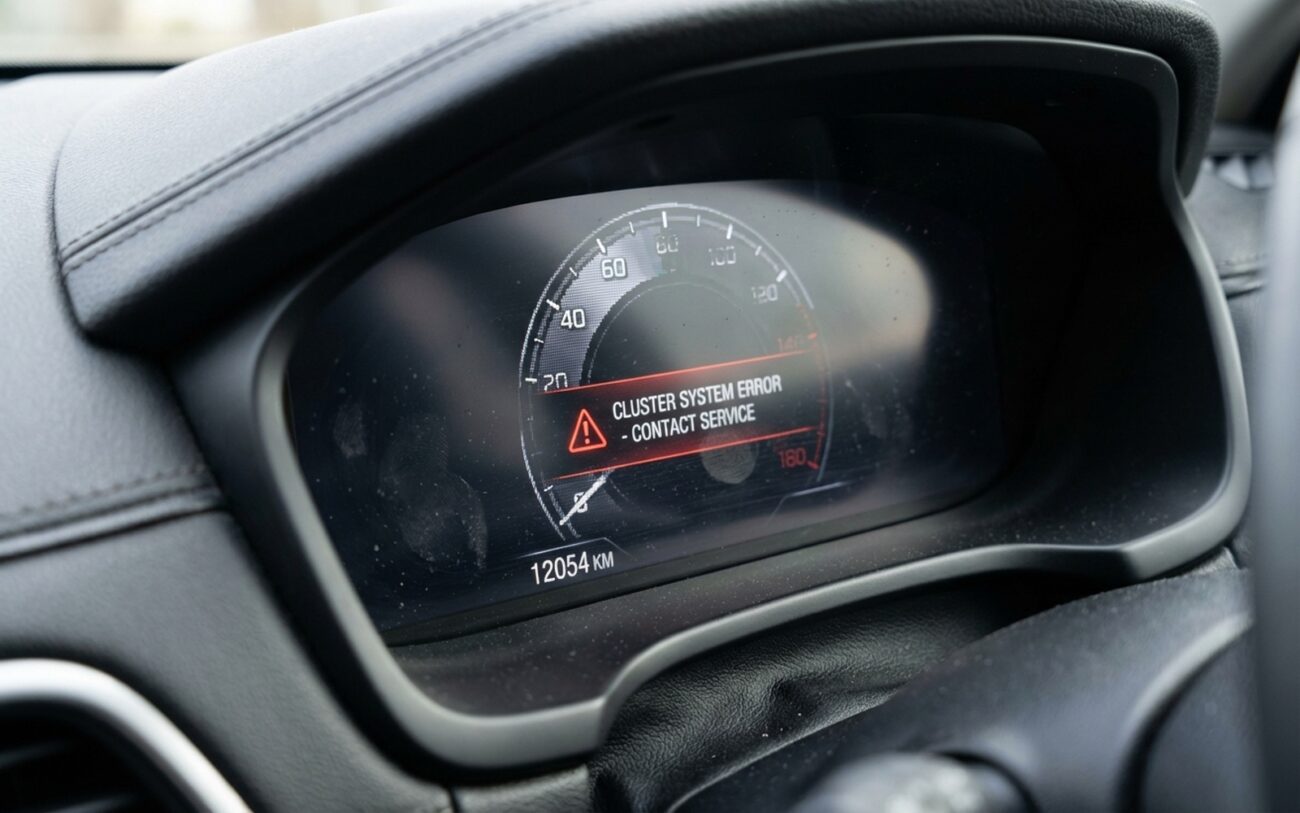
When your digital dash goes black or freezes solid, it’s not just annoying—it’s dangerous. I’ve had customers roll in thinking it’s a glitch. Then they realize they’ve been driving blind: no speed, no oil pressure, no warning lights. That’s how you blow an engine.
What a Dead Digital Cluster Actually Is
This isn’t a screen. It’s a full computer. On a 2018+ VW Golf or Audi A4, that’s a dedicated eGPU, flash memory, microcontroller, and CAN bus interface—all sealed in a housing that doesn’t want to be opened.
When it fails, you don’t lose just one gauge. You lose everything: speed, RPM, fuel, temps, warnings. The car might run fine, but you’re flying blind.
I’ve seen clusters with a faint backlight glow but no image. Classic sign of internal power regulation failure. Or worse—frozen at 3,000 RPM with the engine off. That’s not a sensor issue. That’s the eGPU or memory locking up.
And don’t confuse this with a single gauge acting up. If your fuel needle jumps but the rest works? That’s likely a sender. But a blacked-out or scrambled display? That’s the cluster itself.
Don’t Replace It Yet — Rule Out the Simple Stuff
I’ve pulled clusters only to find a $3 fuse blown. Or a corroded ground under the dash. Don’t be that guy.
The cluster needs three things: clean 12V, solid ground, and CAN communication. If any one fails, the cluster looks dead.
On a 2016 Chrysler 300, I chased a black cluster for two days—turned out the gateway module was dropping offline. No communication, no display. Swapped the gateway, cluster came right back.
Same thing on a 2020 Explorer: intermittent power from a failing ignition switch. Cluster would die after 20 minutes of driving. Voltage tested fine—until I scoped it. Dropped to 9.2V under load. Replaced the switch, problem gone.
So before you yank the dash apart:
-
Check the fuse. It’s usually in the IP fuse block—look for “Instrument Cluster” or “ICM.”
-
Verify power and ground at the cluster connector with a multimeter. Don’t guess.
-
Use a scan tool. If other modules (ABS, PCM, BCM) talk but the cluster doesn’t, and power is good—that’s internal.
When the Cluster Itself Is the Problem
Once you’ve ruled out fuses, wiring, and comms, it’s time to face the truth: the module is failing.
The #1 hardware killer? Cracked BGA solder joints. On the 2012–2016 VW Passat, it’s so common VW issued a TSB. Heat cycles stress the tiny solder balls under the graphics chip. Micro-cracks form. Connection fails. Cluster dies.
I’ve opened dozens. You can see the hairline cracks under magnification. Reflow the BGA with hot air—90% come back to life.
Memory corruption is next. If the car lost power during a software update—say, someone disconnected the battery mid-update—the flash memory can lock up. No boot, no display.
And don’t forget the ribbon cable. On a 2017 F-150, I once replaced a cluster only to find the internal flex cable wasn’t seated. One tiny nudge during install, and the screen went black. Looked like a total failure. Wasn’t.
Real Repair Options — Not Just “Replace It”
Software Reflash DIY-FEASIBLE with proper tool
If the issue started after an update or a battery disconnect, try a reflash. You’ll need VCDS for VWs, Forscan for Fords, or a J2534 pass-thru device. Keep voltage above 12.5V—use a battery maintainer. One dip below 11V, and you could brick it.
On a 2019 Ram 1500, I cleared a frozen cluster with a reflash. Took 45 minutes. Cost: $0, since I already had the tool.
PCB-Level Repair PROFESSIONAL-ONLY / SPECIALIST REPAIR
For BGA cracks or failed memory chips, rework is possible. I send these to a shop with a hot-air station and thermal profiling. They reflow the eGPU, test under thermal stress, and verify stability.
Cost? $300–$600. Beats $2,000 for a new unit. Success rate is high—if the board isn’t burned.
On a 2014 Jeep Grand Cherokee, this saved the owner $1,800. Cluster came back stable after 100 thermal cycles.
Full Module Replacement NON-REPAIRABLE → REPLACE & PROGRAM
If the screen is dead or the board is fried, replace it. But don’t just plug in a used cluster. You’ll need to program mileage, pair the immobilizer, and disable component protection.
Dealers use VCMI or Witech. Independents can use Autel or Autophix with proper licenses. Never skip programming—this isn’t plug-and-play.
And yes, used clusters work—just make sure the part number matches exactly. A 5AB9208xx from a salvage yard can save you $1,000 if programmed right.
Temporary Workaround GET-YOU-HOME ONLY
Disconnect the battery for 15–20 minutes. Sometimes it clears a software hang. But if it’s hardware, it’ll come back—maybe in five minutes, maybe in five days.
And be ready: seat memory, radio presets, steering angle sensor may need recalibration after a reset. Don’t rely on this fix. Use it to get the car to a shop.
Did the Fix Last? Here’s How to Know
A cluster that works today but dies next week isn’t fixed. I test like this:
For a reflash: 50 ignition cycles, 4+ hours of runtime. All gauges must respond. No U-codes. No flickering.
For a hardware repair: thermal stress test. Heat the cluster to 180°F, cool to 40°F, power it through the cycle. Watch for dropouts. I’ve seen “fixed” clusters fail at 140°F—just under normal underhood temps.
For a replacement: verify mileage matches across modules (PCM, TCM, BCM). No “Component Protection” warnings. Immobilizer must allow starts without hiccups.
If it passes all that, it’s good. If not, you’ve got more work to do.
What You’re Actually Paying For
| Repair Type | DIY Cost | Shop Cost | Success Rate | Secondary Risk if Failed |
|---|---|---|---|---|
| Software Reflash | $100–$500 (tool/license) | $150–$300 | High (if software-only) |
Bricking the module if voltage drops. |
| PCB Repair (BGA rework) | Not feasible (equipment >$1k) | $300–$800 | Medium-high (depends on skill) |
Intermittent return; latent damage possible. |
| OEM Replacement & Program | $800–$2,500 (part) + tool | $1,200–$3,500 | Very high (if done right) |
Immobilizer lock-out if programming fails. |
How to Keep It From Happening Again
Prevention That Actually Works
-
Use a battery maintainer during any electrical work. Voltage drops during updates kill clusters. I don’t care if the manual says it’s optional—do it.
-
Watch for early signs. A flickering pixel. A slow boot. A one-second delay when switching screens. These aren’t quirks. They’re warnings.
-
Check for TSBs. On the 2013–2017 Taurus, Ford released a firmware update for cluster instability. Free fix—if you know to ask.
-
Handle the cluster like glass. That ribbon cable? One tug, and it’s disconnected. I’ve seen it happen during airbag module swaps.
