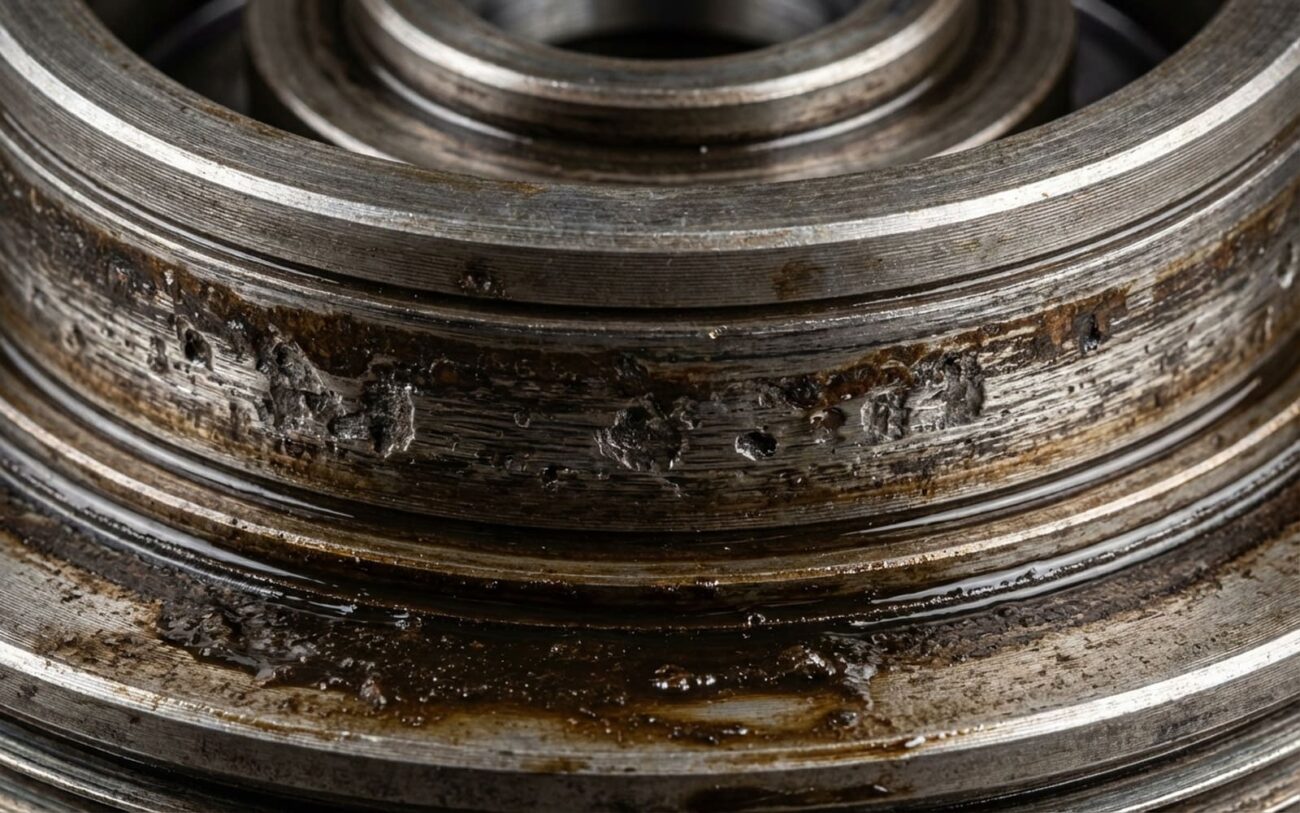
Listen, after 25 years under the hood, I’ve seen just about every way an A/C compressor can die. But when it’s the wrong oil, that death is usually quick, loud, and messy. This isn’t some slow leak you can ignore for a few months. We’re talking rapid, catastrophic failure, sometimes within minutes of the system running. If you know what to listen for, you can catch it early—or at least understand why your A/C just committed suicide.
The Sound of Death: What a Dying Compressor Tells You
The first, most obvious sign that the wrong PAG oil is killing your compressor is a distinct, sharp metallic whine or grinding noise. This isn’t a subtle hum; it’s loud, high-pitched, and consistent. It starts the exact second the A/C clutch engages, and it stops the instant it disengages. I’ve heard it hundreds of times, and it’s unmistakable.
Now, a worn compressor clutch bearing can also whine, but there’s a critical difference I always check: if the clutch bearing is the culprit, that noise often sticks around even when the A/C is off. If the sound is tied directly to the compressor kicking on, you’ve got internal trouble. That means metal-on-metal contact inside the compressor, plain and simple. The wrong oil just can’t hold up under the pressure, and those precision parts start eating each other alive.
If you get the chance to open up the system, the evidence becomes even clearer. Pull the orifice tube or crack open the filter drier, and you’re looking for a dark, smooth metallic paste. It’ll feel gritty, almost like fine sandpaper mixed with grease. That’s not just “wear debris”; that’s the guts of your compressor — bearings, swashplates, piston shoes — being ground down into a fine powder because the oil film failed. When a compressor fails from old age, you might see larger flakes or chips. But with the wrong PAG oil, the wear is uniform, widespread, and moves fast. If the compressor hasn’t seized up yet, it’s only a matter of time. Once it locks, that metal dust floods the entire system, and then you’re looking at a much bigger bill.
Diagnosing the Real Culprit: Is It the Oil or Something Else?
Metallic noise and debris in the A/C system can fool you. It’s easy to jump to conclusions, but misdiagnosis costs time and money. You need to differentiate between an oil-related failure, a mechanical fault, or some other contamination. Here’s how I break it down in the shop to pinpoint the exact cause.
| What You See/Hear | Why It Points to Incorrect PAG Oil | What Else Could It Be? (Common Mimics) | My Go-To Test to Confirm |
|---|---|---|---|
| Metallic Noise (Whine/Grind) When A/C Engages | The oil’s viscosity is too low, so it can’t maintain a protective film under load. This leads to metal-on-metal contact, especially in the swashplate or wobble-plate mechanisms. | A worn clutch bearing (noise often persists when A/C is off), a broken reed valve, or a piston seizing from general overheating. |
Use a scan tool to command the compressor clutch OFF. If the noise vanishes instantly, the problem is definitely internal to the compressor. When you open it up, look for fine, circumferential scoring on the journals and piston shoes – that’s oil starvation, not random gouging. |
| System Contamination (Metal in Filter/Oil) | You’ll find a uniform, fine metallic paste throughout the system. This is classic oil-starved wear, often mixed with oil that’s darkened and oxidized from the heat of friction. | Large, jagged metal fragments usually mean a mechanical breakage (like a connecting rod). Liquid slugging from an overcharge can also cause similar damage, but the debris will look different. |
Inspect the orifice tube and filter drier carefully. Fine, smooth paste screams oil failure; coarse, chunky bits usually point to mechanical trauma. For absolute certainty, I’ll take an oil sample and mix it with the correct OEM PAG oil at about 80°C (176°F). If it gets cloudy, gels up, or separates, you’ve got incompatible oil. |
| Low Oil Level or Poor Oil Return | The wrong viscosity oil just doesn’t circulate right. Too thin, and it migrates too quickly; too thick, and it pools in the condenser or evaporator, starving the compressor. | A refrigerant leak that carried oil out of the system, or an improper oil charge during a previous service. |
Recover all the refrigerant and measure the exact volume of oil extracted. Compare this to the OEM specifications. Also, check the condenser drain points for any pooled oil. For the ultimate confirmation, send an oil sample for FTIR (Fourier Transform Infrared) analysis. That’ll tell you the exact oil type and viscosity. |
The Science of Destruction: How Incorrect Oil Wrecks Your A/C
It’s not just “bad oil”; it’s a domino effect of mechanical and chemical failures. When the wrong PAG oil gets into your A/C system, here’s the breakdown of what happens inside that compressor:
The biggest issue, hands down, is viscosity mismatch. Compressors are built with incredibly tight tolerances, especially modern swashplate or scroll designs. They rely on a specific oil film thickness to keep metal parts from touching. OEMs specify PAG 46, PAG 100, or PAG 150 for a reason. If you use a lower-viscosity oil (like PAG 46) when PAG 100 is needed, that oil film simply collapses under the high pressures. That leads to what we call “boundary lubrication”—metal rubbing directly on metal. I’ve seen compressors that went from mirror-smooth journal bearings to deeply scored, glazed surfaces in just a few hours of operation. It’s brutal.
And don’t think using a higher-viscosity oil is a safe bet either. Thicker oil doesn’t circulate efficiently, especially in systems with long refrigerant lines or small-diameter passages. It can pool in the condenser or evaporator, leaving the compressor starved for lubrication. Oil return is absolutely critical; without it, even a perfectly charged system will fail fast.
Then there’s the additive package. Genuine OEM PAG oils aren’t just base oil; they contain anti-wear agents (like ZDDP), antioxidants, and corrosion inhibitors. Many off-brand or generic oils skimp on these or use incompatible additives. When those additives break down, the oil loses its protective ability, accelerating wear even further.
And let’s not forget moisture. PAG oils are naturally hygroscopic—they absorb water from the air. But some non-OEM oils hold more moisture or lack the hydrolysis inhibitors that prevent problems. Inside a hot, pressurized A/C system, that moisture can react to form organic acids. These acids attack copper-lead bearings and aluminum housings, causing pitting, corrosion, and premature failure. I’ve pulled compressors where the bearings looked chemically etched, not worn down, which is a classic sign of acid formation.
Automakers are well aware of this. There are documented service bulletins (not just shop rumors) for certain models—some Ford, GM, and Honda applications come to mind—explicitly warning that using non-specified PAG oil voids compressor coverage and leads to premature failure. For instance, many variable displacement compressors are incredibly sensitive to the difference between PAG 100 and PAG 46. Get it wrong, and you’re looking at a dead compressor in under six months.
Important distinction: this is all about the oil in the compressor. If the correct oil is used but the system overheats because of a clogged condenser or a failing clutch coil, that’s a different failure path. In those cases, the oil itself isn’t the root cause, it’s just a victim.
The Fix: What It Really Takes (No Shortcuts Here)
Professional Territory Only
Let’s be clear: this isn’t a “top it off and hope” kind of repair. A/C systems are complex, and the procedures are methodical. You need specialized tools, proper safety training, and the right PPE. There are no safe shortcuts here, and trying to DIY it often costs more in the long run.
Preventive Flush & Oil Analysis Professional Only
System Flush & Component Replacement (Early Stage Failure) Professional Only
Full System Overhaul (Catastrophic Failure) Professional Only
Making Sure the Repair Actually Worked: Verification is Key
Just recharging the system and handing back the keys isn’t enough. You need to validate the repair. After any flush or overhaul, the system must hold a 500-micron vacuum for at least 10 minutes after the vacuum pump is turned off. Any rise indicates a leak or moisture still lurking in the system.
Once charged, use a digital manifold gauge set to verify the high- and low-side pressures. They should match the manufacturer’s performance chart for the current ambient temperature and humidity. A properly functioning system should cool the air exiting the vents by at least 20°F (11°C) within 5 minutes of operation. And, of course, that metallic noise absolutely has to be gone. Use a stethoscope or an electronic pickup to confirm no abnormal sounds from the compressor.
For a full system replacement, I add one more check: measure the temperature drop across the condenser with an infrared thermometer. A healthy system should show a 30–50°F (17–28°C) drop from the inlet to the outlet. A smaller delta could mean residual blockage or poor airflow, which means more trouble down the road.
For Proper Verification, You’ll Need:
-
A micron gauge to verify vacuum levels.
-
A digital manifold set to monitor high- and low-side pressures.
-
A good thermometer to measure vent and condenser temperatures.
-
Preferably a scan tool to monitor compressor cycling and pressure sensor data.
-
This isn’t guesswork—it’s how you ensure a lasting repair.
The Hard Truth About Cost and Your Car’s Value
Let’s be realistic: fixing a compressor that’s been destroyed by the wrong oil isn’t cheap. The actual cost depends heavily on how far the damage has progressed. Here’s a breakdown of what you can expect:
Preventive Flush & Oil Analysis
When caught early, before damage. Cheapest option, but still requires professional tools.
Flush & Repair (Early Stage Failure)
Only if compressor still runs and condenser can be flushed or replaced. DIY not advised due to specialized equipment and risk.
Full System Overhaul (Catastrophic)
When done correctly, has a high success rate. DIY not advised due to complexity and risk.
Compressor-Only Swap (No Flush)
Extremely high risk (I’d say 10% success rate, tops). Contaminated condenser will destroy the new compressor in weeks. DIY not advised.
I mark all DIY options as “Not Advised” for good reason. The cost of a vacuum pump, micron gauge, recovery machine, and flushing equipment runs into thousands. Plus, one mistake—like introducing moisture or using the wrong oil—can kill the new compressor faster than the old one. And most reputable shops won’t warranty a system that was serviced with non-OEM oil, or if you bring in your own parts.
Cost-Saving Tip from My Experience
Here’s a rule of thumb I’ve used for years: if the repair cost exceeds 20% of your car’s current market value, and the vehicle is over 10 years old, you need to seriously consider if it’s worth fixing. On older cars, a contaminated A/C system can sometimes make more economic sense to abandon rather than repair—especially if cooling performance isn’t a critical need for you.
How to Make Sure This Never Happens to You
Prevention is simple, but it demands vigilance. A/C system lubrication isn’t something you can just “wing.” Every single time your system is opened—whether for a leak repair, a condenser replacement, or even just a refrigerant recharge—you must ensure the correct PAG oil is used.
That means the exact viscosity (PAG 46, 100, etc.) and the OEM-specified formulation. Some brands require ND-OIL 8 (Nissan), SP-10 (BMW, Mercedes), or other branded oils. These aren’t suggestions; they’re engineering requirements. Never, ever mix PAG oil brands or viscosities. They are not interchangeable, even if they look the same. I’ve seen too many systems ruined by someone thinking “oil is oil.”
For early detection, make it a habit to pay attention each spring when you first turn on the A/C. Listen closely when the compressor clutch engages. A clean “thunk” or a quiet click is normal. A new whine, grind, or screech means you need to stop using it and get it checked out immediately. The faster you act, the less damage (and cost) you’ll face.
