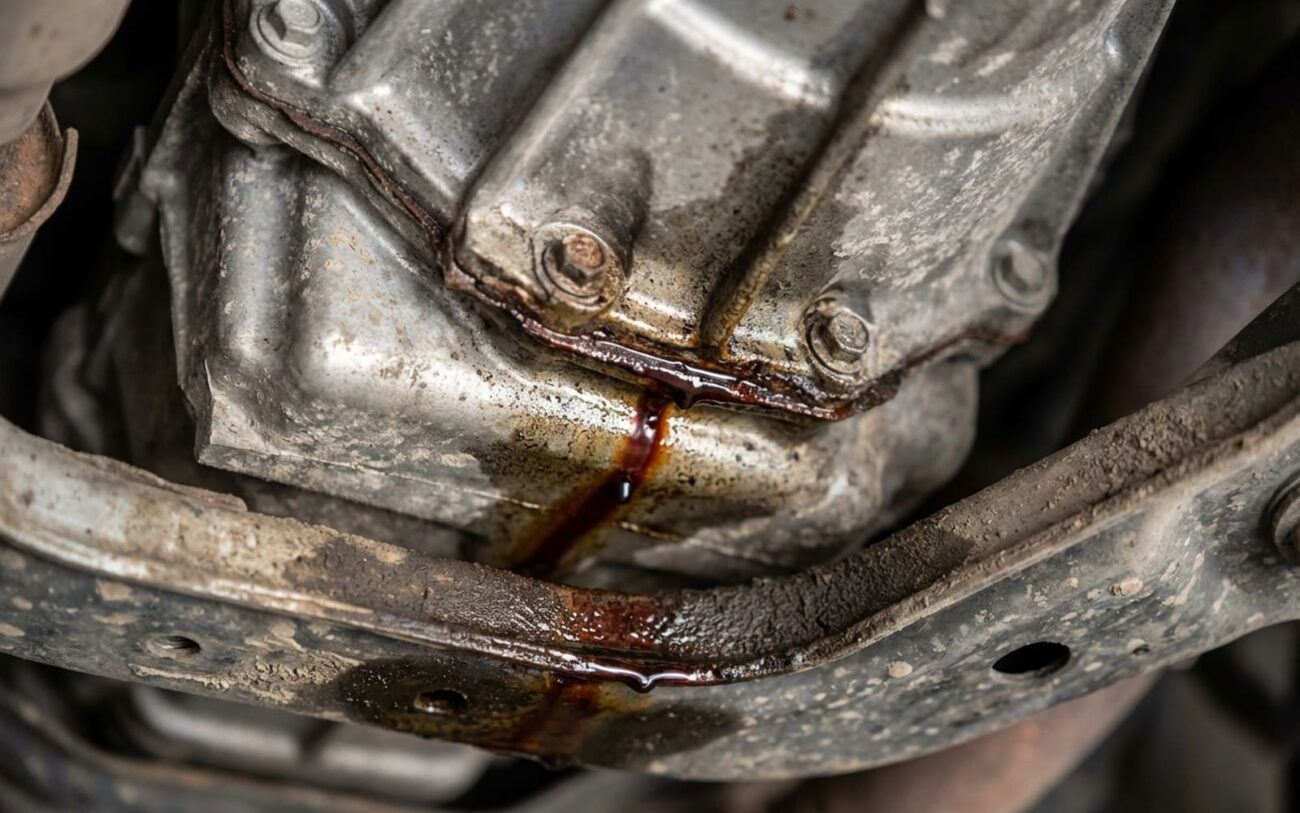
Alright, let’s talk transmission fluid leaks. I’ve been turning wrenches for over 25 years, and a leaking transmission is one of those things that can go from a minor annoyance to a major headache real fast if you don’t know what you’re looking at. Most folks panic and think “new transmission” right away, but often, it’s something much simpler. The trick is knowing how to tell the difference.
First Signs: What You’re Seeing and Feeling
You’ve got a puddle under the car, or maybe just a greasy spot on the garage floor. The first thing I always tell people to check is the fluid itself. If it’s red or reddish-brown, and it has that distinct, slightly sweet but burnt smell, you’re almost certainly looking at automatic transmission fluid (ATF). Engine oil is usually black or dark brown, and it smells different. If the leak is pooling under the middle or rear of the transmission pan, or up near the bellhousing where the transmission bolts to the engine, that’s a strong indicator it’s coming from the transmission system.
But here’s the kicker, and what really gets drivers worried: gear slippage. You hit the gas, the engine revs up, but the car just doesn’t go like it should. It might feel like the transmission “flares” between gears, where the RPMs jump before the next gear engages, or it hesitates during upshifts. This isn’t the leak itself, of course, but it’s a direct consequence. Your transmission relies on hydraulic pressure to engage clutches and bands. When that fluid leaks out, the level drops, pressure drops, and those internal components can’t hold properly. It’s like trying to lift a heavy load with a hydraulic jack that’s low on fluid — doesn’t matter how hard you pump, the car isn’t going up.
The Concept
“Think of it like a hydraulic jack: if the oil leaks out, it doesn’t matter how hard you pump the handle—the car isn’t going up.”
Sometimes, though not as common, you might even experience the transmission popping out of gear while you’re driving. You’ll be cruising along, and suddenly, you lose drive, almost like you shifted into neutral without touching the shifter. This can point to an internal hydraulic leak that bleeds pressure from the detent circuit – that’s the system that keeps the transmission locked in gear. But don’t jump to conclusions about a cracked case just yet; mechanical failures like a broken detent spring or a worn shift fork can cause the exact same behavior.
Differential Diagnosis: Is It Really the Case?
This is where my experience really comes into play. Not every leak means the transmission case itself is cracked. In fact, most leaks I see are from simpler, external sources. Misdiagnosing a worn pan gasket as a casting defect is a quick way to rack up unnecessary costs and downtime for a customer. Let’s break down how I pinpoint the true source.
Leak at the Transmission Pan
If you’re seeing fluid weeping from the middle or bottom of the pan, your first thought might be a cracked case. But usually, it’s a worn pan gasket, a warped or rusty pan flange, or simply loose pan bolts. I’ve even seen drain plugs that weren’t tightened properly. To definitively tell if it’s a case issue (like porosity or a crack in the pan rail casting), I’ll clean the area thoroughly and then apply aerosol foot powder to the dry case above the gasket line. If fluid starts to appear through the powder above where the gasket sits, then you’ve got a case problem. Otherwise, it’s likely an external seal issue.
Leak from the Bellhousing Area
This is a trickier one, because a leak here could be coming from a few places. It could be a failed front pump seal, a torque converter seal, or even an engine rear main seal (which is engine oil, but can look similar if it’s mixed with road grime). A crack in the bellhousing flange or porosity in the front pump bore casting is less common but definitely possible. For this, I use a borescope. I’ll snake it up into the bellhousing to get a direct look at the front pump and the case. If I see fluid weeping directly from the metal of the case itself, that’s a case crack. Otherwise, I’m looking at those seals.
Gear Slippage with Low Fluid
As I mentioned, slippage is a secondary symptom, a consequence of low fluid pressure. It doesn’t tell you where the fluid went, just that it’s gone. So, if you have slippage and a low fluid level, you need to find the external leak first. If the fluid level is full but you’re still getting slippage, then the problem is internal to the transmission – maybe a worn pump, a faulty valve body, or worn clutch packs. The definitive test here is a transmission pressure test. I’ll hook up a gauge and check mainline hydraulic pressures in all gears. If the pressure is low even with a full fluid level, that confirms an internal issue, not necessarily a case leak.
Why Transmission Cases Actually Fail
Once you’ve confirmed the leak is from the case casting – and not just a gasket or seal – you need to understand why. A transmission case isn’t really supposed to fail, but when it does, the causes are usually pretty predictable. It’s rarely just “bad luck.”
Important Distinction:
Leaks from the pan gasket, shaft seals (input/output), cooler line O-rings, or electrical connector seals are all external seal issues. They’re annoying, but they’re not case defects. Don’t let a shop upsell you on a new transmission because of a $20 gasket. Always get a second opinion if they jump straight to a case replacement without proper diagnosis.
Repairing a Leaking Transmission Case
This is Professional Territory Only
Repairing a transmission case defect requires specialized knowledge of metallurgy, hydraulic pressure, and precise assembly. One mistake in torque or sealant application can lead to catastrophic failure, and trust me, you don’t want that. This isn’t a DIY job for the average weekend warrior.
Minor External Porosity Professional Only
Cracks in High-Stress Areas
Internal Porosity or Cracked Fluid Passage
Emergency Epoxy Fix Last Resort Only
Post-Repair Validation: Don’t Guess
A repair isn’t done until it’s proven. Period. Guessing leads to comebacks, unhappy customers, and often, bigger failures down the road. For any external sealant repair, I make sure the vehicle goes through at least three full thermal cycles. That means cold start to operating temperature (usually 160–200°F), and then back down to ambient temperature. You need to see how that sealant holds up under expansion and contraction.
My Validation Pass Criteria
-
Zero seepage or fluorescence (if I used UV dye, which I often do) at the repair site after those three thermal cycles.
-
Smooth engagement in all gears, with absolutely no slipping, flaring, or harsh shifts during a thorough road test.
-
Mainline hydraulic pressures must be within 5% of factory specifications across all gears and RPM ranges. I check this with my pressure gauges.
Cost, Risk, and Making the Right Decision
Let’s talk money, because that’s usually the bottom line for most folks. Repairing a transmission case defect can get expensive fast, and you need to weigh the cost against the value of your vehicle.
External Sealant Repair
This is mostly labor for cleaning, disassembly, and precise application. The long-term success rate, in my experience, is often less than 50%. It’s a gamble, even when done right.
Case Replacement (Rebuild)
This involves a full transmission teardown and re-assembly into a new casting. It’s labor-intensive but has a high success rate if performed by a skilled technician.
Remanufactured Exchange Unit
This is a full transmission swap. It’s often the best option for high-mileage units or when there’s confirmed internal damage along with the case issue. You get a warranty, which is huge peace of mind.
Prevention & Monitoring
Always, and I mean always, use the manufacturer-specified ATF. The wrong fluid can lead to pressure instability, premature wear, and stress on the case. Catching a leak early often means a simple gasket or seal replacement. Just like small issues in the fuel system can escalate, a tiny transmission leak can snowball fast. Check your fluid regularly, especially if you tow or drive hard.
