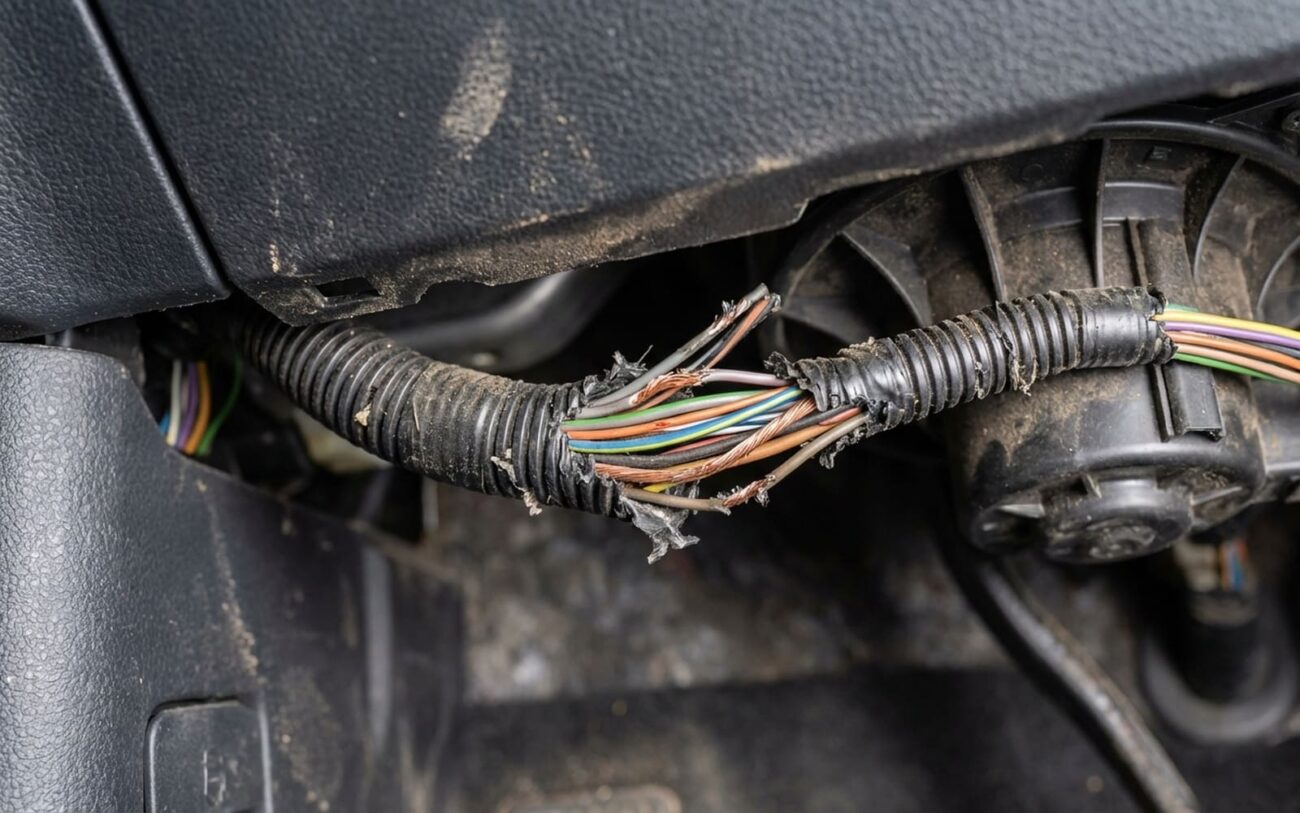
Rodent damage under the dash isn’t a “maybe”—it’s one of the most common root causes of mysterious electrical gremlins I see, especially in vehicles parked for days at a time. I’ve torn into hundreds of these harnesses over 25 years, and let me tell you: what looks like a blown module or a failed sensor is often just chewed-up wires and rat piss eating through copper. This isn’t theory—it’s what I find every week in my shop.
Symptoms That Scream Rodent Damage
If your car starts acting up after sitting—especially in colder months—and you’re seeing multiple systems fail at once, don’t jump to replacing parts. I’ve seen this a thousand times: HVAC acting weird, airbag light on, seat memory gone, maybe even the radio glitching. That’s not three separate failures. That’s a shared harness getting chewed.
The HVAC system is usually the first clue. Blower motor only works on high speed? Classic resistor circuit fault—but if the wires feeding it are damaged, no amount of resistor swaps will fix it. And when the problem comes with a musty, ammonia-like stench near the glove box? That’s rodent urine. I’ve pulled down lower dash panels and found nests made of shredded foam, insulation, and yes—droppings right next to exposed copper.
On the 2014–2018 Toyota Camrys I work on weekly, the cabin air filter housing is a direct path into the dash. Rats crawl in, chew the harness that runs alongside the ductwork, and bingo—you’ve got a $1,200 repair bill before you even know what hit you.
How I Diagnose: Cut Through the Noise
Here’s what separates the pros from the parts replacers: we test the circuit, not just the component. If the blower motor isn’t working, I don’t yank it out first. I check the power and ground at the connector. And I do a voltage drop test—under load.
If you’re seeing more than one system down—say, HVAC, SRS, and power seats—your first move is to scan for module communication. If multiple modules are offline, check the CAN bus. Measure the differential voltage between CAN-H and CAN-L at the HVAC control head. You should see 1.8–2.5V. No signal? But power and ground are good? That means the harness upstream is compromised.
And don’t forget the ground buss. I’ve found main ground points under the dash completely eaten through by urine corrosion. One Nissan I worked on had 1.8V drop from battery to BCM power pin—should’ve been under 0.2V. That’s why everything was glitching.
Oh, and if you’re seeing ADAS systems working but not displaying on the dash? That’s not a camera issue. That’s a CAN bus problem—usually tied to rodent damage in the main harness behind the glove box.
Why They Chew—and Why It Keeps Getting Worse
Rodents chew to wear down their teeth. They don’t care about your car. But they do care about warm, dry spaces—and your dash is perfect. The cabin air filter housing? It’s like a welcome mat. Once they’re in, they gnaw through insulation, build nests, and leave behind urine that eats copper like acid.
And yes—soy-based insulation is real. I’ve seen it on GM and Ford harnesses from 2010 onward. It’s biodegradable, which sounds great until you realize it’s also edible. Rats will eat the damn wires. There are TSBs on this—GM has one for the 2013–2015 Silverado where they recommend a protective sleeve for the harness near the filter housing.
Here’s the kicker: the chewed wire might just short a fuse at first. But that same short can send a voltage spike into the HVAC module and fry its logic board. Now you’ve got a secondary failure. Same goes for debris in the blower motor—rodent nesting material gets sucked in, motor seizes. That’s not a wiring issue, but it’s still rodent-related. So when you’re under there, check everything.
How I Fix It—And What Actually Works
There are four ways this goes. Pick the right one based on damage, location, and your skill level.
[DIY-FEASIBLE] Isolated Wire Repair
[PROFESSIONAL-ONLY] Section Replacement with OEM Sub-Harness Professional Only
[NON-REPAIRABLE] Full Dashboard Harness Replacement Professional Only
[TEMPORARY / LAST-RESORT] Emergency Protection Only Professional Only
Testing the Repair—Because “Looks Good” Isn’t Good Enough
After the repair, power up the circuit and run it under load. For a blower motor, set it to high and recheck voltage drop. Should be under 0.5V. If it’s higher, you’ve got resistance somewhere—maybe a bad splice.
If you replaced a harness section or fixed CAN bus wiring, scan the modules. All should be live. If the HVAC module was replaced, it needs programming. Some models—like the 2017+ Honda Accords—require a full calibration after module swaps.
And if you’re dealing with a high-risk harness—say, one near hybrid components or ADAS sensors—use a megohmmeter to test insulation resistance. You want over 100 megohms between wires. Less than that? You’ve got leakage. Fix it before it takes out another module.
Costs—And When to Walk Away
Here’s what you’re looking at:
| Repair Type | DIY Cost (Tools/Materials) | Shop Cost (Parts + Labor) | Success Rate (When Done Correctly) | Risks of Poor Repair |
|---|---|---|---|---|
| Single Wire Repair | $20–$50 | $150–$300 | Over 95% | Intermittent operation, recurring shorts, potential fire hazard if poorly insulated. |
| Harness Section Replacement | $200–$500 (part only) | $500–$1,200 | Near 100% with OEM parts | Pin misalignment, poor sealing, or incorrect routing leading to new damage. |
| Full Dash Harness Replacement | $1,500–$3,000 (part only) | $2,000–$5,000+ | Near 100% with proper installation | Interior damage during disassembly, rattles, or misconnected systems if not reassembled correctly. |
My rule? If the repair exceeds 40% of the car’s market value, walk. On a $6,000 Corolla, a $3,000 harness job makes no sense. I’ve had customers do it—then a week later, the BCM fails from residual damage. Now they’re $4,500 in the hole. Not worth it.
Prevention—Because You’ll Thank Me Later
Parking in a garage helps, but it’s not a guarantee. I’ve seen rats get in through quarter-inch gaps. Ultrasonic devices? Mixed results. Some work for a few weeks, then the rodents ignore them.
What I do? I check the cabin air filter housing every fall and spring. If I see leaves, droppings, or nesting material, I pull it out and inspect the harness. Takes 10 minutes. On a 2016 Mazda3 I service, I caught chewed insulation early—fixed it for $40 before it took out the BCM.
And if your blower motor acts up or warning lights flicker after the car’s been sitting? Don’t wait. Get under there. Early detection saves money, time, and maybe even your car from burning up.
