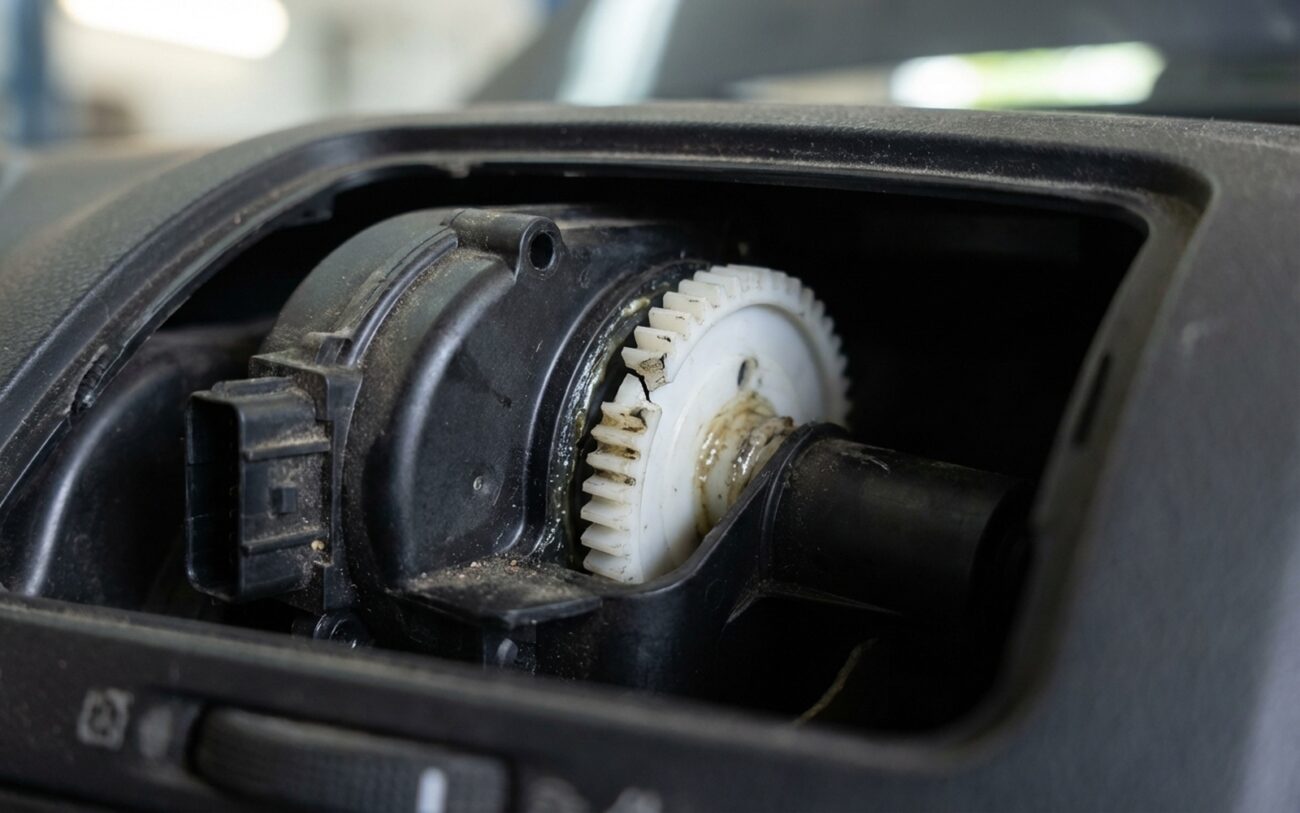
That clicking noise behind the dash? I’ve diagnosed it hundreds of times. It’s not “maybe” the recirculation actuator—90% of the time, it’s exactly that. And if you wait too long, you’re not just replacing a $120 part. You’re pulling the dash. I’ve seen cracked HVAC housings from a stripped actuator motor grinding for weeks. Don’t be that guy.
What You’re Hearing — And Why It Matters
That rhythmic click or grind when you switch to recirc mode? It’s not the blend door. Not the mode door. It’s the recirc actuator’s plastic gears stripping. The motor spins, the gears chatter, and nothing moves. I’ve taken dozens of these apart—same story: white nylon gears with teeth sheared off at the root. No surprise. They’re not steel. They weren’t meant to last 200,000 miles.
And yes, it gets worse if you ignore it. The motor keeps running, trying to position a door that won’t budge. That constant torque on a stripped gear train can crack the HVAC housing. Seen it on a 2016 Explorer—$1,200 repair instead of $180 because the owner “thought it was just a noise.”
How to Confirm It’s the Recirc Actuator — Not a Guessing Game
You can’t diagnose this by ear. I don’t care how good you think you are. Blend door actuators sound identical. Mode doors too. The only way to know? Command the recirc door independently and listen.
In my shop, I use a bi-directional scan tool—Snap-on, Autel, even a decent Foxwell NT510 will do. I send the recirc actuator open and closed while the HVAC is off. If the clicking syncs with the command, it’s confirmed. No guesswork. No wasted parts.
Don’t have a scan tool? You’re working blind. But you can still check airflow.
Real-world test: Set the fan to high, switch to recirc mode. If airflow feels weak and you hear the click, but the cabin doesn’t cool as fast, the door isn’t closing. But—(yes, this matters)—rule out a clogged cabin filter first. I’ve replaced two actuators in one week only to find the filter was packed with leaves. Embarrassing. Don’t do that.
Another solid move: remove the cabin air filter and peek into the plenum. On most Toyotas, Hondas, and Fords, you can see the recirc door edge. Use a flashlight. Cycle the mode switch. If the door doesn’t move but the actuator motor runs? Gears are gone. If the door is stuck halfway and won’t budge by hand? Then it’s not the actuator—it’s debris.
Why It Failed — And What Else Could Be Lying
Three internal failures cause 95% of recirc actuator issues:
- Stripped plastic gears: By far the most common. The gear train is molded nylon. It works fine for 100,000 miles—then the teeth start chipping. Once it starts, it’s a death spiral. I’ve seen gears with only three teeth left.
- Motor brush wear: Less common, but happens. The DC motor runs intermittently or not at all. No noise, no movement. You’ll need a multimeter to check for voltage at the connector. If the module sends power but the motor doesn’t run, it’s the actuator.
- Potentiometer failure: This internal feedback sensor tells the HVAC module where the door is. If it drifts or fails, the system thinks the door is already closed—so it never commands movement. No click, no action. You’ll need scan tool data to see position mismatch.
But—and this is critical—don’t assume the actuator is the root cause. On a 2018 Silverado I worked on, the actuator tested bad. Replaced it. Failed in two weeks. Turns out, leaves had jammed the door. The actuator wasn’t the problem—it was the victim.
Same with rodents. I’ve pulled out nests from HVAC plenums on Jeeps parked in garages. The door was bent. No actuator in the world fixes that.
Always check for mechanical binding first.
Disconnect the actuator and try moving the door shaft by hand. If it’s stiff or stuck, fix the blockage before installing a new actuator. Otherwise, you’re just wasting money.
How I Fix It — Based on Access and Damage
Replace the Actuator (If the Door Moves Freely) DIY-FEASIBLE Professional Only
This is the standard fix. On a Honda Accord or Camry? 20 minutes. Remove the glove box, unplug the actuator, three T20 screws, swap it out. Done.
But on a 2015+ F-150 or Silverado? Forget it. You’re pulling the radio, HVAC controls, center console. That’s 5–6 hours in a shop. Labor will cost more than the part.
Tools: trim tools, T20, 7mm socket, multimeter. Always disconnect the battery first. I’ve seen modules freak out if you don’t.
Key tip: when installing the new actuator, make sure the drive arm is fully seated on the door shaft before tightening. If it’s even slightly misaligned, it’ll bind and strip in a week. I rotate the shaft by hand to find the “home” position, then install.
Clear the Plenum + Replace Actuator Professional Only
If the door is jammed, you’re doing this right: remove the wiper cowl, clean out the plenum, inspect the door.
Common on trucks and SUVs parked under trees. Leaves, pine needles, acorns—sucked in every time the fan runs. I had one Cherokee with a squirrel nest deep in the duct. No actuator was moving that door.
After cleaning, test the door by hand. It should move smoothly from full open to full closed. No binding. Then install the new actuator.
Yes, it’s a big job. But skip it, and you’ll be doing it again in three weeks.
Manual Override (Emergency Only)
In a pinch, you can set the recirc door manually. Remove the cabin filter or actuator, rotate the shaft to closed (recirc) position, leave it.
You’ll stop the noise and get airflow. But you lose automatic climate control. And vibration can slowly shift the door open over time. I’ve seen it happen. It’s not a fix. It’s a band-aid.
Test It Right — Or You’ll Be Back
Don’t just bolt it on and call it good. You need to verify.
First: reconnect the scan tool. Command the recirc door open and closed 10 times. Watch the position feedback. It should track perfectly with the command. No jumps, no stalls.
Second: real-world test. Fan on high. Switch modes. In recirc, airflow should feel stronger, cabin cools faster, outside noise drops. In fresh air, you’ll hear more wind rush. That’s normal.
If the door doesn’t fully close, you’ll notice a drop in A/C efficiency. That’s usually a misaligned actuator or a bent door.
Is It Worth Fixing?
Here’s the breakdown:
| Repair Type | DIY Cost (Parts) | Shop Cost | Success Rate | Secondary Risk |
|---|---|---|---|---|
| Actuator R&R | $40 – $150 | $250 – $500 | 95%+ | Stripped housing tabs if forced |
| Actuator + Plenum Clean | $150 – $300 | $500 – $900 | 85% | Incomplete cleaning → repeat failure |
Most of the time, it’s worth it. But if the car has 180k miles, rusted frame, and a failing transmission? Maybe not. I’ve had customers spend $600 on HVAC, then junk the car three months later. Ask yourself: is this car going another 50,000 miles?
How to Keep It From Happening Again
Prevention That Actually Works
-
Change your cabin air filter on schedule. Every 15,000–30,000 miles. It’s not just for air quality—it blocks debris from entering the plenum. I see twice as many actuator failures on vehicles with neglected filters.
-
Listen early. The first few clicks are your only warning. Diagnose it then. And check for HVAC codes—U0253, B1000-series. They point to actuator communication issues. Don’t ignore them.
-
Keep the cowl clear. That’s where leaves and junk enter. Clean it out every few months if you park under trees. A $5 shop vac nozzle saves a $500 repair.
