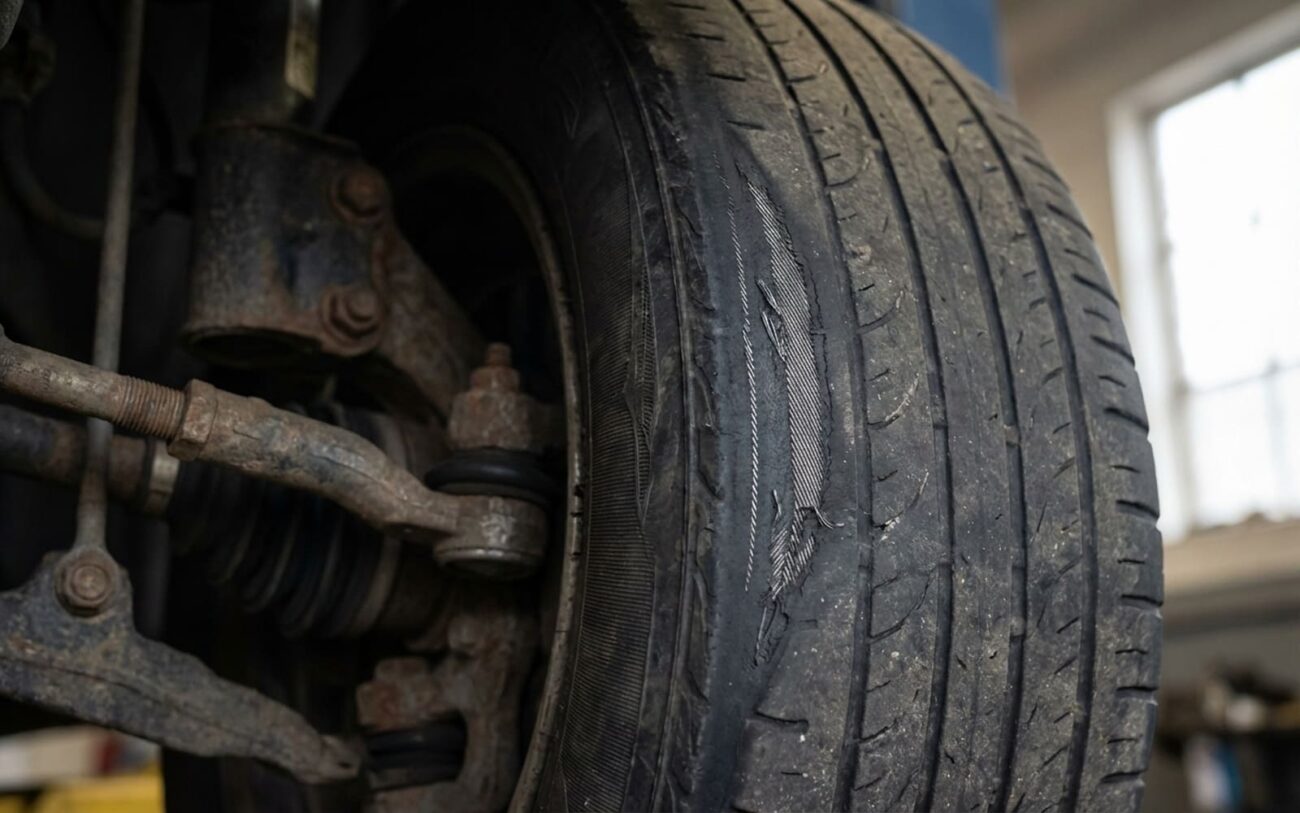
Tie Rods: The Real Story Behind That Bad Tire Wear
Listen, if you’re seeing one of your front tires chewed up on the inside or outside edge, and the rest of the tread looks fine, you’ve got a toe misalignment. And nine times out of ten, that means your tie rod end is shot. I’ve seen it a thousand times in my shop.
The tie rod is a critical link. It connects your steering rack to the steering knuckle, and its main job is to control the wheel’s toe angle – that’s whether the front of the tire points slightly in, out, or perfectly straight ahead. When that tie rod wears out, gets bent, or is just plain adjusted wrong, that toe angle goes haywire. What happens then? Your tire starts scrubbing sideways down the road as it rolls, literally grinding one shoulder down. This isn’t slow, gradual wear; I’m talking about a tire that can be bald to the steel belts in just a few thousand miles if the problem is severe enough.
So, if you spot that aggressive one-sided tire wear, or if your steering feels loose or sloppy, you need to stop driving and get it checked. This isn’t a “wait and see” situation; it’s a safety issue.
How I Confirm It’s the Tie Rod (And Rule Out Other Stuff)
It’s easy to point the finger at the tie rod right away, especially with that tire wear. But here’s the deal: a lot of other suspension or steering problems can act just like a bad tie rod. Jumping to conclusions usually means you’re replacing parts you don’t need, and you’ll still have the original problem. I’ve seen bent control arms, damaged knuckles, even a dragging brake caliper cause pulling or uneven wear that looks exactly like a toe issue. You need a systematic approach to find the real culprit.
The Go-To Test: Checking for Play
This is my first step in the shop. With the vehicle lifted and the wheel off the ground, grab the tire firmly at the 3 o’clock and 9 o’clock positions. Now, try to rock it side to side, pushing with one hand and pulling with the other. If you feel any clunking, looseness, or movement, that’s almost always a worn tie rod end. That’s your definitive test for tie rod play.
What Other Symptoms Mean (And How I Check Them)
-
Vehicle Pulls to One Side: If the car constantly wants to drift left or right, it could be an asymmetric toe setting caused by a bent or improperly adjusted tie rod. But don’t stop there. I always check for brake drag first – just spin the wheel by hand and listen. If that’s clear, I’ll swap the front tires side-to-side. If the pull switches, it’s the tire (what we call ‘conicity’). If it doesn’t, then I’m looking at alignment issues like uneven camber or caster, or yes, a tie rod.
-
Steering Wheel is Off-Center: This usually means the tie rods are unevenly adjusted. It’s common after an alignment if the technician didn’t center the steering wheel before setting the toe, or after a repair where the tie rod length wasn’t matched. It could also be a problem with the steering rack itself not being centered, or a damaged steering column coupler. An alignment rack will quickly tell you if the toe readings are uneven but the car tracks straight – that points to unbalanced tie rod adjustment.
-
Uneven Wear on Inner or Outer Tread Edge (Beyond Tie Rods): While this is the classic tie rod symptom, don’t forget other possibilities. I’ve seen bent steering knuckles, worn control arm bushings, collapsed struts, or even a misaligned subframe cause similar wear patterns. That’s why the ‘3 and 9 o’clock’ test is so important to isolate the tie rod itself.
Why Tie Rods Give Up the Ghost: Wear, Damage, and Rust
Tie rods fail for pretty predictable reasons. Most of it comes down to basic mechanics or Mother Nature. The outer tie rod end is a ball-and-socket joint, just like your shoulder, and it’s constantly pivoting with every little steering input. Over time, that internal bearing wears down, and the spring-loaded seal that keeps grease in and dirt out starts to lose its tension. When that happens, you get play – what we mechanics call “slop.” That tiny bit of movement is all it takes for the toe angle to shift around as you drive, leading to that rapid, uneven tire wear.
The Mechanic’s Nightmare
“Corrosion is a major killer, especially up here in the rust belt. That threaded adjuster sleeve can seize solid, making future alignment adjustments nearly impossible without cutting it off and replacing everything.”
Impact damage is another huge one. Hitting a nasty pothole or curb can easily bend the tie rod shaft itself, instantly throwing off your alignment. And while it’s not common, I’ve seen manufacturing defects – like a poorly pressed ball stud – lead to a joint separating way too early. That’s a scary one.
Inner vs. Outer Tie Rods: What’s the Difference?
The outer tie rod end connects to your wheel’s steering knuckle. The inner tie rod connects to the steering rack itself, usually hidden behind a boot. Both can wear out. The outer one is easier to spot with that 3-and-9 o’clock wiggle test. Inner tie rod wear often goes unnoticed until you’re on the alignment rack or doing a deeper inspection. If I’m replacing one, especially if the boots are torn or the inner feels loose with a pry bar, I usually recommend replacing both the inner and outer as a set on that side. It just makes sense for longevity and peace of mind.
Fixing It: When You Can DIY, When You Need a Pro
Safety First, Always.
Let me be clear: never try to straighten a bent tie rod. It’s made from hardened steel, and bending it just once weakens the metal significantly, setting you up for a catastrophic failure down the road. Always replace a bent tie rod with a brand new, quality component.
Standard Tie Rod Replacement DIY-FEASIBLE
Seized Adjusters or Inner Tie Rods PROFESSIONAL-ONLY
“Emergency” Fixes TEMPORARY / UNSAFE
You Replaced It, Now What? Validating the Repair
Replacing the tie rod is only half the battle, trust me. The real work, and the safety check, happens after you’ve bolted everything back together. First, with the car still lifted and the wheel off the ground, do that mechanical inspection again. Grab the tire at 3 and 9 o’clock and rock it side to side. There should be zero play. Any clunk or movement means something isn’t tightened properly, or you’ve got another worn component you missed. Double-check your work.
This Step Is Non-Negotiable. Seriously.
A professional front-end alignment is mandatory. I can’t stress this enough. Replacing a tie rod completely throws off your toe setting. You must get the total toe brought back into factory specifications – usually somewhere around 0 to +0.20 degrees toe-in for most vehicles. Without it, you’ll be right back where you started, replacing those expensive tires again in no time. Don’t skip the alignment.
What to Expect: Tie Rod Replacement Cost
Alright, let’s talk money. Here’s a rough breakdown of what you’re looking at:
-
One Outer Tie Rod End + Alignment: If you’re doing this yourself, parts will run you about $40 to $120. If you take it to a shop, expect to pay anywhere from $200 to $400, which includes parts, labor, and the alignment. The main risk here is still that joint separating and losing steering control.
-
Both Outer/Inner Tie Rods (especially if seized) + Alignment: For the DIYer, parts might be $150 to $300. For a professional job, you’re looking at $500 to $900. This is a more complex job, and the risk of damaging the steering rack during inner tie rod replacement is higher if not done correctly.
And don’t forget the tires! One severely worn tire often means you need to replace at least that one, and ideally a pair on the same axle to keep handling balanced. Factor in another $150 to $300+ for tires, depending on what your vehicle needs.
Keeping Your Steering Tight: Prevention Tips
My Maintenance Checklist
-
Check those boots at every oil change. If you see a split or grease leaking out, that’s a red flag. Contaminants are getting in, and the joint’s life is now on borrowed time.
-
Listen for clues. A faint clunking sound when you’re turning at low speeds, especially pulling into a parking spot, can often be an early sign of tie rod wear. Don’t dismiss it.
-
Feel your tires for “feathering.” Run your hand across the tread. If it feels sharp in one direction and smooth in the other, your toe is out of alignment. That’s a sign something in your steering or suspension needs attention.
-
Avoid potholes and curbs. I know, easier said than done, but impact damage is a huge reason for premature tie rod failure.
Sometimes, what looks like a tie rod issue is actually something else in your suspension. For example, worn shock absorber bushings can cause premature tire wear, too. Or if your car looks like it’s squatting, it might not be alignment at all; you could have sagging springs. It’s all connected down there.
