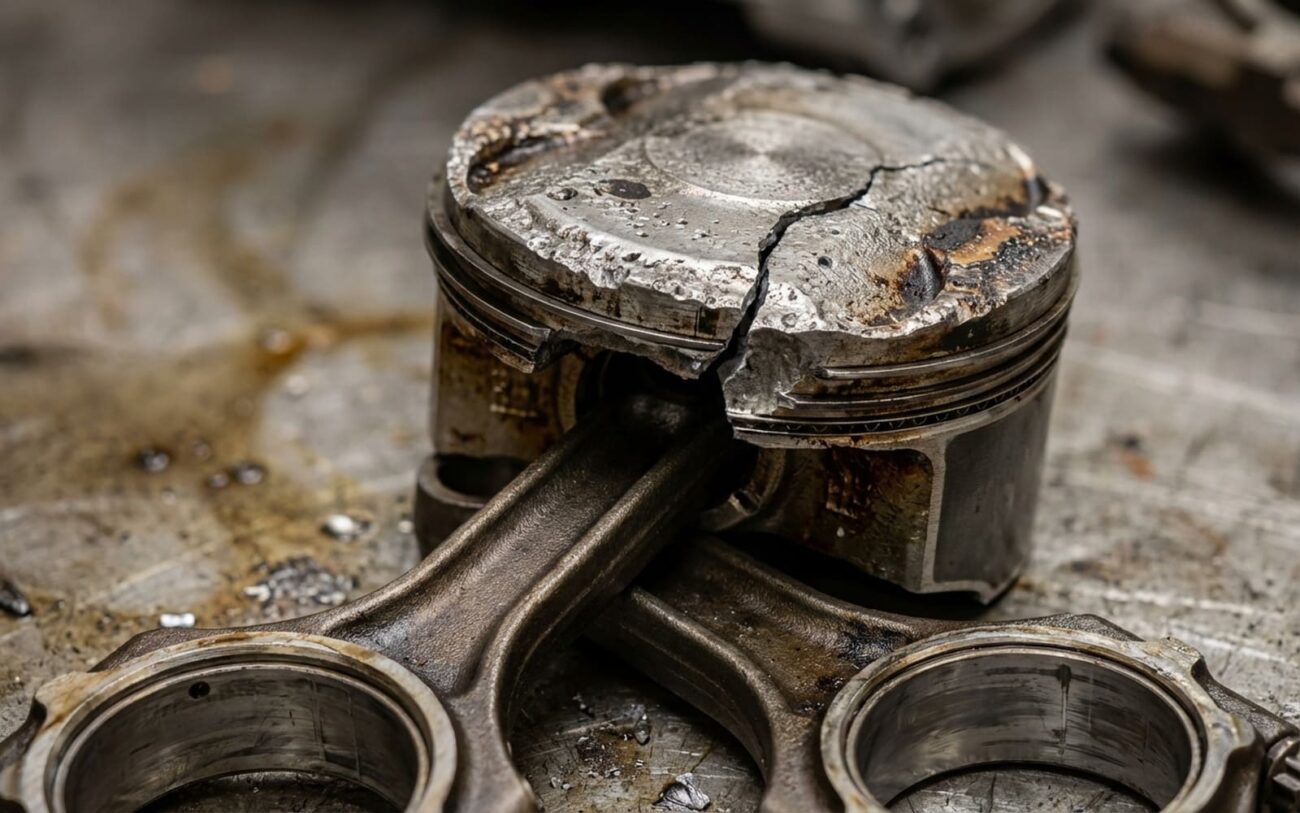
Listen up, because this is one of those sounds that can quickly turn a minor worry into a major engine rebuild. When you hear that metallic pinging, that distinct rattling like a can of marbles under the hood, especially when you’re accelerating hard, climbing a hill, or just putting the engine under a good load – that’s not just background noise. That’s detonation, and it’s your engine screaming for help.
The Concept
“Think of it this way: normal combustion is a firm, steady push on the piston. Detonation? That’s like hitting it with a sledgehammer.”
That sledgehammer effect is a violent, uncontrolled explosion inside your cylinder, happening after the spark plug has already fired. It creates supersonic pressure waves that just hammer away at your piston crown, the ring lands, and even the cylinder walls. I’ve seen engines where this repeated abuse literally fatigues the metal, causing micro-cracks, erosion, and eventually, catastrophic mechanical failure.
At first, you might only hear it occasionally, maybe just on a hot day or when you floor it. Consider that your only warning shot. If you ignore it, the damage is progressive. You’ll start losing power, get misfires, and then, eventually, that deep, rhythmic knocking from the bottom end of the engine. And trust me, that’s not just “piston slap” anymore; that’s a rod bearing or a connecting rod on its last legs, about to give up entirely. I’ve pulled engines apart where the top ring land was completely sheared off the piston, leaving the ring free to just chew up the cylinder wall. If you ever get a borescope in there and see cratering or melting on the piston, the damage is already severe.
Is That Knock Really a Piston, Or Something Else Sneaky?
Now, not every knock you hear means your pistons are about to go on vacation. A lot of other issues can mimic serious internal engine damage, and I’ve seen too many people (and even some less experienced techs) throw parts at a problem without truly diagnosing it. That’s just wasted time and money. The trick is to isolate the source with targeted testing, not just guess and hope.
| What You’re Hearing | The Nasty Internal Culprit | Common Imposters | My Go-To Definitive Test |
|---|---|---|---|
| Metallic pinging/rattling under load | Detonation causing piston erosion, ring land damage, or rod bearing fatigue. | Pre-ignition (different beast, same destruction), heavy carbon knock, or just plain old low-octane fuel. |
An in-cylinder pressure transducer test. Detonation shows up as sharp pressure spikes after the normal peak combustion pressure. It’s unmistakable. |
| Deep, rhythmic metallic knock (RPM dependent) | A failing rod bearing or a broken piston pin. This is serious. | Worn main bearings, a loose flexplate (on automatics), or even an accessory drive issue. |
Disable one cylinder at a time (pull the coil or injector, safely). If the knock stops or changes significantly, you’ve found your cylinder. Then it’s time for a tear-down. |
| Misfire with low compression | Cracked piston, completely seized rings, or a hole in the piston. | Burnt valve, blown head gasket, or a camshaft issue. |
A cylinder leak-down test is your best friend here. If air rushes out the oil filler cap, you’ve got a piston or ring issue. If it’s coming out the exhaust, it’s an exhaust valve. Radiator? Head gasket. |
| Excessive oil consumption (with or without smoke) | Damaged piston rings, a cracked oil ring land, or a broken piston skirt. | Bad valve stem seals, a clogged PCV system, or even a turbocharger issue. |
Start with a borescope inspection to look for visible damage. Follow up with a “wet” vs. “dry” compression test. If the wet test shows a significant improvement, it points to ring issues. |
Don’t skip these tests. I’ve seen guys pull an engine thinking it was a rod bearing, only to find a loose flexplate bolt. Or worse, replace pistons when it was a burnt valve. Diagnostic time is never wasted time.
How Detonation Actually Wrecks Your Engine Internals
Let’s be clear: detonation isn’t just a bad noise; it’s a destructive force that generates pressures far beyond what your engine was designed to handle. Normally, when your spark plug fires, a controlled flame front expands smoothly across the combustion chamber. But with detonation, the remaining air-fuel mixture, often superheated and under too much pressure, spontaneously explodes instead of burning. It’s like a second, uncontrolled ignition event, and it’s incredibly violent.
The piston crown is usually the first victim, especially on aluminum pistons. That repeated “sledgehammer” effect causes pitting and erosion. Over time, these turn into microcracks. The most vulnerable spot I see is the top ring land—that thin section of piston material between the first and second ring grooves. Once that cracks, the top compression ring loses its support, sealing goes out the window, and your compression drops like a rock. I’ve torn down engines where the ring land was completely gone, sheared right off, allowing the ring to just flop around and score the cylinder wall. That’s when you start seeing blue smoke out the exhaust from oil getting past those damaged rings.
Some Engines Are Just More Prone:
In my experience, some engine designs are just more susceptible to this kind of damage. For instance, certain LS-series V8s, especially when modified or pushed hard, are known for ring land cracking under sustained detonation. Similarly, I’ve seen plenty of Ford 4.6L 3V engines come in with piston skirt failures, often linked to persistent cold-start pinging that was ignored. It’s not always a design flaw, but sometimes a particular setup just doesn’t tolerate abuse as well.
So, You’ve Got Damage. What’s the Fix?
No Shortcuts Allowed, Period.
Let me be absolutely clear here: once a piston is cracked, a ring land is broken, or a rod bearing is spun, there’s no magic bullet. No additive, no fuel system cleaner, no ECU reset, and no software tweak is going to fix physical damage. The engine has to come apart. The repair path depends entirely on what we find once we get inside.
The “Caught It Early” Top-End Rebuild
The Full Engine Rebuild (Or Worse)
Okay, It’s Rebuilt. Now, Did It Actually Work?
Just because a rebuilt engine fires up doesn’t mean the job’s done. I’ve seen too many engines leave the shop only to come back with issues because the tech didn’t properly validate the repair. You need to confirm the performance, sealing, and overall combustion health before you can call it a true success.
-
Pre-Installation Leak-Down Test: This is non-negotiable. Before that engine goes back in the car, perform a leak-down test on every cylinder. If any cylinder is leaking more than 10%, you’ve got a problem with your rings, valves, or head gasket that needs to be addressed immediately. It’s far easier to fix it on the stand.
-
Monitor Oil Consumption: After the initial break-in period (I usually tell customers 2,500 to 3,000 miles, but check your manufacturer’s specs), the engine should be using less than a quart of oil every 1,000 miles. If it’s drinking oil, you’ve got sealing issues somewhere.
-
Live Data Monitoring (Post Break-in): Get your scan tool out and watch the knock sensor activity under various loads. You shouldn’t see the ECU pulling timing aggressively (more than 3–5 degrees under load) to prevent detonation. If it is, the underlying cause of the original detonation hasn’t been fixed, or there’s a new issue.
The Hardest Part: Do You Fix It, Or Walk Away?
This is where I often have the toughest conversations with my customers. Once we’ve diagnosed the damage, the big question is always: “Is it worth fixing?” You’ve got options, but none of them are cheap, and you need to weigh the cost against the vehicle’s value and your long-term plans for it.
| Repair Type | DIY Cost (Parts Only) | Shop Cost (Parts & Labor) | Typical Success Rate | Key Secondary Risk |
|---|---|---|---|---|
| Top-end rebuild | $800 – $2000 | $2500 – $4000 | High, if done right. | Rapid oil consumption if cylinder walls aren’t perfectly round or honed correctly. |
| Full engine rebuild | $2000 – $5000 | $4500 – $8000+ | High, with a reputable machine shop and careful assembly. | Assembly errors like incorrect bearing clearances or improper torquing. |
| Used engine swap | $1500 – $3000 | $3000 – $5000 | Moderate. It’s a gamble. | Unknown wear, potential for mismatched electronics, or inheriting someone else’s problems. |
| New OEM engine | $5000 – $15k+ | $7000 – $20k+ | Very High. It’s the “reset button.” | Minimal, usually covered by a manufacturer’s warranty. This is the most expensive but often the most reliable option. |
My Rule of Thumb:
Here’s what I tell my customers: if the estimated repair cost is going to exceed 60% of the car’s current private-party value, it’s usually time to seriously consider replacing the vehicle. Putting $8,000 into a car that’s only worth $6,000 just doesn’t make financial sense in the long run. It’s a tough pill to swallow, but sometimes it’s the right call.
How To Keep This From Ever Happening To You
Look, an ounce of prevention is worth a pound of cure, especially when the “cure” is a new engine. Detonation almost always starts with something preventable: using the wrong octane fuel, excessive carbon buildup in the combustion chamber, incorrect ignition timing, or a failing sensor that’s supposed to protect your engine.
My Proactive Maintenance Checklist:
1. Use the Right Fuel: Always, always use the octane rating recommended by your manufacturer. If it says premium, use premium. Don’t cheap out; it’s not worth the risk.
2. Keep it Clean: On direct-injection engines, periodic intake valve cleaning is crucial to prevent carbon hot spots that can cause pre-ignition and detonation. I’ve seen too many DI engines suffer because this was ignored.
3. Address Check Engine Lights Immediately: If you get a check engine light related to fuel trim, misfires, or especially knock sensors, don’t put it off. That knock sensor system is the only thing protecting your pistons from self-destruction. Get it diagnosed and fixed.
4. Regular Tune-ups: Replace spark plugs at the recommended intervals. When you pull them, inspect them carefully. Melted electrodes, white specks, or unusual deposits are all early warning signs of destructive combustion. Catch it then, and you might just save your engine.
Ultimately, listen to your engine. A light pinging under throttle is different from a hard detonation under load, but both are warnings. Pay attention to what your car is telling you. Early detection is your best defense against a very expensive repair.
