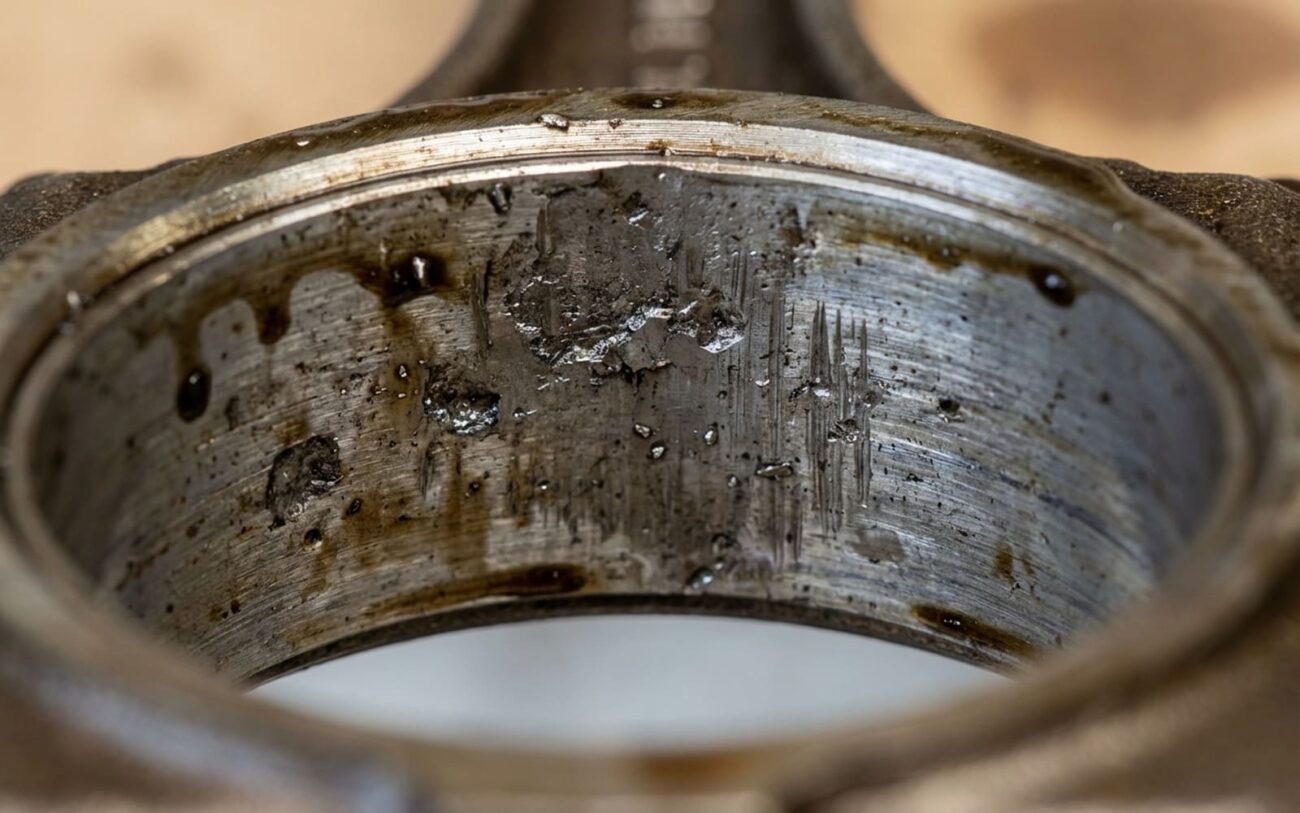
That Dreaded Sound: What Rod Knock Really Means
Alright, let’s talk about rod knock. If you’re hearing that deep, rhythmic thumping coming from your engine, especially when it’s idling or under a light load – say, gently accelerating from a stop – you’ve probably got a rod knock. And trust me, after 25+ years under the hood, I can tell you it’s one of the worst sounds an engine can make.
This isn’t just some “engine noise” that’ll go away. This is metal-on-metal, a connecting rod bearing failing in real-time. It’ll get louder with RPMs, often described like someone hitting the block with a small hammer. Unlike a piston slap, which usually quiets down when things warm up, a rod knock often gets worse as the engine heats up.
What’s actually happening is that the clearance between the connecting rod bearing and the crankshaft journal has opened up too much. As the piston reaches top dead center on the compression stroke, the rod literally whips around and slams into the crank. That’s the knock. Once that starts, your engine’s on borrowed time. I’ve seen some go for a few days with a mild knock, others grenade in minutes. There’s no telling how long it’ll last, but it won’t be long.
How I Confirm a Rod Knock (And Rule Out Other Noises)
So, you’ve got a knock. But how do you know it’s a rod and not something else? Because there are plenty of noises that can fool you. After decades, I’ve got a routine for this. First, the knock itself. It’s usually a deeper, more hollow sound than a valve tap or a timing chain rattle. But that’s just the start. The real tell-tale signs are often found elsewhere:
Low Oil Pressure
This is almost always present, especially at idle. Those worn bearings open up big gaps, and oil just bleeds right out of them before it can get to where it needs to go. You might see your oil pressure light flicker, or even stay on once the engine’s hot. Don’t just assume it’s a bad sensor – that’s a rookie mistake. Get a mechanical gauge on there and verify the actual pressure at the engine’s oil pressure sender port. True low pressure confirms internal leakage.
Metallic Debris in the Oil
This is a huge red flag. Pull your dipstick in good light; if you see a silvery, glittery sheen, that’s bearing material being ground away. Even better, drain the oil and check your drain plug. If it’s magnetic, you’ll often find flakes stuck to it. And when you change the oil filter, cut it open. If you see metallic “confetti” trapped in the pleats, that’s almost certainly bearing material. While other things like cam lobes or turbos can shed metal, with a knock and low pressure, it’s usually the rod bearings. This isn’t normal wear; this is active destruction.
Pinpointing the Noise with a Stethoscope
A mechanic’s stethoscope is your best friend here. Place it along the lower engine block, down near the oil pan rail. You’ll find the loudest point right over the cylinder with the bad bearing. On an inline engine, that’s typically cylinders 2 through 5. On a V-engine, you’ll need to check both banks. Just make sure you’re not putting it on an accessory like the alternator or AC compressor; those can transmit false sounds.
Cylinder Deactivation Test
If your scan tool has the capability, you can try cutting fuel to one cylinder at a time. If the knock significantly diminishes when you disable a specific cylinder, you’ve found your culprit. That takes the load off the rod bearing, and the noise backs off.
Oil Analysis
For the absolute definitive proof, send an oil sample to a lab like Blackstone. Their report will show elevated levels of copper, lead, tin, or aluminum – those are the metals used in bearing alloys. It’s like a blood test for your engine, telling you exactly what’s wearing out inside.
| Symptom | Likely in Rod Bearing Assembly | Common External Mimics | Definitive Test to Confirm Source |
|---|---|---|---|
| Deep knock synchronized with RPM | Excessive rod bearing clearance causing impact during combustion cycle | Main bearing knock (usually deeper, more centralized), piston slap (fades when warm), wrist pin knock, timing chain slap, accessory bearing failure |
Stethoscope/Mechanic’s Ear Test: Sound peaks near oil pan rail adjacent to suspect cylinder. Cylinder Deactivation Test: Disabling fuel to one cylinder reduces knock severity. |
| Low oil pressure at idle | Oil bleeding through enlarged bearing clearances, especially rod or main bearings | Failed oil pump, clogged oil pickup screen, stuck pressure relief valve, faulty oil pressure sensor |
Mechanical Gauge Test: Verify actual pressure at engine port. If low, inspect oil filter contents for metallic particles. |
| Metallic debris in oil or filter | Worn bearing material (babbitt, copper-lead, aluminum-based alloys) shedding into oil | Camshaft lobe wear, timing chain guide debris, turbocharger bearing failure, gear train wear |
Oil Analysis: Lab results show elevated copper, lead, or tin. Borescope Inspection: Visually inspect surfaces with oil pan removed. |
What Actually Kills Rod Bearings?
Now, why does this happen? The bearing itself is almost always the victim, not the cause. It’s a thin shell designed to float on a microscopic film of oil, keeping the hard steel crankshaft from grinding against the softer bearing material. When that oil film breaks down, you get metal-on-metal contact, and that’s when the trouble starts.
In my experience, the biggest culprit is oil starvation. This can be from:
- Low Oil Level: Simple neglect, or a leak you haven’t caught. Running low on oil is a fast track to bearing failure.
- Clogged Oil Pickup Screen: Sludge or debris in the pan can block the screen, starving the pump. I’ve seen this often on engines with extended oil change intervals or poor maintenance.
- Failing Oil Pump: Sometimes the pump just gives up, or its internal clearances wear out.
Other major factors include:
- Wrong Oil Viscosity: Using oil that’s too thin, especially in hot conditions, can compromise that critical oil film.
- Contamination: Dirt, metal shavings from a previous repair, or even coolant getting into the oil. Coolant is particularly nasty; it forms acids that corrode the bearing material and turns your oil into sludge. If you’ve ever seen milky oil, you know what I’m talking about.
- Overheating: Excessive heat breaks down oil quickly and can warp engine components, which changes clearances and stresses the bearings.
- Assembly Errors: This is rarer, but it happens. Improperly torqued rod bolts, or reusing old, stretched torque-to-yield fasteners, can lead to a bearing spinning or failing prematurely. I always tell my apprentices: follow those torque specs exactly.
Your Repair Options: The Hard Truths
This Isn’t a DIY for Beginners
Let’s be clear: there’s no magic additive or thicker oil that’s going to “fix” a rod knock. Anyone who tells you that is selling snake oil. Once that metal-on-metal contact starts, the damage is done. Your repair options depend entirely on how bad the damage is, and frankly, your budget. This is not a DIY job for the faint of heart, or for someone without serious engine experience, proper tools, and a spotlessly clean workspace. You’re dealing with engine internals, and precision matters more than almost anywhere else.
Single Bearing Replacement (In-Chassis)
Full Engine Rebuild
Engine Replacement (Remanufactured or Used)
Financial Reality Check
Before you even think about which repair path to take, you need a financial reality check. I tell every customer: compare the repair quote to your vehicle’s current market value in “Good” condition. If the repair bill is going to be more than, say, 60% of what the car is actually worth – especially if it’s an older vehicle under $10,000 – then you really need to consider if it’s worth it. Sometimes, cutting your losses and putting that money towards a different car, or a remanufactured engine with a warranty, just makes more sense in the long run.
| Repair Type | DIY Cost (Parts) | Shop Cost (Est.) | Success Rate | Secondary Risk if Failed |
|---|---|---|---|---|
| Single Bearing Replace | $100 – $300 | $1,500 – $2,500 | 80% | Catastrophic engine failure due to leftover debris or unresolved root cause. |
| Full Engine Rebuild | $2,000 – $4,000 | $5,000 – $8,000+ | 95% | Repeat failure due to improper machining or incorrect bearing clearance. |
| Remanufactured Long Block | $3,000 – $6,000 | $7,000 – $12,000+ | 98% | Minimal risk; typically backed by a 3-year/unlimited-mile warranty. |
| Used Engine Install | $1,500 – $4,000 | $5,000 – $9,000 | 50–80% | Unknown wear history. Possible imminent failure due to prior abuse. |
The 80% success rate for single bearing replacement assumes: the crank is undamaged, all debris is removed, the root cause (oil pump, pickup screen, etc.) is corrected, and proper assembly procedures are followed. If any of these are missed, failure is likely within weeks.
How to Know the Repair Actually Worked
So, you’ve done the work, or had it done. How do you know it actually worked? First off, on startup, that engine better be silent. No knock at idle, no knock under load, no knock on acceleration. Use your stethoscope again to confirm the noise is completely gone.
Next, immediately verify your oil pressure with a mechanical gauge. It absolutely has to meet factory specifications at both hot idle and at 2,000 RPM. If it doesn’t, something is still wrong.
For a full rebuild or a new engine, follow the manufacturer’s break-in procedure to the letter. That usually means avoiding heavy loads or high RPMs for the first 500 miles or so. Then, change the oil early – around 500 to 1,000 miles – and send another sample off for oil analysis. You want to see those copper, lead, and tin levels drop dramatically compared to your pre-repair results. That’s your proof that the bearing wear has stopped. And keep an eye out for blue smoke on startup or acceleration; that could mean scored cylinder walls, which is a whole other problem.
Preventing Rod Knock: My Best Advice
Protect That Oil Film!
-
Oil Changes, On Time, Every Time: Use the correct viscosity and quality oil specified by the manufacturer. No exceptions. If you do a lot of short trips, heavy towing, or live in extreme temps, follow the “severe service” schedule – it’s there for a reason.
-
Check Your Oil Level Monthly: Seriously, just do it. Low oil is probably the fastest way to kill an engine. Top it off if it’s down.
-
Don’t Ignore Contamination: If you see milky oil on your dipstick, or white smoke from the exhaust that smells sweet (like coolant), stop driving immediately. Coolant in the oil is a death sentence for bearings.
-
Inspect Your Oil Filter: Every time you change the oil, cut open the old filter. Look at the media. If you see any flakes, glitter, or shiny bits, that’s internal wear. Investigate it before it turns into a knock.
-
Listen to Your Engine: Any new ticking, knocking, or changes in oil pressure (even just a flickering light) needs immediate attention. Grab that stethoscope, check the pressure mechanically, and act early.
