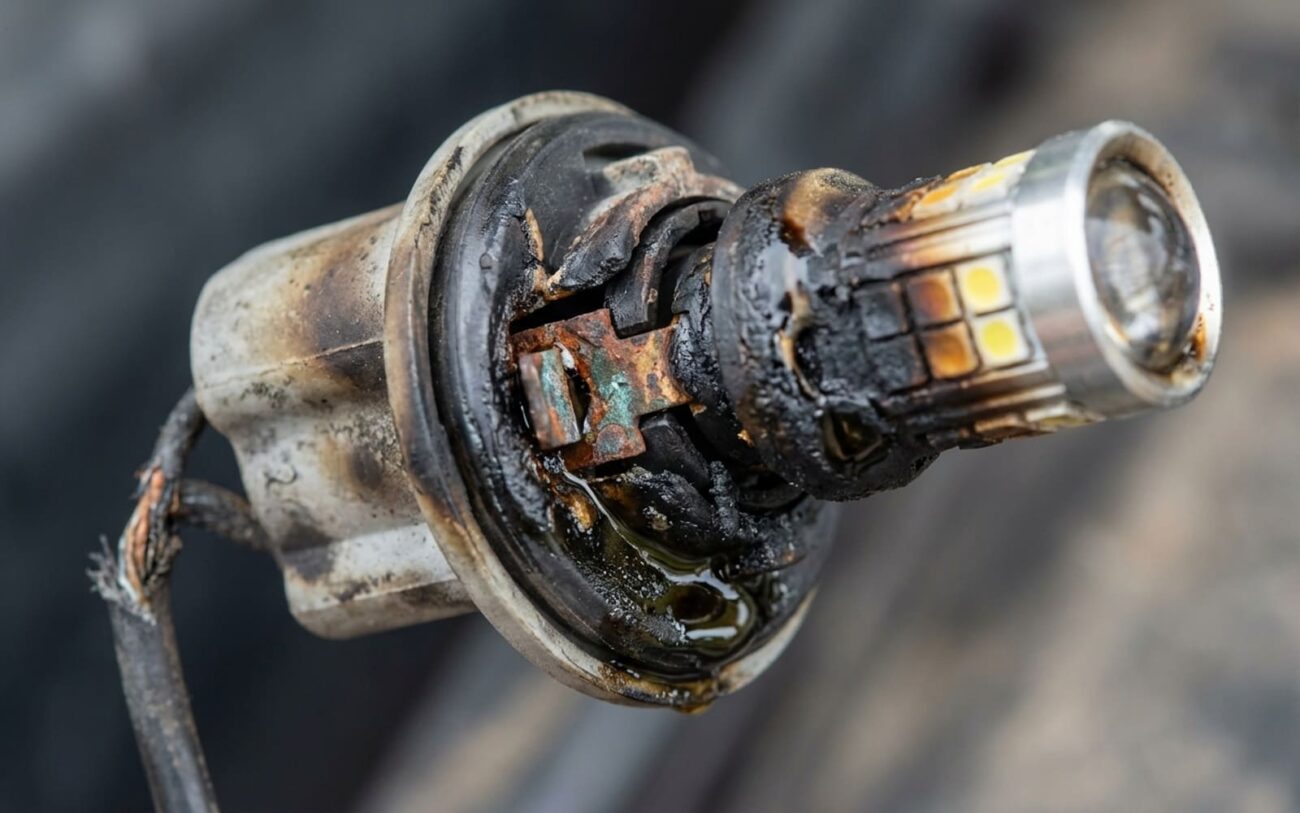
You swapped in LED bulbs, and now your turn signals are strobing like a disco ball. I’ve seen this a thousand times—especially on older trucks and SUVs where owners upgrade for style or longevity. Let me cut through the noise: this isn’t a “fault” in the usual sense. It’s physics meeting legacy electronics. The car thinks a bulb’s burned out because the current draw dropped too low. And it’s screaming at you with that rapid blink. We fix this every week in my shop. Here’s exactly how.
What’s really happening: it’s not the bulb, it’s the math
A stock 1157 halogen draws about 2.1 amps. Your new LED? Maybe 0.2 amps. That’s less than 10% of the original load. The body control module (BCM) doesn’t know you upgraded—it just sees a circuit that’s gone quiet. So it defaults to “bulb out” mode and kicks the flash rate up to 120+ times per minute. That’s DOT non-compliant and dangerous. But again: nothing’s broken. The system is working exactly as designed.
I’ve had customers come in convinced they got a “bad” LED because only one side hyperflashes. So we swap the bulb to the other side. If the problem moves, yeah—it could be a faulty internal resistor or poor build. But 9 times out of 10? The bulb’s fine. The system just wasn’t built for LEDs.
How to confirm it’s a load issue (not wiring, not a bad ground)
Before you start bolting on resistors or chasing ghosts, verify the root cause. Grab a digital multimeter. Set it to measure DC current. Break the circuit—yes, you have to disconnect the harness—and put the meter in series. Turn on the signal and watch the reading.
If you’re seeing 0.1 to 0.3A, that’s normal for an LED. That’s your confirmation. The BCM is reacting to real, expected efficiency. No need to dig into wiring diagrams or replace flasher relays. But if the current is erratic or near zero? Then you’ve got a bad connection, corroded socket, or internal break in the LED’s driver. That’s when you start wiggling wires and inspecting terminals.
| Symptom | Likely Cause | How to Verify |
|---|---|---|
| Hyperflash on one side | Low load or defective LED |
Swap the LED to the opposite side. If the hyperflash follows, the bulb is either defective or just too efficient. If it stays, check socket and ground. |
| Hyperflash on all signals | System-wide low load |
Reinstall one halogen bulb. If the flash rate returns to normal on that side, you’ve confirmed the load mismatch. |
| Intermittent flashing | Loose connection or failing LED driver |
Monitor current while wiggling the harness. Fluctuations mean a physical fault—bad socket, broken wire, or failing solder joint in the bulb. |
How we fix it in the shop (three real-world approaches)
Install load resistors (full LED conversions) Professional Only
Warning: These resistors run over 300°F. I’ve seen them melt harnesses when mounted on plastic inner fenders. Always bolt them to bare metal—chassis or frame works best. Use the included bracket. And if you’re routing near ABS lines or fuel lines? Wrap them in heat sleeve. I don’t skip this step. Not worth the risk.
Use CANBUS-compatible LED bulbs (single or partial upgrades) Professional Only
But “CANBUS” doesn’t mean “works on everything.” On a 2013 Toyota Camry, I’ve had them work perfectly. On a 2008 BMW 328i? Same bulb, same install—still hyperflashed. So check compatibility. And if it doesn’t work, don’t waste time arguing with the seller. Move to resistors.
Reprogram the BCM (cleanest fix, if available) Professional Only
But it’s not magic. Older BCMs can’t be reprogrammed. And the software subscriptions are expensive—so not every shop offers it. I’ll call the dealer first to ask if the TSB exists. If not, we go mechanical.
Bottom line: hyperflashing is a symptom of efficiency, not failure. Diagnose it like one. Test the current. Confirm the load. Then pick the fix that fits your vehicle and skill level. And if you’re not comfortable running wires or flashing modules? Bring it to a shop that knows the difference between a hack and a real repair.
