AC Blowing Weak and Smelling Like a Swamp? Let’s Fix It
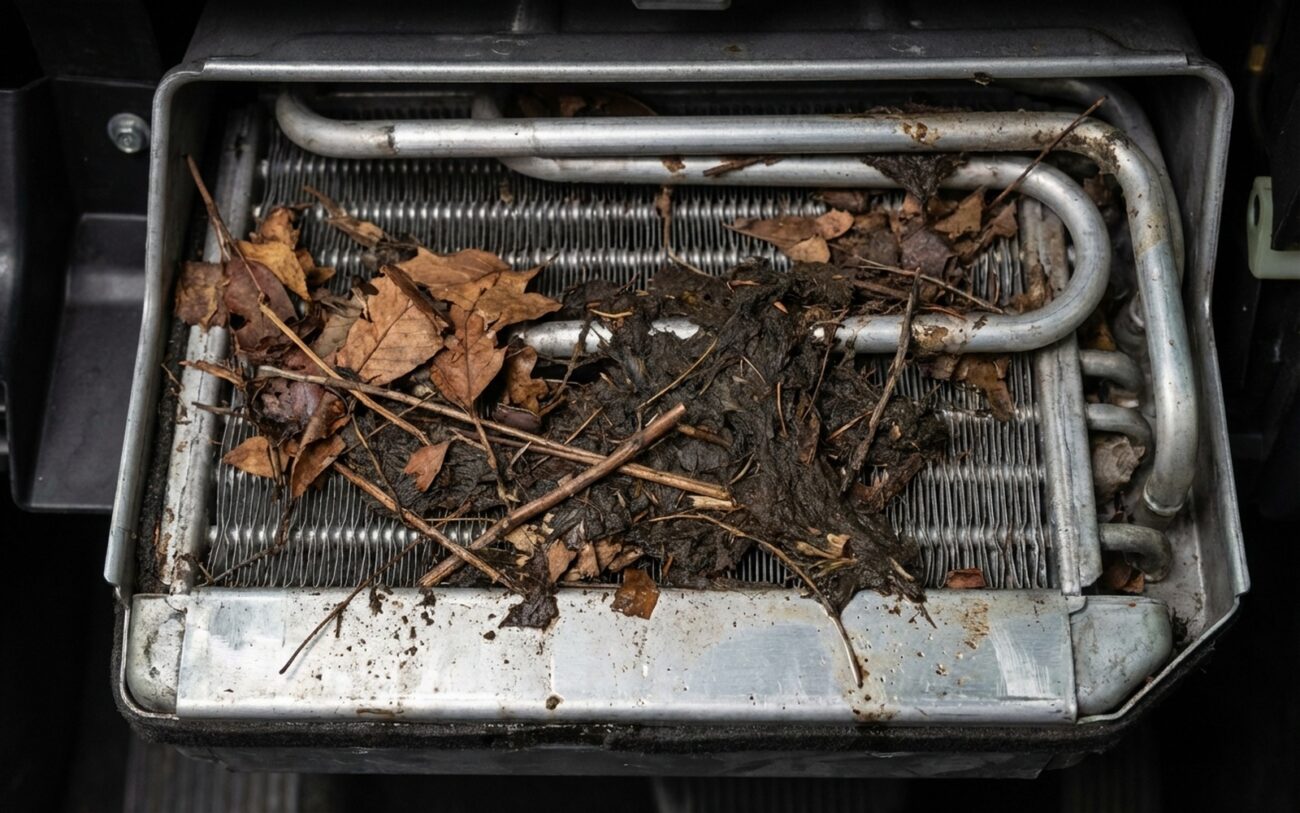
I’ve torn into hundreds of HVAC systems over the last 25 years. When a customer says their AC barely blows air and stinks like mildew the second they turn it on, I don’t reach for gauges first. I think: leaves. Actual, honest-to-goodness leaves stuck in the evaporator core. Sounds like a joke—until you open the housing and pull out a handful of wet maple debris like it’s a compost bin.
It happens more than people think. Especially on vehicles where the cabin air filter is missing, wrong-sized, or poorly sealed. That intake under the cowl? It’s a leaf magnet. And once that junk gets past the filter, it hits the evaporator—cold, wet, sticky—and just… sticks. Over time, it packs down, blocks airflow, traps moisture, and grows mold. That’s your stink. That’s your weak airflow. And if you ignore it? You risk freezing the evaporator, slugging the compressor, and turning a $100 filter oversight into a $2,500 repair.
Symptoms That Point to a Clogged Evaporator
Let’s cut through the noise. Here’s what I look for—every time:
1. Weak airflow, even on high. Not just “a little less”—we’re talking barely a breeze. The blower motor is screaming, but nothing’s coming out. That’s not a weak motor. That’s a blockage. The evaporator core is a dense maze of aluminum fins. Pack it with debris, and it’s like trying to breathe through a wet paper towel.
2. Musty, sour odor when AC kicks on. That’s biological growth—mold, bacteria, sometimes even algae. The evaporator condenses water as it cools, same as a cold soda can. Trap organic material there, keep it damp, and you’ve got a petri dish. I’ve smelled some bad ones—like wet dog and gym socks had a baby.
3. Cooling performance drops, but pressures look normal. That’s insulation at work. The gunk on the fins acts like a blanket, preventing heat transfer. The refrigerant is cold, the system is charged, but the air can’t pick up the cold because it’s not touching the metal. Classic.
How to Diagnose It (Without Guessing)
I don’t guess. I confirm. And here’s how I do it—step by step.
First, rule out the easy stuff: check the cabin air filter. If it’s clogged, replace it. If airflow doesn’t improve, check the blower motor. Is it actually running at full speed? Test the resistor pack. Make sure the mode doors are moving—sometimes a failed actuator traps air in defrost or recirc mode.
If all that checks out, and you’ve still got weak airflow, stink, and poor cooling? Evaporator is suspect.
The only way to know for sure? See it. I use a borescope—flexible inspection camera. You can usually feed it through the cabin air filter housing or blower motor opening. On most cars, you can get a clear view of the front face of the evaporator.
| Symptom | Likely in Evaporator (Clog) | Common External Mimics | Definitive Test to Confirm Source |
|---|---|---|---|
| Low Airflow | Physical debris mat on evaporator fins | Blower motor failure, clogged cabin air filter, mode door actuator failure |
Remove cabin air filter and visually inspect housing for debris. With blower on high, use a borescope through the filter housing to view the evaporator core face. A clog will show a solid layer of debris. |
| Musty Odor | Microbial growth on wet evaporator fins | Dirty cabin air filter, mold in HVAC housing ducts |
Perform an HVAC system cleaning via the evaporator drain tube. If odor persists, a direct visual inspection via borescope is required to confirm debris on the evaporator. |
| Poor Cooling, Normal Pressures | Insulating debris layer on evaporator | Marginal refrigerant charge, failing expansion valve, blend door issue |
Use an infrared thermometer to measure the temperature of the evaporator inlet and outlet tubes. With a clog, the temperature differential will be minimal. Confirm with a borescope inspection. |
If your borescope shows more than half the core face blocked—especially with wet, matted debris—you’ve found your problem. Don’t “hope” it clears itself. It won’t.
Why It Happens (And Where Design Falls Short)
The evaporator isn’t failing. It’s being overwhelmed. The intake under the cowl—right at the base of the windshield—is the entry point. Leaves, pine needles, seed pods, road grit—all get sucked in when the blower runs.
The cabin air filter is supposed to stop it. But I see three big problems:
-
Filter missing (common on older cars or after DIY work)
-
Wrong size or aftermarket filter that doesn’t seal
-
Design flaws—some FCA and GM models have known gaps in the housing
I’ve worked on 2014–2017 Ram trucks where the filter housing had a 1/8-inch gap along one edge. No matter what filter you used, debris got in. Chrysler even issued a service bulletin for it.
Once inside, the evaporator’s fins are perfect for catching junk. Aluminum, thin, wet—like flypaper. Over time, moisture leads to corrosion. I’ve seen fins eaten through, collapsed. At that point, cleaning won’t help. You need replacement.
Important Insight:
Corrosion from trapped debris is a secondary failure. The root cause is always airflow contamination. Fix the seal, fix the filter, fix the cowl—and you stop the cycle.
Repair Paths: What Actually Works
Professional Territory Only
Working on your car’s HVAC system, especially if it involves refrigerant, demands specialized tools, safety training, and proper PPE. There’s no safe shortcut for severe clogs or evaporator replacement.
Here’s how I break it down in the shop:
Light Debris, Accessible (DIY-Friendly)
Heavy, Packed Debris Professional Only
Corroded or Damaged Core Professional Only
And about those “evaporator cleaner” spray cans? Save your money. They might kill surface mold, but they won’t dissolve a mat of leaves. I’ve seen guys spray them for weeks—no change. They’re like air freshener for a dirty toilet. Smells better, still dirty.
After the Repair: Prevent It From Coming Back
You just spent time and money fixing this. Don’t let it happen again.
-
Always use the correct OEM-spec cabin air filter. Aftermarket ones often don’t seal. I’ve measured gaps up to 3mm on some brands.
-
Clean the cowl area 2–3 times a year. A quick pass with a shop vac in fall and spring stops leaves before they get in.
-
When you change the filter, shine a flashlight into the housing. If you see anything on the evaporator face, pull it now. Five minutes today saves you $1,200 later.
Cost-Saving Tip
Independent AC specialists often charge less than dealers for evaporator work. But verify they have a recovery machine, vacuum pump, and micron gauge. This isn’t a job for a general mechanic.
