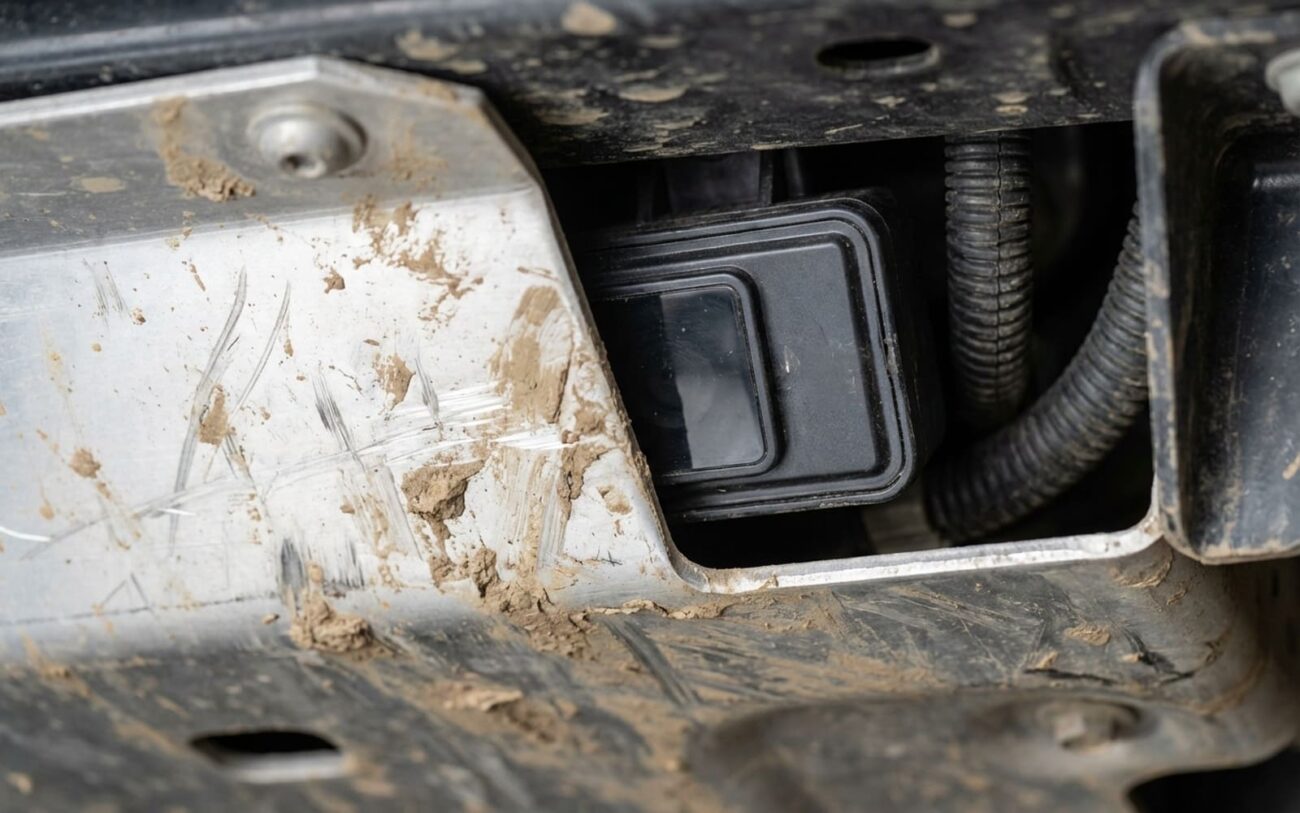
If your adaptive cruise control died right after installing a skid plate—and you’re staring at a “Front Sensor Blocked” or “ACC Malfunction” warning—don’t reach for the scan tool yet. Look at the front bumper. More often than not, the answer is sitting right there, hiding in plain sight.
I’ve seen this exact scenario hundreds of times in my shop. Customer installs a $400 skid plate, hits the highway, and suddenly the car won’t follow traffic or brake on its own. The system isn’t broken. It’s blind.
That radar sensor behind the grille? It needs a clear path—no metal, no composite with carbon fiber, no plate sitting too close. When you block it, the car doesn’t guess. It shuts down ACC and AEB. By design. That’s not a flaw. That’s safety kicking in.
Symptoms That Point to Skid Plate Interference
The biggest clue? Timing.
If everything worked fine before the skid plate went on, and failed immediately after—especially with a “Sensor Blocked” message—it’s not a coincidence. On 2020+ Toyota Tundras, I’ve had three come in this month alone with this exact issue. All had generic steel plates blocking the radar window.
But not every failure is total. Sometimes it’s intermittent—ACC cuts out after hitting a bump or driving off-road. That’s often a plate flexing under vibration, just enough to nudge the sensor or reflect radar back into the near field. I had a Jeep Wrangler once where the owner swore it was a software glitch. Turned out the plate was mounted with one missing spacer. A 10-minute teardown fixed it.
| Symptom | Likely Root | Quick Field Check |
|---|---|---|
| ACC/AEB dead, “Sensor Blocked” on startup | Physical obstruction—plate blocking beam path or in near-field zone (within 15–20 cm) | Visual inspection: shine a flashlight through the lower grille. Can you see the sensor (usually behind emblem)? Is anything metal in front of it? |
| Intermittent ACC failure after rough driving | Plate vibrating or flexing, causing momentary interference | Push up on the plate while monitoring live radar alignment data (if you have a capable scan tool) |
How to Confirm the Skid Plate Is the Problem
You can’t diagnose this blind. A $30 OBD2 scanner from the auto parts store won’t cut it. You need access to the radar module—specifically, live data for signal plausibility, alignment angle, and obstruction status.
On Toyotas, I pull up “Front Monitoring Camera” or “Millimeter Wave Radar” data in Techstream. On Fords, it’s under Co-Pilot360 diagnostics. Look for:
- “Radar Obstruction Detected” flag
- Alignment angle outside ±0.3° spec
- Low or zero target acquisition
If you see any of that, remove the skid plate. Not loosen it. Not adjust it. Remove it completely.
Then clear codes and recheck. If the system comes back online and calibrates—congrats. The plate was the issue. If not, you’ve got a deeper problem: damaged wiring, a faulty sensor, or prior misalignment from an old fender bender.
Root Causes: Why Skid Plates Kill Radar
Three things go wrong—every time.
1. Wrong Material
Radar at 77GHz doesn’t pass through metal. Steel, aluminum, even some carbon-reinforced plastics—they reflect or absorb the signal. OEM skid plates use polypropylene or other radar-transparent thermoplastics. Aftermarket ones? Often not.
If the plate isn’t labeled “ADAS-safe” or “radar-compatible,” assume it’s not. I don’t care if it “fits” your truck. Fitment isn’t function.
2. Poor Design or Clearance
Even a non-metallic plate can cause trouble if it’s too close. The radar’s near-field zone extends about 15–20 cm forward. If the skid plate sits in that zone—even without touching the sensor—it creates multipath interference. The system sees ghost targets or nothing at all.
A good plate has a cutout aligned with the sensor and maintains at least 20mm of clearance. I measure it. Every time.
3. Physical Damage or Misalignment
Hit a rock? That impact can bend the skid plate inward, pressing against the sensor housing or bumper liner. Even light contact can dampen the signal or shift alignment.
And don’t forget the mounting points. Over-torquing M8 or M10 bolts beyond 40 ft-lbs (54 Nm) can warp plastic brackets. I’ve seen it crack the radar housing on a Lexus RX. That’s a $1,200 mistake.
Fix It Right: What Actually Works
Replace with ADAS-Safe Plate DIY-FEASIBLE IF PROPER PART SOURCED
Reinstall with Correct Spacers DIY-FEASIBLE
Repair Bent Plate PROFESSIONAL-ONLY if repair affects integrity
Did It Work? Here’s How to Know
Clearing codes isn’t enough. You need validation—two stages.
First: Static calibration. With a factory-level scan tool, run the radar alignment procedure. On most Toyotas, it’s under “Sensor Calibration.” On Fords, use IDS. The system should report alignment within ±0.3° and no obstruction flags.
Second: Dynamic test drive. Drive at least 10 miles on open road. Engage ACC above 50 mph. It should lock onto a vehicle, maintain distance, and respond to braking. No warnings should return.
On newer trucks—like the 2023+ Tundra or F-150—you might need a target vehicle or reflector for dynamic calibration. Don’t skip it. Without it, the system may appear functional but fail under real-world conditions.
Cost vs. Risk: Making the Call
Let’s be real. A proper ADAS-safe skid plate plus calibration can run $1,000. If that’s 30% of your truck’s value, it might not make sense.
Some of my customers run without the plate daily and only install it for off-road trips—knowing ACC and AEB will be down. Others skip it entirely. I don’t love that, but I get it.
Just make the choice consciously. Not because you forgot to check the sensor. Not because you assumed the plate was compatible. Know the risk. Accept it. But don’t pretend it’s not there.
Prevention: Save Yourself the Hassle
Before you buy any skid plate, check the specs. Not “fits 2023 F-150.” Look for “compatible with Co-Pilot360” or “ADAS-safe.” If it’s not stated, call the manufacturer. I’ve done it. They don’t always know, but at least you tried.
After install, inspect it. After every off-road run, get down and check clearance. Look for new contact points. Listen for rattles. And every time you start the truck, glance at the dash. If the ADAS warning lights up before you move—99% chance it’s a blockage.
One last thing: parking sensors can get messed up too. Some plates interfere with ultrasonic frequencies. Check all front-end systems after any undercar mod. Don’t assume radar is the only victim.
