Alright, let’s talk about that gut feeling you get when your ride just doesn’t pull like it used to. You mash the pedal, and… not much happens. That sinking sensation is universal, whether you’re in a gas-guzzling sedan, a diesel workhorse, or a fancy electric SUV. The symptom is always the same: a noticeable drop in power when you ask for it. But what’s causing it? That’s where things get complicated, because the root causes can be wildly different across powertrains.
Now, I’ve seen countless vehicles come through my shop with this complaint. And here’s the first rule: don’t jump straight to “engine or motor is toast.” That’s the most expensive and often incorrect assumption. Just like a cough could be a cold or something much worse, power loss can be a simple, cheap fix or a major mechanical failure. Misdiagnosing it means you’re either wasting money on parts you don’t need or, even worse, missing the real problem entirely. So, let’s walk through how I figure out what’s really going on, because the next steps depend entirely on what’s under the hood (or floor).
My Diagnostic Approach: Ruling Out the Easy Stuff First
Before we even think about a cracked engine block or a fried EV motor, I always start with the common culprits. In my 25+ years, it’s rarely the “heart” of the machine that fails first. More often, it’s something external, something that mimics a major problem. Think clogged filters, a bad sensor, or a restricted exhaust. Getting these out of the way saves you a ton of time and money.
On gasoline engines, I’ve seen more clogged catalytic converters mimic internal engine failure than actual cracked blocks. Same goes for bad ignition coils or dirty fuel injectors. Always check the easy stuff first.
Gasoline Engines: What I Look For
When a gas engine starts losing power, running rough, maybe you hear an audible misfire, and you’re seeing white exhaust smoke – that’s a red flag. But don’t immediately assume the worst. First, I’m checking ignition coils and spark plugs. Are they firing correctly? Then, fuel injectors – are they spraying evenly? And definitely check the exhaust. A collapsed catalytic converter can choke an engine faster than anything. You’d be surprised how often it’s one of these “mimics.”
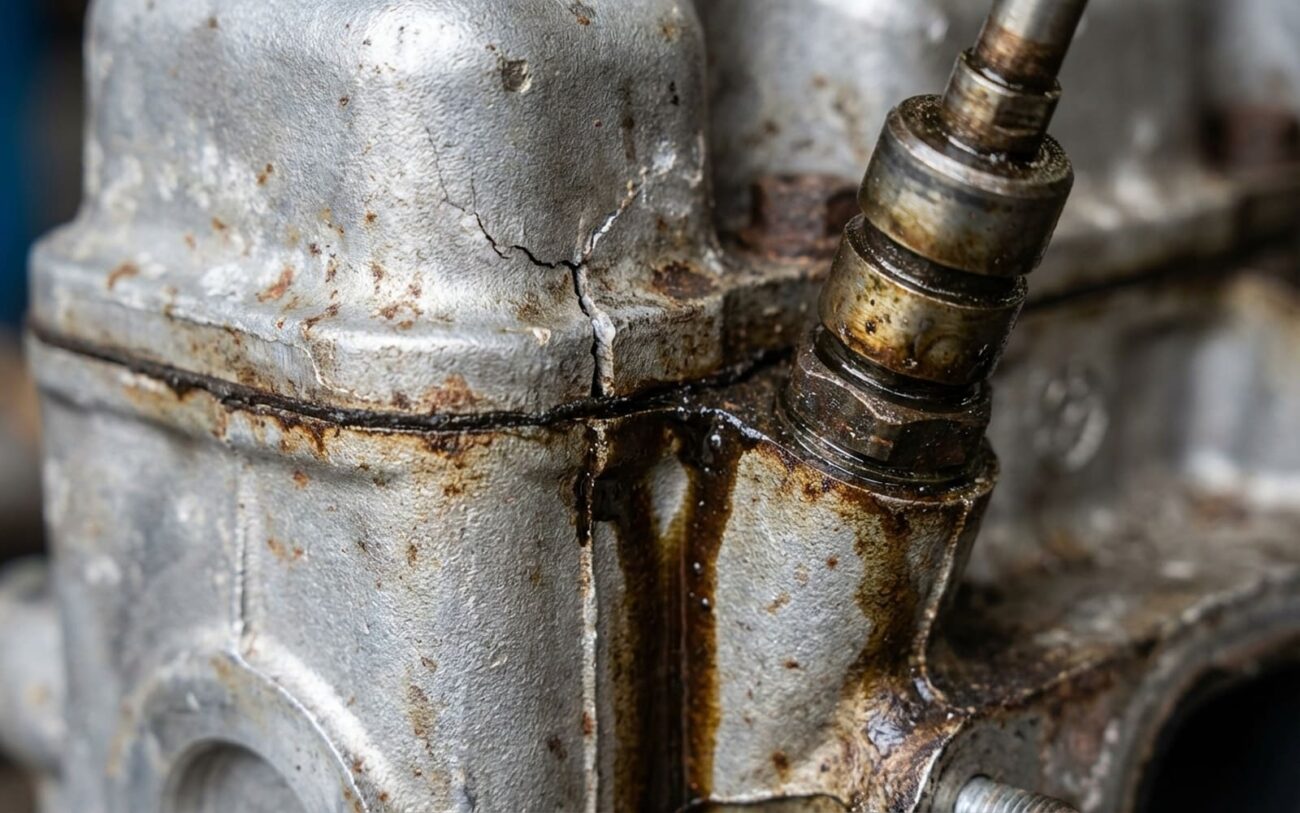
Now, if I’ve ruled all that out, and I’m still seeing those symptoms, especially with coolant loss and no external leaks, then I start thinking about an internal coolant leak into a cylinder. This isn’t your typical head gasket job. This is often block porosity or a crack in the block itself. I’ve seen it on certain aluminum V6s, like some Ecotec or EcoBoost variants, especially near cylinder #4, where casting flaws can show up.
My definitive test here is a cylinder leak-down test. I’ll pressurize each cylinder, usually to around 100 psi, and listen for air escaping. If I get over 20% leakage, and I see bubbles in the coolant reservoir, that confirms an internal breach in the block. That’s a bad day.
Diesel Engines: The Heavy-Duty Checklist
For a diesel, power loss combined with excessive white or gray smoke, and unexplained coolant loss, again, can point to a serious issue. But before I condemn the engine, I’m checking the fuel system – faulty injectors are a common problem on modern diesels. Then the turbocharger – is it building boost? DPF (Diesel Particulate Filter) issues are rampant; a clogged DPF will absolutely choke power. And don’t forget the EGR valve; a stuck EGR can cause overheating and power loss, mimicking something much worse.
If those common issues are clear, and I’m still losing coolant without any external signs, I start suspecting a cracked cylinder block or liner. This allows coolant to get into the combustion chamber, leading to a loss of compression. It’s a tough one.
To confirm, I’ll run a cylinder compression test. I’m looking for a significant difference between cylinders – more than 25% variation usually means a mechanical failure inside the engine. That kind of pressure loss isn’t something a simple external fix can handle.
Electric Vehicles: A Different Kind of Power Loss
EVs are a different beast entirely. If you’re getting reduced acceleration, speed limitations, or that dreaded “limp mode” warning, it’s easy to panic. But here, the “mimics” are often about the high-voltage battery’s state of health (SOH), the inverter, or thermal throttling. EVs are smart; they’ll limit power to protect components if something’s getting too hot, like the motor or the battery.
A true internal motor fault—like shorted windings, a bearing failure, or a demagnetized rotor—is rare, but it does happen. When it does, it’s usually not subtle. You might hear new noises, or the power delivery will feel fundamentally different from a simple thermal limit.
My go-to diagnostic for an EV motor is hooking up an OEM-level scan tool. I’ll monitor the phase current imbalance under load. If I see anything over 5% imbalance, that’s a strong indicator of winding issues or a problem with the inverter. I’ll also use a thermal camera to check the motor housing; uneven heat distribution can point to internal damage.
Why the Heart of the Machine Fails: It’s Not Always Just Wear and Tear
True core failures – a cracked engine block or a faulty EV traction motor – don’t just pop up out of nowhere. There’s almost always a reason. It could be design stress, a material flaw, or, frankly, improper use or maintenance.
Internal Combustion Engines: Blocks Under Stress
Engine blocks are built tough, designed to handle immense pressures and temperatures. But they have limits. As I mentioned, some aluminum V6 engines (yes, those Ecotecs and EcoBoosts) have had known casting porosity issues. This isn’t a head gasket problem; it’s a defect in the block itself, allowing coolant to slowly seep into the combustion chamber. It’s a manufacturing flaw, pure and simple.
Thermal stress is another huge factor. One severe overheat, maybe from a stuck thermostat or a failed water pump, can create microcracks. These tiny fissures might be between cylinders or coolant passages, and they’ll grow over time, eventually leading to a leak. And please, don’t underestimate poor coolant maintenance. Mixing incompatible coolants can lead to electrolytic corrosion, especially in aluminum blocks. I’ve seen it eat away at internal passages like acid, slowly destroying the block from the inside out.
Expert Insight from My Bench:
I see this misdiagnosed constantly: people assume a blown head gasket when the block is actually cracked. The symptoms overlap – coolant in oil, white smoke, overheating – but the repair path is completely different. A thrown connecting rod can also crack a block, but that’s usually secondary damage, not the primary cause. A block crack is a structural failure.
Electric Vehicle Motors: Heat is the Enemy
EV traction motor failures are less common, but when they happen, thermal stress is usually the culprit. Repeated hard launches or sustained high-speed driving without adequate cooldown periods can overheat the motor windings. Over time, that heat degrades the insulation, eventually causing a short circuit. Permanent magnets can also lose their strength if they get too hot – we call that demagnetization – and that directly reduces the motor’s efficiency and power output.
Bearing failure is another real-world issue. If the motor’s cooling system isn’t working right, or if contaminants somehow get into the lubrication (which is rare in a sealed unit, but not impossible), those bearings will wear out. That increases drag, generates more heat, and eventually, the rotor starts rubbing against the stator. Once that happens, the motor is done. It’s game over.
So, It’s the Big One. Now What? (Repair Options & Real Talk)
Okay, so you’ve done the diagnostics, and it’s confirmed: you’ve got a core component failure. Your repair options depend heavily on the type and location of that failure. This is where you separate the wishful thinking from reality.
Engine Block: External vs. Internal Damage
For minor external coolant leaks on an engine block – say, a small weep at a casting seam or around a freeze plug – a professional epoxy repair can work. I’ve seen shops clean the area down to bare metal, roughen it up, and apply a high-strength, engine-grade epoxy. If done right, it holds. But this is strictly for non-structural, external surfaces. If that leak is between a cylinder and a water jacket, forget it. There’s no external patch that’s going to seal that reliably.
Some folks try those “stop leak” sealants, hoping to plug a block leak. In my experience, these products rarely work on anything but the tiniest seepage, and they come with real risks. They can clog your heater core, stick your thermostat open or closed, and do absolutely nothing for an internal crack. I wouldn’t rely on them, especially if you’re trying to buy time. For hard-to-reach external leaks, like a corroded rear freeze plug, you’re often looking at a transmission pull or even engine removal just to access it. It’s labor-intensive, but it’s still usually cheaper than a full block replacement.
Internal Engine Damage & EV Motor Constraints
Now, for internal engine damage—porosity between a cylinder and a coolant passage, or a crack in the deck surface—there is no permanent, reliable fix. Welding or sleeving might sound like options, but they’re just not reliable in high-stress, high-temperature areas like that. You’re looking at a new or rebuilt long block. Same goes for an EV traction motor with internal damage. These units are sealed, often liquid-cooled, and not designed for field repair. You can’t just open them up and rewind the coils without voiding safety certifications and risking further, catastrophic damage. For internal motor faults, replacement is the only real option.
Proving the Fix: Don’t Just Assume It’s Done
Just because the car runs after a major repair doesn’t mean the repair held. You absolutely have to validate it under realistic conditions. Skipping this step is asking for trouble down the road.
For an external epoxy repair on an engine block, I always start with a cooling system pressure test. I’ll hold 15–16 psi for at least 30 minutes with no drop. Then, I add UV dye to the coolant, run the engine through multiple heat cycles (from cold start to full operating temp), and inspect with a black light. Any new seepage, no matter how small, means the repair failed. You need to be thorough.
If you’ve replaced an entire engine block, don’t skip the basics. Perform a leak-down test on the new (or rebuilt) engine to confirm cylinder integrity. Also, use a combustion gas analyzer to ensure no exhaust gases are entering the cooling system. These tests confirm you’re not dealing with residual cracks or an improper head gasket installation on the new block. It’s cheap insurance.
For an EV motor replacement, validation is all about the data. After installation, I use a factory-level scan tool to verify there are absolutely no pending motor or inverter fault codes. Then, I run a live data test during a road drive, carefully monitoring phase current imbalance. Anything over 2% under load is a red flag for me. I’ll also use a thermal camera to check for even heat distribution across the motor housing. If one area runs significantly hotter than the others, it could indicate a winding issue or poor cooling flow. Only when all the data is clean and stable, and the vehicle performs as expected, do I consider the repair complete.
The Hard Numbers: Cost, Risk, and When to Call It
Let’s talk real-world economics, because these aren’t cheap repairs, and they carry significant risk. You absolutely need to weigh the cost against your vehicle’s current value and your long-term plans for it. Here’s what I typically see in terms of costs and outcomes:
| Repair Type | DIY Cost | Shop Cost | Success Rate (My Experience) | Secondary Risk if Failed |
|---|---|---|---|---|
| Engine Block External Epoxy Repair | $50 (for materials) | $300–$600 | ~60% (if done right, on the right type of leak) | Sudden coolant loss can lead to catastrophic overheating and a seized engine. Don’t rely on it for anything critical. |
| Engine Block Replacement (Gas/Diesel) | $2,000–$5,000 (for parts, if you’re good) | $6,000–$12,000+ | ~95% (if done by a competent tech) | Improper assembly (timing, torque, coolant fill) can cause immediate or premature failure. This is a big job. |
| EV Traction Motor Replacement | Not feasible (high voltage risk, specialized tools) | $4,000–$8,000 | ~98% (usually factory new/reman units) | Improper high-voltage handling can result in severe electrical injury, fire, or damage to other expensive components. Leave this to the pros. |
The Mechanic’s Rule of Thumb
For gasoline or diesel vehicles, if the repair cost exceeds 60% of the Kelley Blue Book private-party value, I seriously tell my customers to consider whether replacing the vehicle makes more financial sense. You don’t want to throw good money after bad. For EVs, if you’re under manufacturer warranty—especially powertrain or bumper-to-bumper—these repairs are almost always covered. Don’t delay getting it checked; these high-voltage systems are too critical to ignore.
Keeping It From Happening Again: My Best Advice
Prevention is always, always cheaper than repair. Trust me on that one. A little proactive maintenance can save you thousands down the road.
For Gas and Diesel Engines: Coolant is King
The number one defense against block issues is proper coolant maintenance. Use only the coolant type specified by the manufacturer. Mixing types – especially silicate-based with OAT or HOAT – can create a sludge that blocks passages or, worse, cause galvanic corrosion in aluminum blocks. I’ve seen it destroy engines. Change your coolant on schedule, and never top off with just water unless it’s a true emergency. I recommend an annual cooling system pressure test as part of routine maintenance; it’s a cheap way to catch small leaks before they become catastrophic problems.
Also, get in the habit of visually inspecting your engine bay monthly. Look for coolant stains, rust streaks, or weeping around freeze plugs and casting seams. Early detection can literally save you thousands of dollars and a whole lot of headache.
For Electric Vehicles: Thermal Management and Awareness
With EVs, the focus shifts to thermal management and simply being aware of your vehicle’s behavior. Avoid repeated full-throttle acceleration or aggressive regenerative braking without allowing for cooldown periods. You’re not just stressing the motor; you’re heating up the battery and inverter too. Listen to your car. A new high-pitched whine or grinding noise during acceleration or regen braking is a serious warning sign. Also, monitor your energy consumption. If your kWh/100 miles is creeping up over time without changes in your driving habits, it could indicate increased mechanical drag – possibly from a failing motor bearing.
