Why Only One Knee Airbag? It’s Not a Cost-Cut—It’s Engineering
I get this question a lot: “Why does my car only have a knee airbag on the driver’s side?” And yeah, it’s true—most cars only deploy a knee airbag for the driver. You’ll see the seam under the steering column, but on the passenger side? Smooth plastic. No deployment panel. That’s not a missing part. That’s by design.
Here’s what’s really going on: the driver’s legs are a problem in a crash. You’ve got pedals, a steering column, and a firewall in the way. In a frontal impact, your knees want to jackknife up into that hard structure. That’s how you get pelvic fractures, femur injuries—serious stuff. The driver knee airbag controls that motion. It’s not just padding—it actively limits forward and upward leg travel, which helps the seatbelt and main airbags do their job.
Now, the passenger side? Different story. No pedals. No steering column. The lower dash is wide open. So instead of adding an airbag, engineers use that space to build a passive knee bolster into the instrument panel. It’s foam, sometimes with a crushable bracket, designed to deform in a predictable way. It absorbs energy, reduces femur loads, and meets FMVSS 208 just fine—without the cost and complexity of an inflator, wiring, and sensors.
Don’t get me wrong—passenger knee airbags exist. You’ll find them on higher trims, luxury models, and some SUVs. But in most economy and mid-tier vehicles? They’re optional. If you want one, check the window sticker or the NHTSA safety rating page. Don’t assume it’s there.
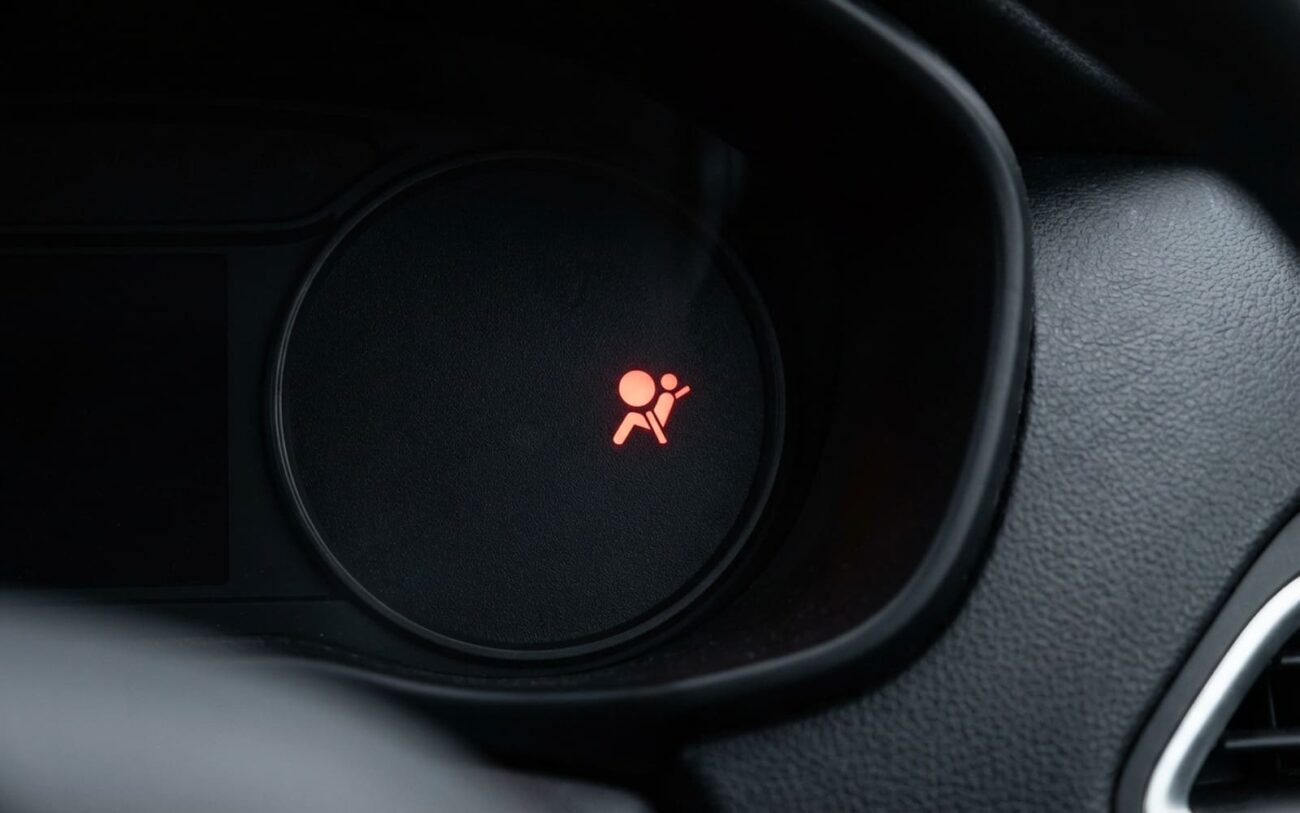
SRS Light On? Here’s What That Really Means
If the SRS light is on after startup and stays lit, the system has detected a fault—and it’s probably disabled one or more airbags. That includes the knee airbag. I don’t care if the car drives fine. That light is not a suggestion. It’s a red flag.
And here’s the thing: most DIY scanners won’t help. Generic OBD2 tools read engine codes, not SRS. You need a scan tool that can talk to the airbag control module. Without it, you’re blind. The codes you need are B-codes—body codes—and they’ll tell you exactly where the circuit failed.
But—and this is important—the code doesn’t tell you to replace the module. It tells you the circuit isn’t reading right. Could be the module. Could be a corroded connector under the seat. Could be a pinched wire near the kick panel. I’ve seen all three.
On a 2012–2015 Toyota Camry, I’ve pulled the seat and found green corrosion in the SRS connector from a spilled soda months earlier. Cleaned it, resealed it, and the light went off. Saved the customer $600.
How I Diagnose It—Step by Step
Start with the scan tool. Pull the B-codes. If you see something like B1921 (Driver Knee Airbag Circuit High Resistance), don’t reach for the wallet yet. That code could mean:
-
The module’s internal squib is failing.
-
The clockspring is worn and adding resistance.
-
There’s corrosion in the harness connector under the driver’s seat.
-
A wire is pinched near the steering column.
So what do I do? I disconnect the battery and wait 15 minutes. SRS has a backup capacitor—don’t skip this. Then I check resistance at both ends of the circuit: at the module connector and at the vehicle harness.
If the resistance is over 1 ohm at the harness side, the problem is external. Trace the wiring. Check the clockspring. Look for chafed insulation. If the resistance is good at the harness but high at the module, then yeah—the module’s likely bad.
And if you hear a rattle from the footwell? Don’t ignore it. I’ve had customers think it was a heat shield. Turned out the knee airbag module wasn’t bolted down after a dash repair. It was bouncing around. That’s a deployment risk. Always inspect the mounting.
What Actually Breaks in the Module
When the module itself is bad, it’s usually one of three things:
Terminal fretting corrosion. Tiny vibrations over years cause the contacts to wear microscopically, building up resistance. Common in older cars, especially those driven on rough roads. I’ve seen it in 2008–2011 Chrysler 300s and Dodge Chargers—intermittent SRS light, comes and goes with temperature.
Squib or inflator degradation. The igniter inside can fail over time. And yes, some knee airbags were involved in Takata recalls—just not as widely as frontal bags. Always check your VIN at NHTSA.gov. If there’s an open recall, get it fixed for free.
Physical damage. The housing is plastic. Kick it hard enough, or lean on it during a dash removal, and it cracks. I’ve seen it happen during door panel work when a tech braces against the lower dash. Even a hairline crack can alter the deployment path. Don’t try to glue it. Replace it.
Quick reality check:
A knee airbag DTC doesn’t mean your crash sensors are bad. It means the circuit to the airbag isn’t reading right. The sensors and control module are separate. Don’t overcomplicate it.
How to Fix It—And Do It Right
This Is Not a DIY Job
You can’t rebuild a knee airbag module. No shop can. The only repair is replacement—with an OEM part or a certified aftermarket unit that meets FMVSS 208. Full stop.
Before you touch anything: disconnect the battery and wait 15 minutes. I don’t care if you’re in a hurry. That capacitor can still fire the bag. And never probe the module with power applied. Static discharge can set it off.
Use the right tools. Most modules are held by T30 or T40 Torx bolts. Torque matters. On a 2015 Honda Accord, it’s 16 N·m (12 lb-ft). Too tight, and you crack the housing. Too loose, and the module shifts—bad for deployment.
If the part is under recall, get it done at the dealer. Free. No questions. If not, expect to pay.
Did It Work? Here’s How to Know
Reconnect the battery, turn the key to “on” (don’t start), and watch the SRS light. It should stay on for 5–7 seconds, then go out. If it stays on, flashes, or comes back later—you’ve still got a problem.
Validation Steps
-
Turn ignition to “on”—SRS light should illuminate for 5–7 seconds, then turn off.
-
Use SRS scan tool to clear codes and verify no new DTCs return.
-
Press firmly on the knee bolster cover—should feel solid, no creaks or movement.
If it fails any of those, don’t drive it. Go back and check your work. Loose connector? Bad ground? Wrong torque? Something’s off.
What It’s Going to Cost You
Let’s be real: this isn’t cheap. OEM module runs $300–$700. Labor is 1–2 hours, depending on dash access. Add diagnostics, and you’re looking at $500–$1,000.
Module Cost
For an OEM driver knee airbag module.
Labor Cost
Typically 1-2 hours of specialized labor.
Total Estimated Cost
Including diagnostics, parts, and labor.
Always check your vehicle’s safety system warranty status before authorizing repairs.
I get it—on a 10-year-old Corolla worth $3,000, spending $800 feels brutal. Some people live with the light. I won’t lie: I’ve done it myself on a beater I was flipping. But I knew the risk. You should too. A failed knee airbag won’t just leave you with sore legs—it can shift your whole position in a crash, increasing the chance of chest or head injury.
Cost-Saving Tip
Independent shops with SRS experience can save you hundreds. But verify they have the right scan tool and training. This isn’t a job for a buddy with a torque wrench.
How to Keep It Working
Prevention is easy. Don’t spill drinks near the lower dash. Water, coffee, soda—any of them can wick into connectors and cause corrosion over time. And don’t kick the knee bolster. I’ve seen modules cracked from loading heavy gear into the footwell.
To Prevent Recurrence
-
Avoid spills near the lower dash—corrosion kills connectors over time.
-
Don’t kick or overload the footwell—physical damage is common.
-
Pay attention to the SRS light. If it comes on, get it checked—don’t ignore it.
-
Check for recalls annually at NHTSA.gov. Could save you money—and your life.
Knee airbags are small, but they’re part of a system. Treat them like the safety-critical components they are. Because when the rubber meets the road, that little bag under your legs might be the difference between walking away and not.
