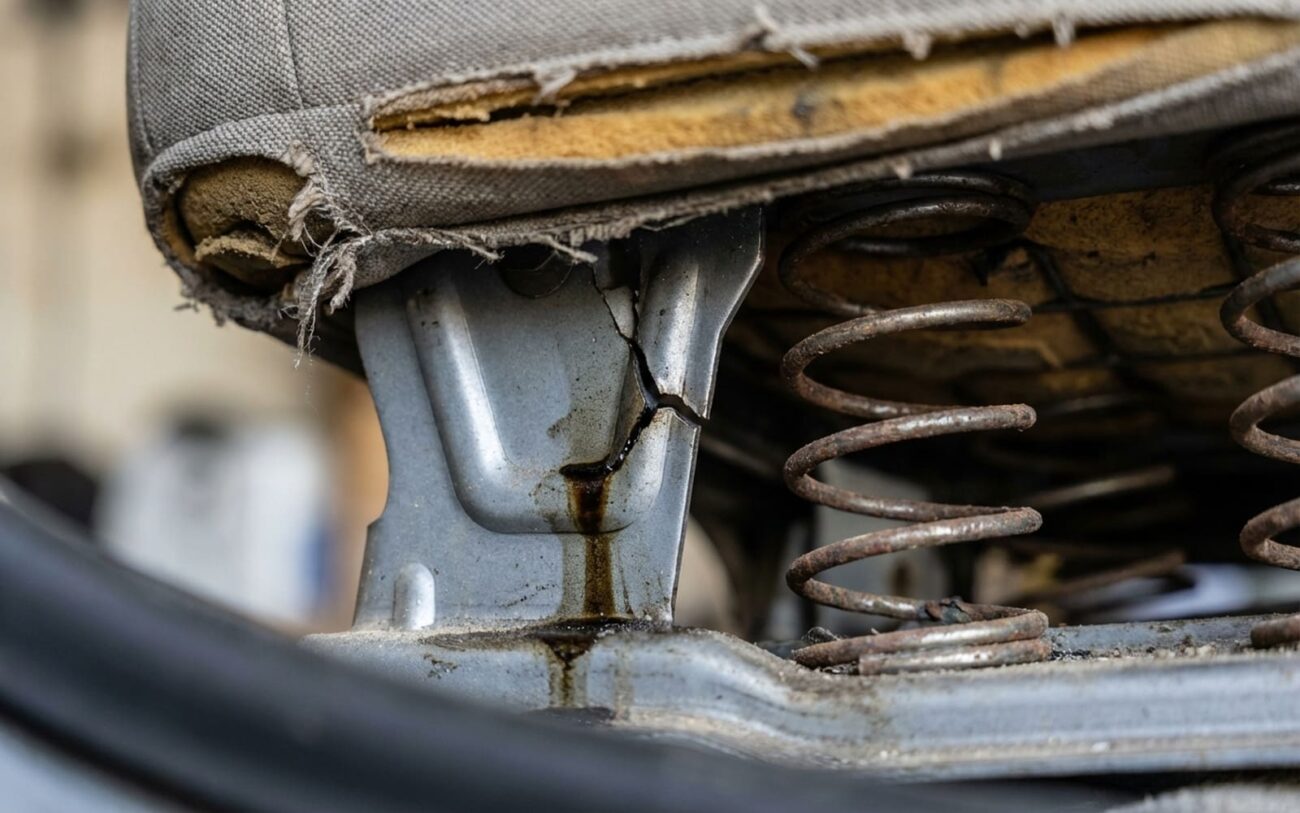
One side of your seat is sagging? That’s not just worn foam — it’s metal fatigue.
I’ve pulled apart hundreds of these seats over 25 years, and when one corner drops like it’s giving up, you’re not dealing with soft cushions. You’re dealing with a broken frame, cracked spring, or failed torsion bar. Foam doesn’t fail on one side and leave the rest perfect — it collapses evenly. If your hip rides lower than the other, or you feel like you’re tipping toward the door every time you sit down, something structural has given out.
And before you start shoving towels or plywood under the cushion — stop. That might level the seat, but it doesn’t fix the broken metal. Worse, if your seat has side airbags or weight sensors, you’re now sitting on a compromised safety system. I’ve seen cracked frames go undetected for months until someone finally pulls the seat and finds a hairline fracture right at the weld zone. By then, the repair gets way more expensive.
Diagnose like a pro: don’t guess, test.
Start simple. Check the seat mounting bolts — 30–40 lb-ft torque on most vehicles. Loose bolts let the whole seat rock, which feels like a sag. Look under the seat: is the floorpan rusted? Are the tracks worn or jammed? If the seat moves side-to-side or rocks front-to-back, that’s not a frame crack — that’s hardware.
Now isolate the cushion. Press down hard on the low side. If it feels solid but tilted — like it’s holding position but just… off — that’s a frame or spring issue. If it squishes unevenly, you might still be looking at foam, but only if both sides respond differently.
On power seats, run the lumbar. If one side inflates and the other stays flat, the internal support wire is broken. I’ve pulled backrests apart on 2012–2016 Camrys and found the wire snapped right at the weld. Motor runs, cable moves — but no support. That’s not a bladder leak. That’s structural.
| Symptom | Root Cause | Mimics | How to Confirm |
|---|---|---|---|
| One side lower, feels rigid | Cracked outboard rail, broken S-spring, failed torsion bar | Collapsed foam, broken height adjuster |
Remove seat (disconnect battery first — airbags are live). Inspect frame rails visually. Use a borescope through a seam to check internal welds. Compress the low corner — if there’s no rebound or you hear metal clunking, a spring is broken. |
| Lumbar works on one side only | Snapped lumbar support wire | Failed bladder, broken cable, bad motor |
Operate control. If motor runs but one side doesn’t inflate, remove backrest cover. Inspect wire for fractures, especially at weld points. Wiggle the lever — if it moves but the wire doesn’t, it’s broken. |
| Seat rocks front-to-back | Cracked crossmember at track mount | Worn track pawls, loose floor bolts |
Torque floor bolts to spec. Have assistant rock seat while you watch the frame-track junction. Any movement? Crack is likely. Use dye penetrant on suspect welds — hairline fractures won’t show up otherwise. |
Why seats fail — and which ones fail first
Metal fatigue. That’s the root cause 95% of the time. Every time you sit down, the frame flexes. Over 10, 15 years, that adds up. The worst spots? Sharp bends in stamped steel, weld joints, and areas with no gusseting. I’ve seen identical seats — one lasts 200k miles, the other cracks at 120k. Difference? Driver weight, entry/exit force, and corrosion.
Rust is a silent killer. In salt-belt states, I see frame rails eaten through from the inside out. Surface rust looks bad, but it’s the pitting under the weld bead that creates stress risers. Once a crack starts, it spreads fast. And yeah, some models are worse than others. The 2010–2014 F-150? I get at least one a month with cracked outboard rails. Ford even issued a service bulletin — poor weld penetration at the factory.
And don’t kid yourself about “helping” by pulling on the seat back when you climb in. That lateral load isn’t part of the design. I’ve seen hinges bend and frames crack from that alone. If you’re over 250 lbs, stay within the seat’s rated capacity — it’s not just comfort, it’s longevity.
Repair options — and which ones actually work
No Shortcuts on Safety
If the frame’s compromised, you can’t half-fix it. Airbags, sensors, crash loads — this isn’t a suspension bushing. You either restore integrity or replace the assembly.
Weld the Crack Pro Job
Replace S-Springs Upholstery Required
Replace Frame or Subframe
Test the repair — or risk a comeback
Welded it? Inspect the bead. No porosity, no undercutting, full penetration. Then load-test it: 200–250 lbs, drop it 50 times on the repaired corner. No movement? Good. But the real test is the SRS scan.
If you unplugged anything — airbag, sensor, seat mat — scan the system. I don’t care if the light’s off. A pending code can hide for weeks. I use a Snap-on MODIS with airbag module access. Clear any codes, cycle the ignition, re-scan. If it’s clean, you’re good.
For spring replacements, press each corner. Measure height — should be within 1/2″ across. And have someone sit, exit, repeat 20 times. Listen for new creaks. If it sounds like a haunted house, you missed a clip or isolator.
Critical Validation Step
-
Scan the SRS system after reassembly. Even if no light is on, a stored fault can disable airbags. I’ve seen it. Don’t skip this.
Cost vs. value — when to walk away
Here’s what repairs actually cost:
Weld Single Frame Crack
Shop: $250–$400. Only attempt if you’ve welded before.
Replace Sinuous Spring Set
Shop: $450–$700. Upholstery skills required.
Replace Entire Seat Frame
Shop: $900–$1,500. Often cheaper to swap in a used seat.
Bottom line: If the repair costs more than 40% of your car’s value, just buy a used seat. A cracked frame is a red flag on Carfax and private sales. Fix it right, or replace it — but don’t drive on a broken seat.
Prevention: habits that extend seat life
Don’t pull on the seat back. I can’t say this enough. Use the door or B-pillar to pull yourself in. That lateral force on the hinge is what cracks welds.
Keep the rails clean. Debris jams the tracks and forces the motor to overwork. And in rust zones, slide the seat forward every six months, wipe the floorpan, check for corrosion. A little undercoating on the frame rails won’t hurt.
And if your car has a known seat issue — like those F-150s or certain Accords — inspect the welds every 3–4 years. A quick borescope check takes 10 minutes and can save you $1,000 down the road.
