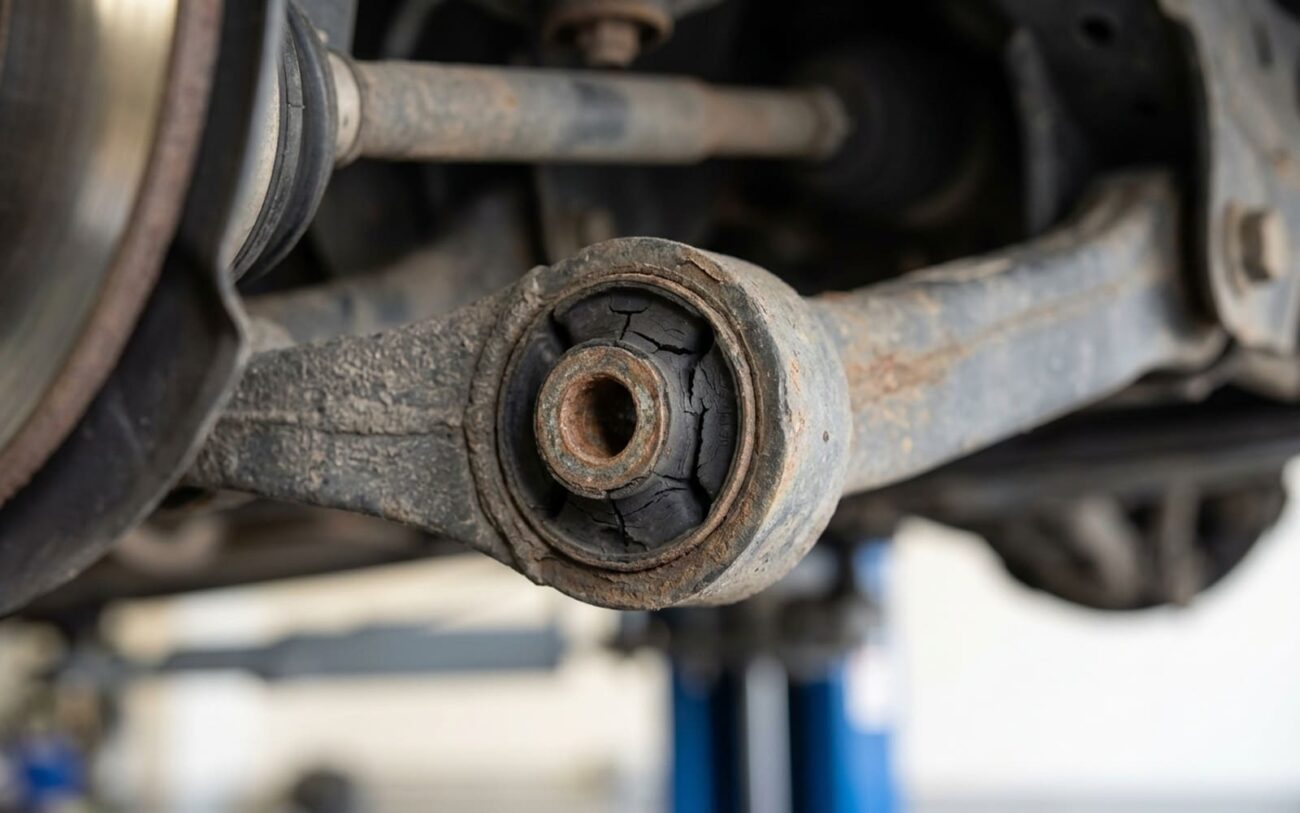
Alright, let’s talk about that unsettling “clunk” you’re hearing from your Mercedes W204 or Audi B8. I’ve been turning wrenches for over 25 years, and when a customer comes in describing a sharp, metallic knock, especially from the suspension when they hit a speed bump or a driveway apron, my ears perk up. That’s not just road noise; that’s the car trying to tell you something serious is going on.
What That Noise Really Means
See, a soft thud or a creak? That’s usually a worn bushing drying out or getting a little tired. Annoying, sure, but rarely critical. A sharp, precise, metallic “clunk” though? That’s a different animal entirely. In my experience, that sound almost always points to something structural failing in the multi-link assembly. We’re talking about a cracked control arm casting, a ball joint weld that’s given up the ghost, or a multi-link component that’s bent out of shape.
But it’s not just the noise. I’ve seen a couple of other tell-tale signs that scream “structural problem”:
- Abnormal Camber: Stand behind your car on a flat surface and look at the rear wheels. If one or both are leaning inward at the top – what we call negative camber – and you haven’t recently hit a curb or been in a collision, something is bent. It could be the hub carrier (knuckle), but more often than not, it’s a rear upper or lower control arm that’s permanently deformed. Steel arms, once bent, don’t just spring back.
- Persistent Vibration After Balancing: You’ve had your wheels balanced multiple times, maybe even bought new tires, but you still get that steering wheel shake at highway speeds. Don’t immediately blame the tires or the balancing shop. A bent linkage can cause hub runout, meaning the wheel isn’t sitting perfectly flat against the hub. That’ll throw off any balance job, no matter how good.
My Approach to Diagnosis: No Guesswork
A clunk can come from a dozen places – loose top mounts, worn sway bar links, even a bad strut bearing. Abnormal alignment might stem from a bent subframe or a damaged mounting point. That’s why you can’t just guess. You need a methodical approach to isolate whether the issue is truly in the multi-link arms themselves or something mimicking it. Here’s how I typically break it down:
For that Metallic Clunk:
First, I get the car on the lift. With the suspension unloaded, I’ll visually inspect the control arms for any obvious cracks, bends, or corrosion around the ball joint welds. Then, I’ll grab a chassis ear (it’s basically a stethoscope for cars) and have someone compress and release the suspension corner. A sharp knock directly at the ball joint or an arm weld confirms a structural failure in that component. Don’t just shake the wheel; you need to cycle the suspension to load those joints properly.
For Abnormal Camber or Toe:
This is where a proper 4-wheel alignment comes in. I’m not just looking for “in the green” on the alignment rack; I’m looking for target values. If we can’t achieve factory alignment specs, and I can visibly see an arm that’s bent compared to the opposite side, then it’s deformed. Sometimes, a collapsed bushing can mimic this, but a bent arm usually stands out.
For Vibration After Balancing:
If a customer tells me they’ve balanced their wheels multiple times and still have a vibration, I immediately suspect hub runout. I’ll mount a dial indicator to the hub mounting surface – where the wheel bolts on – and measure lateral runout. Most manufacturers specify less than 0.05mm. If it’s over that, even with a perfectly balanced wheel, you’ll feel it. A bent control arm can easily cause this by twisting the hub carrier.
Why These Parts Fail: It’s Not Always a Pothole
It’s critical to distinguish between a worn bushing and a failed control arm. A cracked bushing or a worn ball joint is a common wear item, something we expect to replace over time. But when the arm itself cracks, bends, or corrodes structurally, that’s a component-level failure, and it’s often due to a few common culprits:
- Material Fatigue: Constant load cycles, especially on the road, concentrate stress at weld points. Mercedes even issued a service bulletin for some W204 front arms regarding fatigue near the ball joint weld. It’s just metal getting tired.
- Internal Corrosion: This is a sneaky one. Many of these arms are boxed-section steel, which means they can trap salt and water. The arm looks fine on the outside, but it’s rusting from the inside out, eating away at the wall thickness until it just can’t take the load anymore.
- Impact Damage: Potholes, curb strikes, or even just hitting debris can deform steel arms. Unlike aluminum, which might flex and return, steel arms often deform plastically. Once bent, they’re compromised, and their structural integrity is gone.
A Quick Note on Modern Design:
On most modern multi-link suspensions, especially on those quattro models or performance trims, the arms are one-piece assemblies. If the ball joint is integral – meaning it’s welded or riveted into the arm – there are no field repairs. You can’t just replace the ball joint; you replace the whole arm. No shortcuts here.
The Fix: My Recommendations for a Lasting Repair
Structural Integrity First
Suspension repairs on high-performance German sedans aren’t like working on a ’98 Civic. They demand precision. Many bolts are one-time-use stretch bolts that require specific torque-plus-angle sequences. If you don’t follow those specs, you’re looking at premature wear or, worse, catastrophic failure down the road.
1. DIY Preventative Maintenance (If the Arm is Sound)
If you catch surface rust early and the arm is still structurally sound, you can definitely slow down corrosion. Clean it up with a wire brush, apply a phosphoric acid-based rust converter, then prime it with epoxy and finish with a good chassis paint. This won’t fix a bent arm, obviously, but it can extend the life of components in salt-prone regions. It’s a good weekend job if you’re comfortable under the car.
2. Professional Replacement (Required for Damage)
If the arm is bent, cracked, or that integral ball joint is loose, replacement is the only safe option. This isn’t a beginner DIY. You’ll need specialized tools like a ball joint separator and a high-capacity torque wrench (we’re talking 150–250 Nm for some of these bolts). For Audi B8 models, you’ll often need special alignment pins to get everything lined up correctly. And here’s a critical tip: final torque on the control arm bushings must be done with the suspension at ride height. If you torque them while the car is hanging on the lift, you’ll pre-load the bushings, and they’ll tear themselves apart in no time.
3. The “Joint Stiffener” (Last Resort, Not a Repair)
Okay, so if an integral ball joint has a grease fitting and only minor play, a high-viscosity lubricant might quiet a clunk for a few hundred miles. Let me be clear: this is not a repair. It’s a band-aid. It masks symptoms and can give you a false sense of security. I only ever recommend this if you absolutely need to get the car to a shop safely, and even then, I tell the customer exactly what it is – a temporary measure, nothing more.
Making Sure the Job Is Done Right
Replacing the arm is only half the job. The other half, and just as important, is ensuring the suspension geometry is restored to factory specs. That means a full 4-wheel alignment – no exceptions. The alignment has to include camber, toe, and caster adjustments where applicable, and it absolutely must hit the manufacturer’s target values, not just fall within some broad “acceptable” range. These cars are precise machines, and their alignment needs to be just as precise.
After the alignment, a proper road test is mandatory. I’ll drive it over bumps, through turns, and at highway speeds to check for any new noises or handling quirks. And here’s a pro tip: a good technician will also re-check the torque on those new bolts after 50–100 miles. Suspension components can settle, and those stretch bolts need to be verified to ensure everything is still tight and safe.
The Hard Numbers and Making the Call
Now, the hard question: is it worth it? Here’s a rough idea of what you might be looking at:
| Repair Type | DIY Cost | Shop Cost | Success Rate | Secondary Risk |
|---|---|---|---|---|
| Single Front Lower Arm (W204) | $150 – $400 | $500 – $900 | 100% | Loss of steering control, collision risk, tire damage |
| Full Rear Multi-Link Kit (Audi B8) | $800 – $1,500 | $2,200 – $3,500 | 100% | Rapid tire wear, poor handling, stress on other parts |
| Temporary “Stiffener” | $20 | $50 | <10% | Sudden joint failure, safety liability |
If the repair cost starts to approach 40% or more of your car’s current market value, you’re at a crossroads. You can just replace the single failed arm, but you’ll likely pay for multiple alignments over the car’s life as other original components wear out. My advice? If you plan on keeping the car, consider doing a full axle refresh with quality parts like Meyle HD or OEM. It resets the clock on handling and safety for that entire axle, and you’ll only pay for one alignment.
Pro-Active Maintenance Tip
Every time you rotate your tires, take an extra 5 minutes to inspect the suspension. Shine a bright light on the control arms, especially around the welds and bushings, looking for cracks or deep rust. And when you do replace parts, stick with proven brands. Meyle HD, for example, offers reinforced bushings and better corrosion protection. It’s often worth the extra cost on a car you plan to keep for a while.
Yes, multi-link suspensions can be expensive to repair. But that’s because they’re precision systems, designed to deliver excellent ride quality, sharp handling, and rock-solid stability – especially on vehicles with adaptive damping or quattro AWD. They just demand the same level of care and quality when it’s time to fix them. Don’t cheap out; your safety and the car’s performance depend on it.
