Alright, let’s cut to the chase. You’ve got that dreaded rear axle clunk on acceleration, right? The kind that makes you wince every time you pull away from a stoplight in your RWD or AWD car—think BMW E60, Mercedes C-Class, or even some performance SUVs. You give it some gas, the tires hook up, and BAM! A single, sharp “thud” from the back. It’s not subtle, and it’s definitely not normal. That, my friend, is mechanical lash being taken up with a bang, and after 25+ years turning wrenches, I can tell you it’s a warning sign.
Symptom: The “Clunk” vs. The “Clunk-Clunk-Clunk”
Most times, that single, sharp clunk points straight to excessive rotational play—what we call driveline slack—somewhere in the rear axle assembly. Usually, it’s worn splines where the axle shafts connect to the differential side gears. But don’t jump to conclusions just yet. It could also be worn differential gears themselves, especially if there’s too much backlash between the pinion and ring gear, or the side gears.
My Rule of Thumb
“A rotating defect gets worse with RPM. A lash issue shows up mostly during torque transitions (like accelerating or decelerating).”
Now, if you’re hearing a rhythmic “clunk-clunk-clunk” that increases with road speed—especially during light throttle or coast-down—that’s a different beast entirely. That’s typically a rotating component with lateral or angular play. Think damaged axle shaft splines within the shaft itself, a galled stub axle (where the axle connects to the hub), or even a failing outer CV joint. The key here is the rhythm that follows wheel speed.
Diagnosis: Pinpointing the Problem
Okay, so you’ve got a noise. The next step is figuring out exactly where it’s coming from. A lot of driveline issues mimic a rear axle clunk, but the source could be elsewhere. This is especially true on older vehicles like those BMW E60 525i, 530i, or 550i models that are starting to show their age. Here’s how I approach it:
Step 1: Rule Out the Mimics
Before you even think about cracking open the differential, get the car safely on a lift. Transmission in Park, wheels chocked. You need to eliminate the most common external culprits first:
-
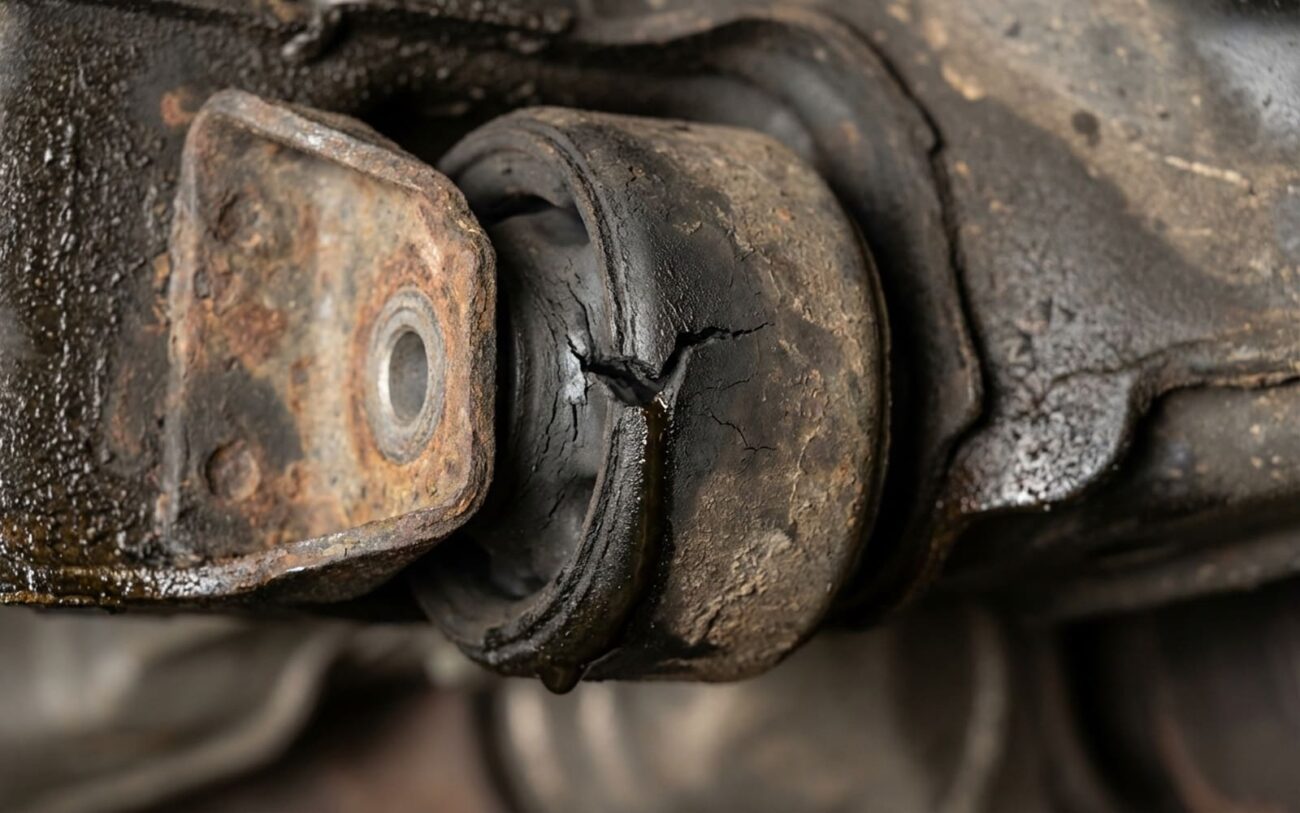
Worn differential mounts: Grab the differential housing and try to rock it. Any significant movement or tearing in the rubber bushings? That’s a common clunk source.
-
Failed subframe bushings: These are often overlooked. Inspect them for cracks, tears, or excessive play. A bad subframe bushing can make the whole rear end feel loose and clunky.
-
Worn driveshaft guibo (flex disc): This rubber coupling on the driveshaft can degrade. Look for cracks, tears, or missing chunks. A bad guibo will often give you a clunk on acceleration and deceleration.
-
Center support bearing: This one gets misdiagnosed a lot. A bad center support bearing won’t usually make a single clunk. It’ll produce a constant vibration or hum that increases with speed. If you have that, look here, not in the diff.
Step 2: Isolate the Rear Axle Assembly
If the external stuff looks good, then it’s time to dig into the axle itself. This is where you need to get hands-on:
-
Rotational Lash Test (Single Clunk): With the car on the lift, transmission in Park, grab one rear wheel. Rotate it back and forth by hand. Watch the driveshaft input flange on the differential. If you can rotate the wheel a significant amount (more than a few degrees) before the input flange starts to move, you’ve got excessive lash somewhere between the wheel and the differential. Now, isolate it further:
- If the wheel moves but the axle shaft doesn’t immediately, suspect the axle shaft splines at the differential.
- If the axle shaft moves but the differential output flange doesn’t, suspect internal differential wear.
For precision, I’ll put a dial indicator on the differential output flange. If I see more than 0.5mm of rotational play here, that’s a strong indicator of internal wear or worn axle splines.
-
Visual Inspection (Rhythmic Clunk): If you’re chasing a rhythmic clunk, you’re looking for different things:
- Axle shaft splines: Pull the axle shaft from the differential and the hub. Inspect the splines for polishing, pitting, or galling. This is common where the axle shaft meets the stub axle or differential side gear.
- CV Joints: Check for torn boots, grease leakage, or any free play in the CV joint itself. Grab the axle shaft and try to twist it, or push/pull it. Any crunching or excessive play points to a failing CV joint.
- Wheel bearing: Rock the tire at 12 and 6 o’clock, then 3 and 9 o’clock. Any play here indicates a worn wheel bearing, which can sometimes produce a clunking, grinding, or humming noise.
Root Causes: Why This Happens
Once you’ve confirmed the issue is indeed inside the rear axle assembly, it usually boils down to three main factors: material fatigue, poor lubrication, and corrosion. These things don’t happen overnight, but they combine to create that clunk.
The BMW Factor (SIB 33 10 07):
This isn’t just theory. BMW actually issued a technical bulletin (SIB 33 10 07) for E60/E61 models specifically addressing insufficient factory lubrication on axle splines. The official fix involves disassembling the axle, cleaning the splines, and applying a special corrosion-resistant paste. It’s a pattern you see across many brands with sealed axle designs that rely on a thin film of grease to prevent wear.
Think about it: high-torque applications put immense stress on those axle shaft and differential splines. Every time you accelerate, that force is transmitted through a few square inches of metal. Cyclic loading leads to micro-cracking, especially in heat-treated steel. And if the gear oil hasn’t been changed, it loses its film strength, leading to metal-to-metal contact and galling. Finally, moisture ingress through clogged vents or torn boots causes rust, which increases friction and creates gaps in those splines, eventually leading to that clunk.
The Fix: Resolution Pathways
This Ain’t a DIY for the Faint of Heart
Look, I’m all for saving a buck, but these repairs often require specialty tools, press equipment, and strict adherence to factory torque-plus-angle specs. Most of this is beyond the average home mechanic’s garage setup. If you’re not confident, take it to a pro.
Can you buy yourself some time? Sometimes. Draining the old, possibly contaminated gear oil and refilling with fresh, OEM-spec fluid (like SAF-XJ with FM Booster for many BMWs) might reduce the noise temporarily. But let’s be clear: it only masks the symptom. The mechanical play is still there, and it will eventually get worse.
Post-Repair Validation: Did We Fix It?
Any good technician knows the job isn’t done until you’ve validated the repair. Don’t skip this. Start with another rotational lash test on the lift. With the transmission in Park, rotate the rear wheel back and forth. The movement should be smooth and minimal. For precision, use that dial indicator on the output flange again; you want less than 0.3mm of rotational lash now. If you replaced the differential, confirm backlash is within OEM specs (typically 0.08mm to 0.15mm) before you even install it.
Then, it’s road test time. Perform multiple hard launches from a stop. Listen critically for any clunks and feel for vibrations during aggressive throttle transitions, as well as during light throttle and coast-down. If the noise is gone and the car feels solid, you’ve done it right.
The Bottom Line: Cost, Risk & Your Wallet
| Repair Type | DIY Cost (Parts) | Shop Cost (Est.) | Success Rate | Secondary Risk |
|---|---|---|---|---|
| Replace one axle shaft | $300 – $600 | $800 – $1,400 | 95% | Low if done correctly; high risk of wasted money if misdiagnosed. |
| Replace wheel bearing/hub | $250 – $500 | $700 – $1,100 | 95% | Moderate; improper press fit can lead to premature failure. |
| Differential rebuild/replacement | $1,500 – $3,000 | $2,500 – $4,500 | 90-98% | High; a faulty rebuild can cause catastrophic gear seizure. |
Here’s my rule of thumb on these kinds of repairs: if the estimated repair cost exceeds 40% of the car’s current private-party value, you need to seriously reconsider the investment. For older BMWs, that threshold comes up fast, and you might be better off putting that money towards a newer vehicle.
Prevention: Keep That Clunk Away
My Maintenance Checklist
-
Change that differential fluid: I don’t care what the “filled for life” label says. Change it every 60,000 miles, especially in high-performance or AWD vehicles. It’s cheap insurance.
-
Use the right stuff: Always use the correct OEM-specified gear oil with friction modifiers. Don’t cheap out here.
-
Inspect seals and boots: Annually, or at every oil change, quickly check your differential seals and axle boots for leaks or tears. Catching a torn boot early can save you an axle.
-
Listen for early signs: Pay attention to any faint “tick” or “click” during takeoff. That’s often the earliest sign of lash developing, long before it becomes a full-blown clunk.
