If your DRLs go out when you turn on the headlights, that’s not a bug—it’s by design. I’ve had this conversation hundreds of times in the bay: customer walks in, convinced their daytime running lights are broken, only to find out the system’s working exactly as engineered. But if the DRLs stay on with the low beams, or flicker like a strobe, now we’ve got a real issue. Let’s cut through the noise and get straight to what’s actually failing—and how to fix it right.
First: Know What Normal Looks Like
DRLs exist for one reason—visibility in daylight. Once the low beams come on, whether manually or via auto-sensing, the system disables the DRLs. Why? Because running both is redundant and can blind oncoming traffic in low-light conditions. This behavior is baked into the BCM logic on most North American vehicles, especially those built after Canada’s DRL mandate influenced OEM designs.
So if your DRLs shut off when you flip the switch—good. That’s correct operation. Don’t waste time chasing ghosts.
Symptoms That Actually Matter
Real problems show up in three distinct ways. Everything else is noise.
- DRLs stay on with low beams — This is a control logic fault. The BCM isn’t overriding the DRL output when it should. Common on Hondas and GMs with outdated firmware.
- Flickering during beam transition — Classic electrical gremlin. Usually a bad ground (G201 or G203 on GMs, junction block under dash on Toyotas) or worn headlight switch contacts.
- No DRLs at all — Could be a fuse, failed ambient light sensor, or dead DRL module. But don’t jump to conclusions—verify power and ground first.
And yes, I’ve seen guys replace BCMs because they skipped checking the $5 fuse in the underhood box. Don’t be that guy.
Where to Look: Control vs. Components
The trick is knowing whether the fault is in the brain (BCM) or the body (wiring, switches, grounds). Here’s how I break it down:
| Symptom | Likely in DRL Control Logic | Common External Mimics | Definitive Test to Confirm Source |
|---|---|---|---|
| DRLs ON with Low Beams | BCM programming fault, aftermarket DRL hack | Wrong bulb (single-filament in dual-filament socket), failed headlight switch |
Scan tool: check BCM config. Verify bulb type and socket wiring against factory diagram.
|
| DRLs flicker with beam switch | Poor ground (G201, G203), failing multifunction switch | Internal DRL module failure |
Voltage drop test on ground circuit (should be <0.1V). Inspect switch contacts for carbon buildup.
|
| No DRLs at any time | Blown DRL fuse, DRL module failure, BCM output dead | Faulty ambient light sensor, damaged harness near headlight |
Check battery voltage at DRL module power pin (ignition ON). Use scan tool to command DRL output.
|
What Actually Fails in the Module?
I’ve cracked open more than a few “failed” DRL modules and BCMs over the years. Most of the time, it’s not the hardware—it’s the software. A voltage spike during a jump-start or a power interruption while the BCM was in sleep mode can corrupt the calibration. The DRL disable logic gets scrambled, and suddenly the lights stay on.
But when the hardware does fail, here’s what I find:
- Stuck solid-state relay — Keeps the DRL circuit energized even when it shouldn’t be.
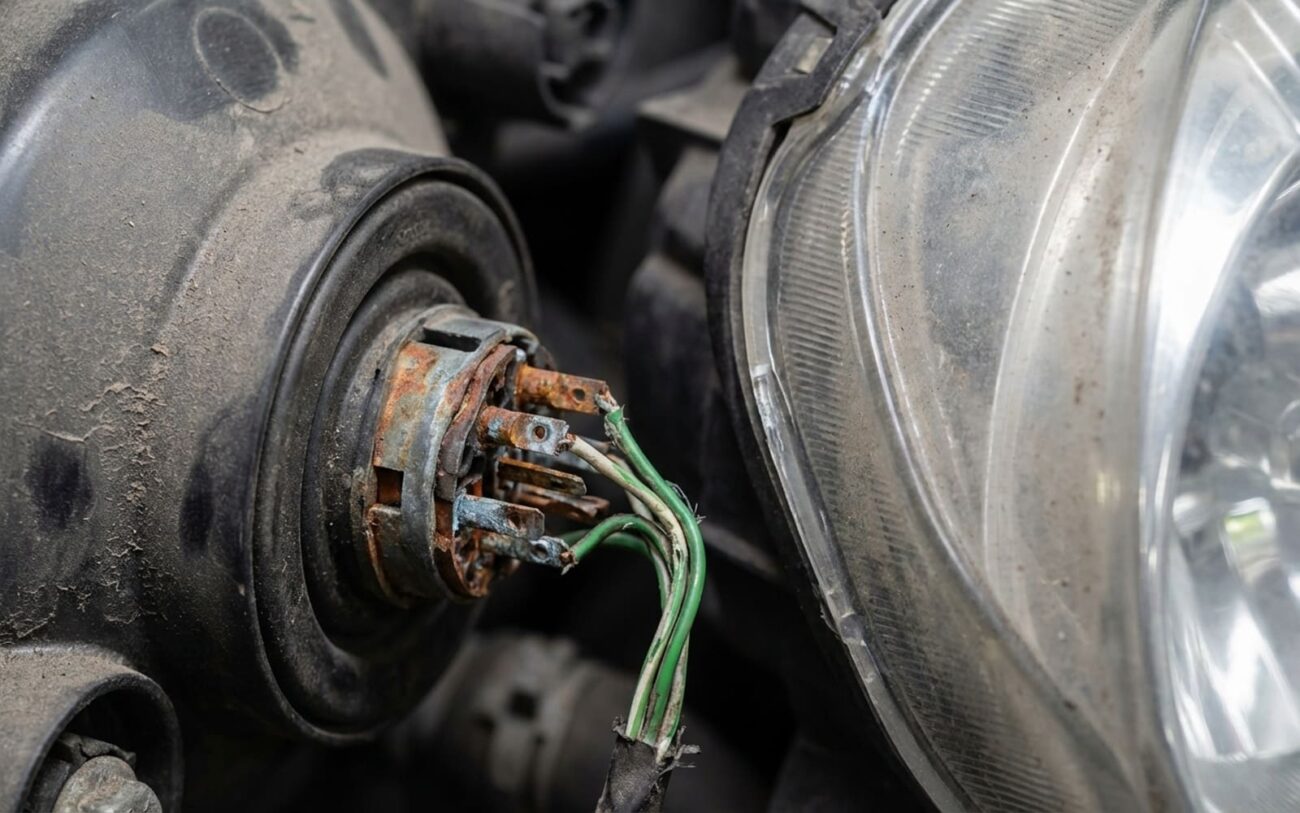
- PCB corrosion — Moisture gets in through a bad seal or connector, eats the traces. Common in older Toyotas with under-hood modules.
- Failed driver transistor — Can’t switch the load. Leads to intermittent or no output.
And before you replace anything: check the simple stuff. A corroded headlight socket or a burned-out bulb looks like a BCM fault when the module’s actually sending the right signal. Always verify the output with a DMM before condemning the brain.
How I Fix It
Software or Configuration Fault Professional-Only Reprogramming DIY-Feasible Check
Dedicated DRL Module Failure DIY-Feasible if Accessible
Internal BCM Fault Professional-Only → Replace/Reprogram
Temporary Fix Last-Resort Option
Did It Actually Work?
Never assume. Test.
For software fixes: DRLs should shut off within 1–2 seconds of low-beam activation. Test it three times—once isn’t enough. If it hesitates or flickers, the BCM didn’t take the update.
For hardware: Use a DMM at the headlight connector. With low beams on, the DRL feed should read 0 volts. Any voltage means the circuit’s still live—and the problem’s not solved.
What’s This Gonna Cost?
BCM Reprogramming
DIY: $0 (if you own a capable scan tool—otherwise $500+ investment). Shop rate covers labor and software access. Success rate is over 95% when done right.
DRL Module Replacement
DIY: $50–$150 for the part. Shop: $200–$350 with labor. Almost always a solid fix.
BCM Replacement & Programming
DIY: $300–$600 for the module, but programming still requires pro tools. Shop: $800–$1,500. Only do this if reprogramming fails.
If you’re looking at a $1,200 BCM replacement on a $6,000 car, stop. That’s not a repair—that’s throwing good money after bad. On older vehicles, sometimes the smartest move is to pull the fuse and live with it, as long as it’s legal in your state.
How to Keep It From Coming Back
The #1 cause of DRL logic issues? Voltage drops during BCM sleep cycles or programming. Always use a battery maintainer when working on the electrical system.
Also, avoid aftermarket “always-on DRL” mods. I’ve seen so many hacked resistors and rewired relays that confuse the BCM. They might work for a month—then you’re back in the shop with codes and flickering lights.
And check your lights after a jump-start or battery replacement. A full power loss can reset the BCM’s behavior. On the 2015–2017 F-150s, I see this weekly—customer jumps the truck, and suddenly the DRLs stay on. Reprogramming fixes it every time.
