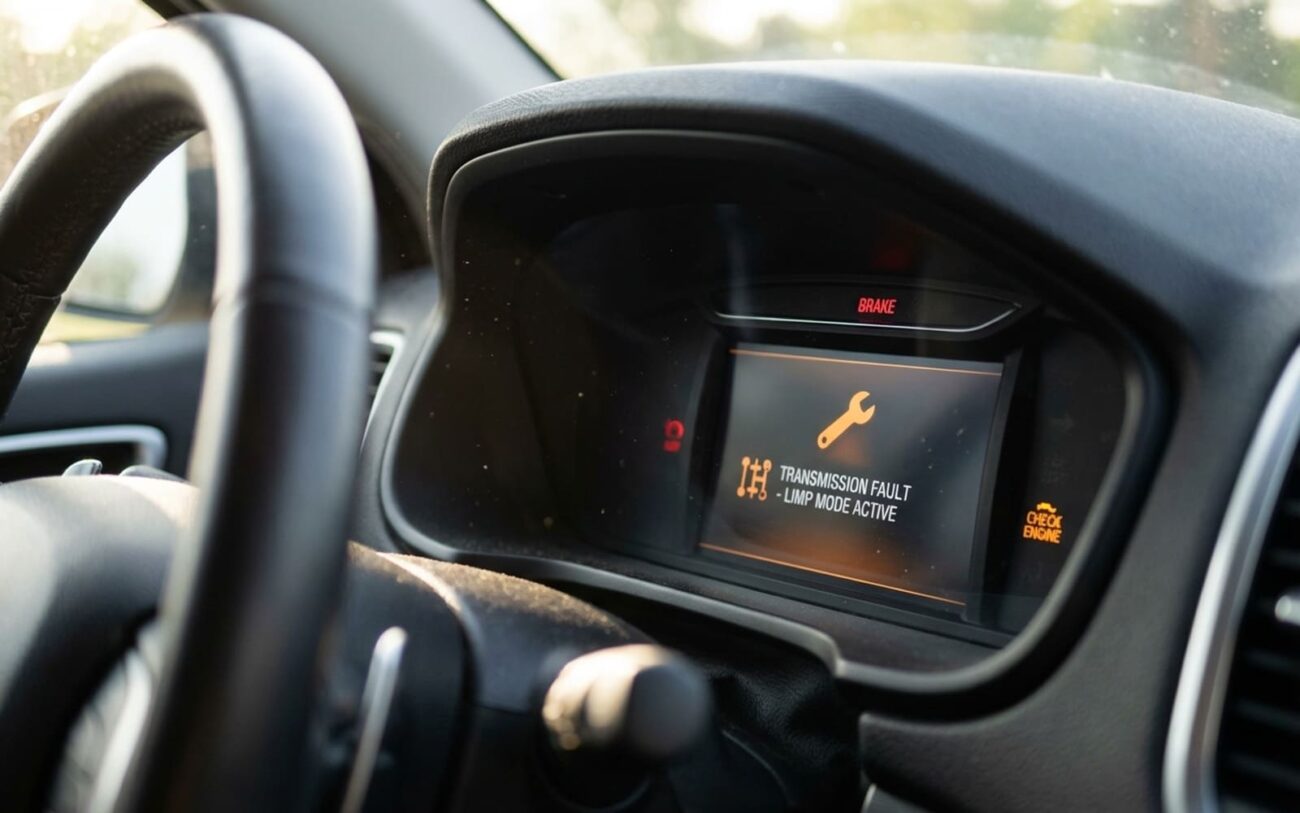
Alright, let’s talk about limp mode. If you’re reading this, chances are your automatic transmission just decided it’s had enough, locking itself into a single gear—usually second or third—and refusing to shift. You might think the transmission just blew up, but from where I sit, after 25+ years under the hood, I can tell you it’s almost never a random mechanical failure right out of the blue. This is your Transmission Control Module (TCM) doing its job, deliberately shutting things down to protect itself and the rest of the drivetrain.
When your car goes into limp mode, the TCM has detected something it considers a critical fault. It cuts power, disables torque converter lockup and overdrive, and locks you into a “safe” gear. You’ll feel a harsh, jerky engagement when you accelerate from a stop. That’s not necessarily a sign of worn clutches; it’s the TCM cranking up the line pressure to maximum, ensuring enough hydraulic force to engage that single gear firmly. It’s a protection mechanism, not a symptom of immediate internal damage, though it can certainly feel like it.
And yes, you’ll almost always see that check engine light glaring at you. Some vehicles even throw up a dedicated transmission warning or an “AT” light. All of these are screaming, “Hey, something’s wrong, get me to a shop!”
Diagnosis: Finding the Real Culprit
Okay, so you’re in limp mode. The million-dollar question is always: what actually triggered it? Is it an electrical glitch, a control system meltdown, or is there something physically broken inside the transmission? Getting this right is everything, because it dictates the repair path and, let’s be honest, the cost. You can’t just throw parts at it and hope for the best.
First things first: Scan for codes.
This is non-negotiable. A professional scan tool is your best friend here. Don’t even think about trying to diagnose this without pulling Diagnostic Trouble Codes (DTCs) from both the engine (ECM) and transmission (TCM) modules. A stuck shift solenoid or a leaking valve body isn’t a TCM failure, but it will absolutely trigger a DTC that forces the TCM into limp mode. The TCM is just doing its job, protecting the transmission from further damage. Without those codes, you’re just guessing in the dark.
Common Triggers & How I Pinpoint Them:
Most limp mode scenarios boil down to a few key areas. Here’s how I approach them:
1. No Shifting, Fixed Gear & Communication Issues
If the transmission is locked solid in one gear and won’t budge, and you’ve got a check engine light or transmission warning, the first place I look is the TCM itself, or its communication lines. Sometimes, the TCM just flat-out dies internally—heat, vibration, age, they all take their toll. Other times, it’s a loss of power or ground, or a breakdown in the vehicle’s Controller Area Network (CAN bus).
My Test: I connect a professional scan tool. Can I even talk to the TCM? If it’s unresponsive, I’m immediately checking power and ground at the TCM connector. If it does respond, I pull all the P07xx (transmission-specific) codes. If you see U-codes (like U0100 for lost communication), that points directly to a wiring or CAN bus issue.
Tech Tip: Don’t overlook engine-related codes (P0300 misfire, for instance). Severe engine issues can sometimes force the ECM to request torque reduction, which can then put the transmission into a limited operating mode, mimicking limp mode.
2. Harsh Engagement in Limp Gear
Remember that harsh, jerky shift I mentioned? While it’s often the TCM defaulting to max line pressure, it can also be a symptom of actual mechanical problems like worn clutch packs, failed accumulator springs, or internal leaks in the valve body. How do you tell the difference?
My Test: I’ll hook up a mechanical transmission pressure gauge. In a true TCM-induced limp mode, the pressure will be pegged at its maximum specification—we’re talking 200-250+ psi, sometimes even higher depending on the transmission. If you have a mechanical leak or a weak pump, that pressure won’t hold steady at max spec. It’s a definitive way to separate a control issue from a hydraulic one.
3. Specific Electrical System Failures (Beyond Codes)
Let’s drill down into the electrical side, because these are often misdiagnosed as major transmission failures.
- Internal TCM Failure: These modules live a hard life—underhood heat, cold, constant vibration. Over years, solder joints crack, internal components fail, or the software gets corrupted. When that happens, the TCM just stops working right, or stops communicating altogether, forcing limp mode.
- Power or Ground Loss: This isn’t about your car battery dying. This is about the dedicated fuse, relay, or wiring that feeds the TCM. I’ve seen countless cases where a corroded connector at the transmission case (especially on front-wheel-drive transaxles) breaks the circuit. Water intrusion is a common culprit on some models, leading to corroded pins and intermittent faults. Also, look for chafed or broken wires at harness bend points, like near engine mounts or where the harness rubs against something.
- CAN Bus Communication Failure: The TCM doesn’t work alone; it talks to the ECM, ABS module, and other systems over the Controller Area Network (CAN). If that network goes down—due to wiring damage, a failing module, or a shorted termination resistor—the TCM can drop offline and default to limp mode. This is a classic “bad transmission” misdiagnosis.
Getting It Fixed: Your Repair Options
Once you’ve done your homework and pinpointed the actual problem, the fix becomes much clearer. Here’s how I typically approach these repairs, depending on what we found.
External Electrical Faults (Wiring, Connectors)
Internal TCM or Solenoid Body Failure Professional Only
CAN Bus Network Fault Professional Only
The “Temporary Fix” (It’s Not a Fix)
Post-Repair Validation: Is It Really Fixed?
Look, a repair isn’t truly done until you’ve verified it. Just because the check engine light is off doesn’t mean the problem’s gone. Here’s my process to make sure the fix actually stuck:
For any electrical repair (wiring, connectors, sensors): The first thing I do is re-scan the system. The TCM absolutely must communicate without any U-codes (like U0100 for lost communication). Then, I clear all the transmission DTCs. After that, it’s time for a proper road test. This isn’t just a quick trip around the block. I’ll drive it for at least 15-20 minutes, including acceleration, coasting, and manually shifting through all gears (forward, reverse, and any manual mode if equipped). The goal is to put the transmission through its paces and ensure no codes return. If they do, you haven’t found the root cause yet.
If you’ve replaced a TCM or solenoid body: After programming and initialization (which, again, requires specialized tools), the transmission needs to shift smoothly under light throttle and firmly under heavy throttle—just like it did from the factory. I always monitor the line pressure PID (Parameter ID) on my scan tool during the road test. In normal operation, that pressure should vary with engine load and throttle position. If it’s stuck at maximum pressure, then either the TCM hasn’t properly relearned its adaptive values, or there’s still an underlying fault forcing it into a fail-safe state. Don’t sign off on the repair until that pressure behaves normally.
The bottom line is simple: if you can’t reproduce normal shift behavior, and the system isn’t holding any codes, then your repair isn’t complete. You’re just waiting for the next breakdown.
The Bottom Line: Cost, Risk, and Common Sense
Alright, let’s talk money, because that’s usually where the rubber meets the road. Here’s a realistic look at what you can expect for these types of repairs.
| Repair Type | DIY Cost (Parts Only) | Shop Cost (Parts & Labor) | My Success Rate | Secondary Risk if Not Fixed Right |
|---|---|---|---|---|
| External wiring/connector repair | $50–$150 | $200–$500 | High (if diagnosed correctly) | Unresolved intermittent issues, potential damage to other electrical components from shorts. |
| TCM/solenoid body replacement | $400–$1,200 | $800–$2,200 | High (with proper programming) | New TCM damaged if the root electrical or mechanical cause isn’t addressed. Incorrect shifting without programming. |
| Full transmission rebuild/replacement | $2,000–$4,000 | $3,500–$7,000+ | High (if done by reputable shop) | Major financial loss if the car isn’t worth the investment. Could be cheaper to replace the vehicle. |
Here’s the hard truth: when transmission repair costs start creeping past 50% of your vehicle’s current market value, you’ve got to think long and hard. Putting $6,000 into a car that’s only worth $8,000 on a good day rarely makes financial sense for most folks. Now, if it’s a classic, a rare model, or has deep sentimental value, then sure, the numbers might not matter as much. But for your average daily driver, that’s usually the point where I tell customers it’s time to seriously consider cutting their losses and looking for a replacement vehicle.
Prevention: Keep Your Transmission Out of Limp Mode
The easiest way to deal with limp mode is to never experience it. A little proactive maintenance goes a long, long way. Trust me, it’s always cheaper to prevent a problem than to fix one.
My Top Maintenance Tips
-
Change your transmission fluid and filter. Don’t just follow the “normal service” intervals; if you do any towing, heavy city driving, or live in extreme climates, stick to the severe service schedule. Fresh fluid keeps solenoids clean, prevents sludge buildup, and helps the transmission run cooler. It’s cheap insurance.
-
Grab a basic OBD2 scanner and use it. Every few months, just plug it in and check for “pending” codes. These are faults that haven’t quite triggered the check engine light yet but are on their way. Catching an intermittent sensor fault early can save you from a full limp mode event later.
-
Inspect the main transmission harness connector. Any time the car is up on a lift, take an extra minute to look at that main connector on the transmission case. Check for fluid leaks, cracked insulation, or corrosion on the pins. A little preventative cleaning or dielectric grease can prevent a huge headache.
