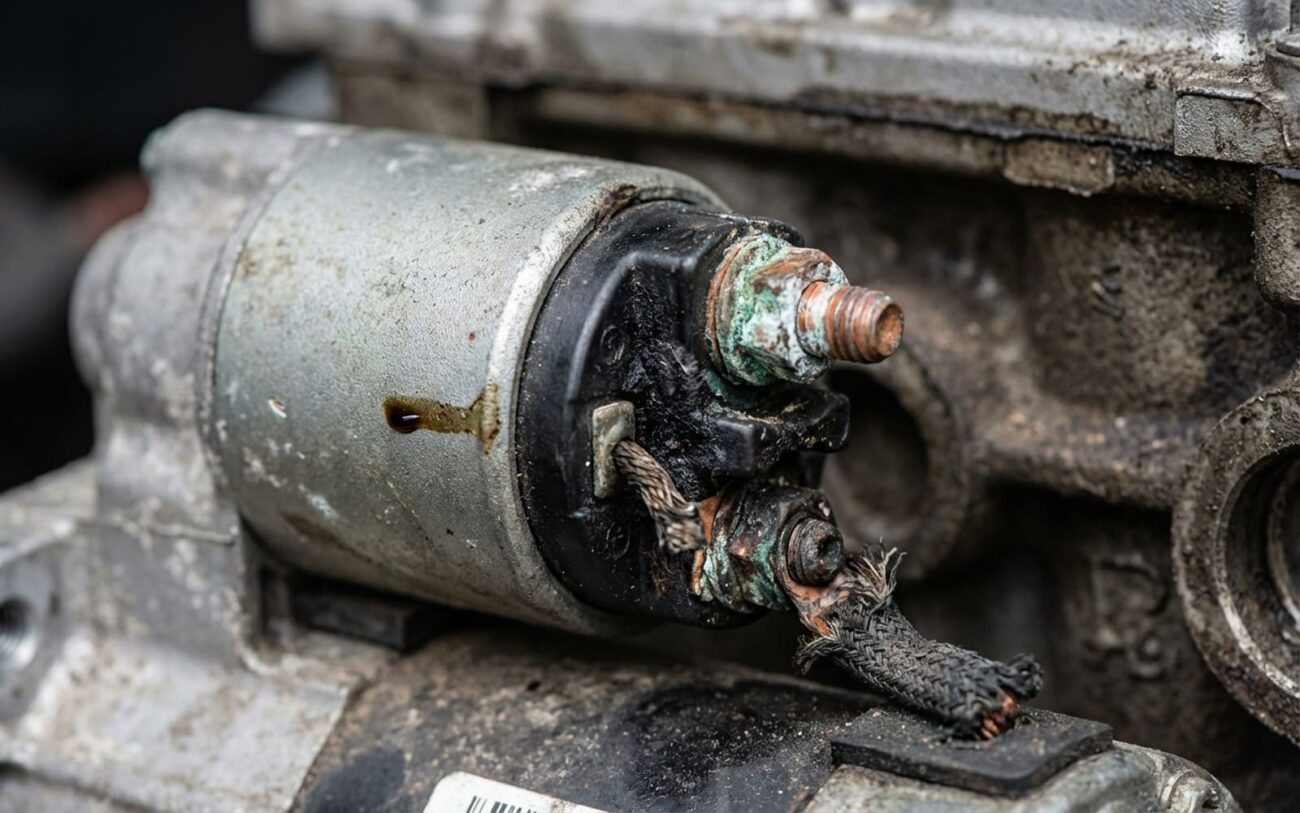
That loud “clunk” when you turn the key? That’s your starter solenoid talking.
I’ve been doing this for over 25 years—two and a half decades of dead batteries, fried solenoids, and customers who’ve been told they need a new starter when all they needed was a $3 wire brush. That single, solid click under the hood? It’s not random. It’s a message. And it usually means: “I tried. But I couldn’t deliver.”
The Sound
You turn the key. You hear one deep, metallic “CLUNK” from the starter—like a relay slamming shut. Then silence. No grinding, no whirring, no attempt to crank. That clunk? That’s the solenoid’s plunger being pulled in by electromagnetism. Its job is to slam a copper disc into two heavy-duty contacts, bridging battery power to the starter motor. When you hear the click but no crank, it means the solenoid moved—but the contacts are cooked. Pitted. Burned. They’re not passing the 200+ amps needed to spin the engine. It’s like flipping a light switch that clicks but doesn’t actually connect the circuit.
Now—don’t confuse that with rapid clicking. That machine-gun chatter? That’s not the solenoid failing mechanically. That’s voltage collapse. The battery has just enough juice to pull the solenoid in, but the second it does, the voltage sags. The solenoid drops out. Voltage recovers. Then it tries again. Repeat. I see this constantly on cars that sit for weeks. Or on vehicles with a single dead cell. It’s not the starter. It’s the battery gasping for air.
Symptom → Test → Fix: The Real Diagnostic Path
You don’t fix this by swapping parts. I’ve seen guys replace starters, then batteries, then alternators—only to find out the problem was a corroded ground strap bolted to the fender. Corrosion, loose cables, bad grounds—they mimic a dead starter every time. So here’s how I do it. Every time. In my shop. No guesswork.
| Symptom | Most Likely Fault | What Else Could Fool You | How to Test (My Way) |
|---|---|---|---|
| Single loud click, no crank | Solenoid contacts burned out | Loose battery cable, corroded starter terminal, dead battery cell |
Voltage drop test. Have someone hold the key in “Start.” Put the multimeter’s red probe on the starter’s main power terminal (big battery cable). Black probe on the starter housing. If you read battery voltage (say, 12.2V) but no crank, power is getting there. Then check the signal side: red probe on the small “S” terminal, black on housing. Should see less than 0.5V drop. Full power, good signal, one click? It’s the solenoid. |
| Rapid clicking, no crank | Weak battery (high internal resistance) | Corroded terminals, loose main cables, bad ground |
Load test. Connect the multimeter directly to the battery posts—clean metal only. Have someone crank. Voltage should stay above 9.6V. If it drops below 9.0V, especially into the 5–6V range, the battery is done. I use a conductance tester (free at most parts stores) to check CCA and state of health. It’s faster and more accurate. |
| No click, no crank, dash lights dim | Failed battery or total power loss | Broken main cable, failed ignition switch, open in relay or neutral safety switch |
Start with static voltage. Below 12.0V? Battery is dead or deeply discharged. Try a jump start. If it fires right up, battery’s the issue. If still nothing—check the starter relay and neutral safety switch. But 90% of the time? It’s the battery, especially if you’ve been ignoring slow cranking for weeks. |
What Actually Fails — And Why
Batteries don’t just “die.” They fail in specific ways. Most common? Sulfation. Let a battery sit below 12.4V for weeks, and lead sulfate crystals harden on the plates. They don’t dissolve back. Surface area drops. Capacity drops. Then there’s internal shorts—collapsed separators between plates. Or grid corrosion over time, especially in hot climates. And vibration? If the battery isn’t clamped down tight, internal connections crack. I’ve seen it on trucks with aftermarket sound systems—big amps, loose batteries, failed cells.
Starter solenoids? They take a beating. Every start, hundreds of amps arc across copper contacts. Over time, that erodes them. Pits form. Carbon builds up. Eventually, the disc can’t make solid contact. The solenoid clicks, but no power flows. Sometimes the contact post loosens in the housing. Or the return spring weakens. Either way, it’s done.
Don’t Assume It’s the Starter
If the solenoid clicks, power is present, but the motor doesn’t turn—it could be a seized armature or dead commutator. If the motor spins but the engine doesn’t crank, maybe the starter drive is shot or the flywheel teeth are stripped. I once had a customer with a hydrolocked engine—liquid in a cylinder—trying to blame the starter. Always rule out the simple stuff first: battery, cables, grounds, control circuits.
How to Fix It — And Do It Right
Replace the Battery
Replace the Starter
Did It Work? Here’s How to Know.
Post-Repair Validation
-
After battery replacement: Cranking should be strong and smooth—no hesitation. Use a scan tool if you have one: “Engine RPM (starter)” should read 150–250 RPM. Re-test voltage during cranking—must stay above 9.6V. Then check charging: engine at 2,000 RPM, headlights on, voltage at battery should be 13.8–14.8V. That tells you the alternator will keep it charged.
-
After starter replacement: Test it three times. Key on, one click, immediate crank, no grinding. If it works once, try it twice more. If it hesitates or makes noise, stop. Could be misalignment or damaged flywheel teeth. I’ve seen starters chew up ring gears on flexplates—especially on transverse V6s where clearance is tight.
Cost vs. Value: Is It Worth It?
Let’s be real. I’ve had customers spend $700 on a starter for a car with 190,000 miles and a transmission that clunks into gear. The starter worked. But three months later, the transmission blew. That $700 didn’t buy reliability. It bought six more weeks of driving.
| Repair | DIY Cost | Shop Cost | Success Rate | Secondary Risk |
|---|---|---|---|---|
| Battery Replacement | $150 – $300 | $200 – $400 |
99% |
Wrong CCA or size can cause undercharging or damage to sensitive modules. |
| Starter Replacement | $100 – $400 | $400 – $800 |
95% |
Improper install can damage flywheel, cause no-start, or drop bolts into bellhousing (especially on transverse V6s). |
| Solenoid Rebuild (if possible) | $20 – $50 | N/A |
80% |
Rebuilt units often fail fast. If the bore or plunger is worn, new contacts won’t fix alignment. |
If the repair costs more than 40% of what the car’s worth to you as reliable daily transport? Think hard. That math rarely works out. I’ve seen too many people throw good money after bad on cars with bigger issues lurking.
Prevent It Next Time
Check battery voltage monthly—above 12.4V off, 13.8–14.8V running. Avoid long cranking cycles. If it doesn’t start in 10–15 seconds, stop. Let it cool. And inspect terminals and grounds every year. Clean them. Tighten them. Dielectric grease. That’s 80% of electrical issues right there.
