Radio died after a car wash? Don’t replace the head unit.
I’ve seen this a hundred times: customer pulls out of the tunnel wash, radio’s dead. No AM, no FM, SiriusXM stuck on “Searching.” But the screen still lights up, Bluetooth works, USB plays fine. So what’s really broken?
It’s not the radio. The tuner’s fine. The problem is upstream — specifically, the antenna signal path. Water got in somewhere, shorting the RF feed before it ever reaches the head unit. On FM, that means a constant hiss. AM? Dead silence or buzzing. Satellite just hunts. And while the head unit won’t fry — its input stage is protected — leave it wet and you’re inviting corrosion that’ll kill the signal for good.
Diagnose like a pro: start with the multimeter
Don’t guess. Test.
First, rule out the obvious. If the display’s dead or USB doesn’t work, yeah — you might have a bad radio. But if only the tuner’s down, the fault is external. Water intrusion is the prime suspect, especially if it happened right after a wash or heavy rain. But don’t stop there — could also be a blown antenna amp (common on satellite systems), a pinched coax in a door pillar, or even a failed tuner. Timing tells you a lot, though. If it died immediately after water exposure? That’s your smoking gun.
Here’s how I check it in my shop:
Access the back of the head unit. You’ll need to pop off trim or a faceplate — depends on the car. Look for the thick coaxial cable with the FAKRA connector (usually black, sometimes red). Unplug it.
Set your digital multimeter to ohms (Ω). Put one probe on the center pin of the vehicle-side connector, the other on the outer metal shield. You’re checking for a short to ground.
| Symptom | Likely Issue: Antenna Connector or Seal | Other Possible Causes (External Mimics) | Definitive Test to Confirm |
|---|---|---|---|
| Total signal loss after car wash or heavy rain | Water bridging the center conductor to the shield at the antenna base or connector, creating a short to ground | 1. Failed antenna amplifier (if equipped) 2. Open or short in coaxial cable run 3. Internal tuner failure in head unit |
1. Disconnect antenna cable at radio 2. Measure resistance between center pin and outer shield 3. <10 kΩ = short in antenna system Infinite resistance (OL) = likely failed amp or head unit |
If your meter reads under 10 kΩ, you’ve got a short. Now isolate it.
Go to the antenna base — roof, fender, or trunk lid. Disconnect the coax there. Test again. If the short’s still there, the problem is at the base or in the connector housing. If the short disappears, the fault is in the cable run — maybe it’s pinched in a pillar, or the shield’s grounded out inside the body.
Why the seal fails — and where water sneaks in
This isn’t rocket science. It’s wear and tear.
The rubber or silicone gasket around the antenna mast takes a beating. Heat, cold, UV, car wash chemicals — they all degrade it over time. It hardens, shrinks, loses elasticity. Once that happens, a high-pressure spray doesn’t need a gap. It’ll force water right past the seal.
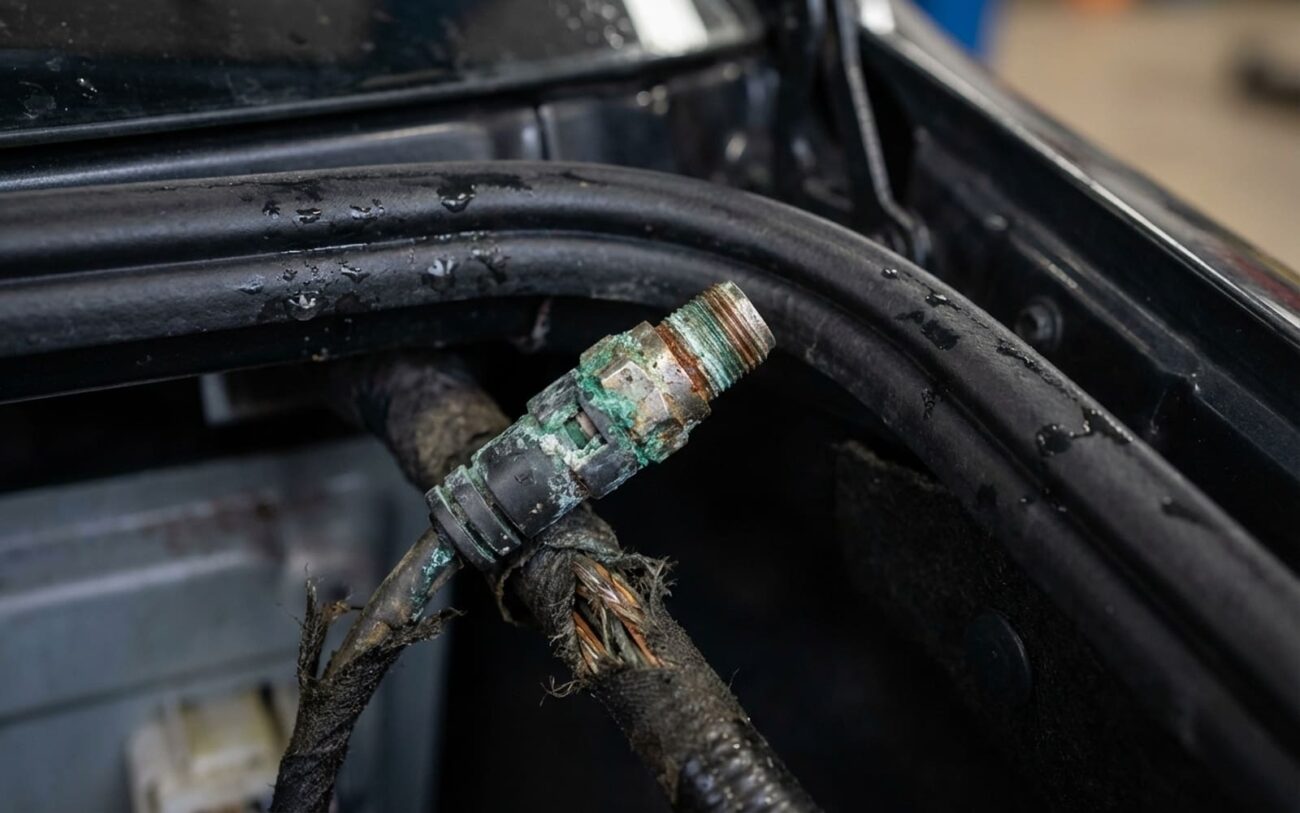
And that’s all it takes. A single drop bridging the center pin to the grounded housing kills the signal. I’ve pulled connectors that looked perfect from the outside — but inside? Green with corrosion. Copper pin, steel housing — classic galvanic corrosion setup.
Also: check for prior damage. If someone yanked the coax out instead of pressing the release tab, they might’ve bent the center pin or torn the internal seal. That kind of hack-job never seals right, even if it screws back together.
And don’t forget — satellite antennas (like the shark fin on BMWs or Hondas) have their own amplifiers. Same vulnerability. Water gets in, kills the amp, and now you’ve got no XM, no HD, maybe no AM/FM either.
Fix it right: three real-world paths
[DIY-FEASIBLE] Path A: Mast-style antenna with accessible connector
This is the easy one. Common on older Toyotas, Fords, Jeeps. Remove the trim cover (plastic pry tool — don’t scratch the paint), loosen the mounting nut — torque spec is usually 35–50 inch-pounds. Over-tighten it and you’ll crack the base or crush the seal.
Unplug the coax. Clean the center pin and socket with electrical contact cleaner and a soft brush (an old toothbrush works). Blow it out with compressed air — moisture hides in tiny crevices.
Inspect the rubber gasket. Cracked? Flattened? Brittle? Replace it. OEM or quality aftermarket — doesn’t matter, as long as it seals.
Before reconnecting, apply a small amount of dielectric grease to the connector. Not a glob — just enough to coat. It displaces moisture and prevents corrosion. I use Dow Corning 4, but any good silicone-based grease works.
Reassemble, torque the nut properly, and test. This fixes 8 out of 10 cases where water just got in.
[PROFESSIONAL-ONLY] Path B: Shark fin or roof-mounted antenna
Professional Only
On modern cars — think BMW, Mercedes, most SUVs — the antenna’s buried under the headliner. Getting to it means removing A, B, or C-pillar trim, sun visors, maybe even roof handles. It’s not hard, but it’s time-consuming, and one wrong move cracks a clip or creases the fabric.
If the center pin’s corroded, you’ll need a FAKRA depinning tool to pull the terminal. You can’t just jam a paperclip in there — you’ll wreck the connector.
A pro also knows how to reseal it properly. Heat-shrink boots, proper cable routing, avoiding sharp bends in the coax — all critical. I’ve seen DIYers kink the cable inside the pillar, killing the signal even after a clean connector.
If you’re not comfortable with interior trim removal, skip it. Pay a shop. Labor’s $100–$150/hour, but it’s worth it.
[NON-REPAIRABLE → REPLACE] Path C: Corroded base or damaged cable
Sometimes the antenna base is molded, and the connector’s shot. Or the coax is frayed inside the body. No fix. You replace the whole assembly.
New antenna base or coax harness — $150–$400 depending on the car. Labor’s 1.5–2 hours. But it’s a permanent fix. No guessing, no comebacks.
On some Hondas and Acuras, the shark fin module is a sealed unit — if the amp’s dead, you swap the whole thing. No repair possible.
[TEMPORARY / LAST-RESORT] Quick moisture displacement
If you’re stranded and need a quick test, a shot of WD-40 can help — but use it sparingly. Spray it into the connector housing, wait 30 seconds, blow it out with compressed air. It’ll push out water and might restore signal.
But don’t make a habit of it. WD-40 leaves residue that attracts dirt and degrades conductivity over time. And never use it on connectors with integrated amps — that gunk can migrate into the circuit board.
This is a field expedient, not a repair. Fix it right later.
Verify the repair — don’t just assume it’s fixed
Radio comes back on? Good. But is it really fixed?
Tune to a weak station — one that was noisy before. You should get a clean lock, no static. If your radio has a signal strength meter, compare before and after. Even better: do a multimeter check on a dry day.
Disconnect the antenna cable at the radio. Measure resistance between center pin and shield. Should read infinite (OL). Anything less means a lingering short.
For real-world validation: with the radio on and tuned to a weak station, mist the antenna base with a spray bottle. If the signal drops or fills with static, the seal’s still compromised. A proper repair handles light moisture no problem.
Prevent it from coming back
This is easy to prevent — if you do it regularly.
Every few months, inspect the antenna base. Look for cracks in the seal, gaps, or water tracking. If you live in a rainy climate, check it after the first heavy storm. That static you hear? It’s your early warning.
Avoid aggressive car wash brushes. I’ve seen more than one snapped antenna mast from a rotating brush.
And here’s the golden rule: every time you disconnect the antenna — for any reason — apply dielectric grease. Not optional. Not “if you feel like it.” Do it. Chrysler even has a TSB recommending specific grease for their FAKRA connectors. You don’t need OEM, but use a quality product.
A little grease now saves a $500 repair later.
What it’ll cost you
| Repair Type | DIY Cost | Shop Cost | Success Rate | Secondary Risk if Failed |
|---|---|---|---|---|
| Clean, dry, and re-seal connector | $15–$25 (contact cleaner, dielectric grease, gasket) | $100–$200 (1 hour labor) | ~85% for recent water intrusion, no corrosion | Minimal — non-destructive |
| Antenna base assembly replacement | $150–$400 (OEM or quality aftermarket) | $500–$800 (1.5–2 hours labor) | ~98% when installed correctly | Water leaks if seal not seated |
There’s a point where it’s not worth fixing. If the car’s older and the repair’s pushing $600, consider an aftermarket solution. A glass-mount or magnetic antenna on the rear window will restore reception. Not pretty, but it works. Sometimes the smartest fix is the one that doesn’t break the bank.
Pro tip: On 2015–2017 F-150s, the antenna base seal fails all the time. Ford even revised the gasket design. If you’ve got one, replace it with the updated part — it lasts twice as long.
