You turn the key, and the engine drags—like it’s tired. Or worse, you get a click, nothing happens, and after a few tries it fires. That’s the starter talking. And in my 25 years of shop work, I’ve learned: when it starts acting up, you don’t guess. You test. Because 60% of the time, it’s not even the starter.
What Worn Brushes Actually Do
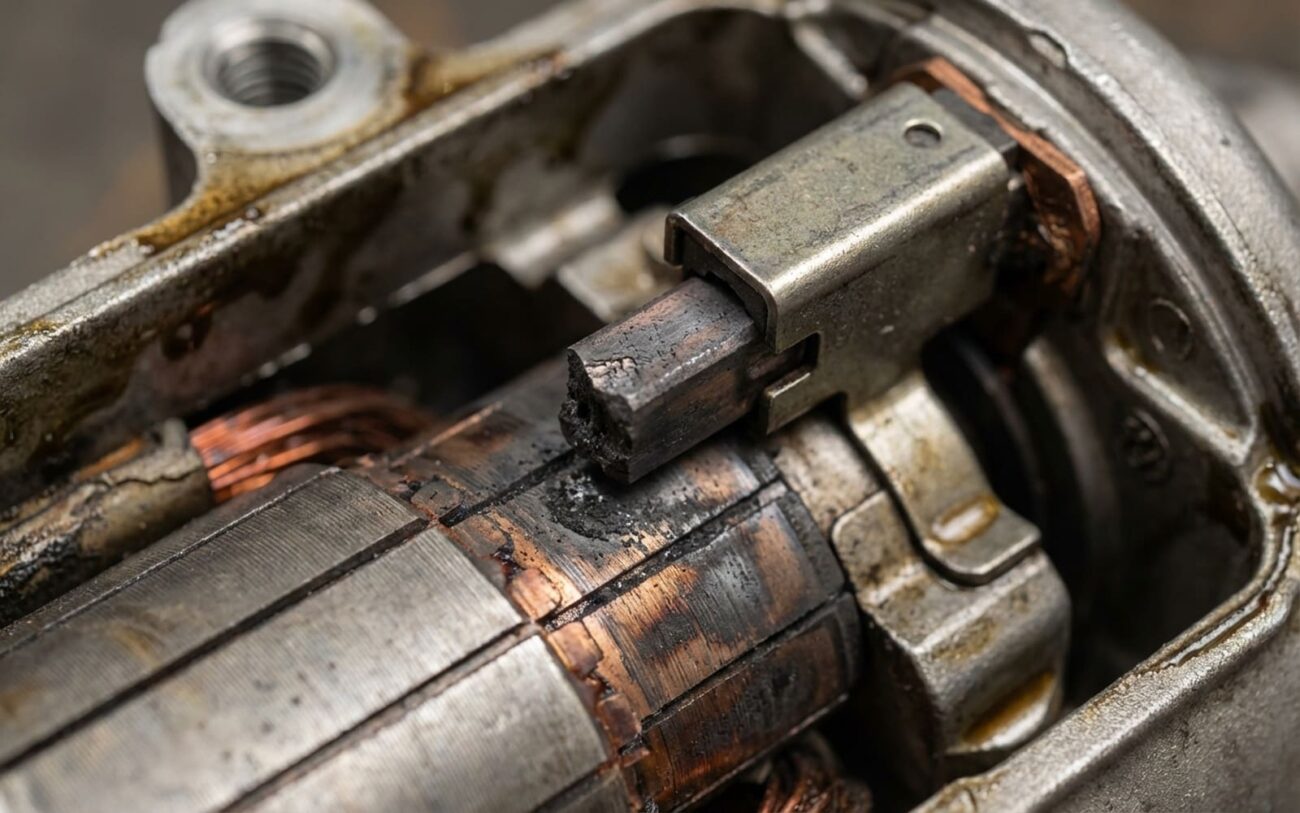
Starter brushes are carbon blocks—about the size of a fat pencil eraser—pressed against the commutator on the armature. They carry hundreds of amps. Over time, they wear down. When they get too short, they don’t make solid contact. Resistance goes up. Current drops. Cranking slows.
It’s a wear item. Not a mystery. Just like brake pads.
But here’s the trap: worn brushes mimic other problems. A weak battery? Same symptom. Corroded cable? Same thing. So before you pull the starter, you rule those out. Every time.
Symptoms That Matter (And One That Doesn’t)
Slow cranking—yes, that’s a sign. But only if the battery is strong and the cables are clean. I’ve seen brand-new batteries fail under load. So test voltage during cranking. If it drops below 10V, don’t blame the starter yet.
Intermittent no-crank—this one’s classic. You turn the key, hear a click, nothing. Then it starts. Or you tap the starter with a wrench and it fires. That tap can reseat a worn brush. But—(and this is big)—it could also be the solenoid, ignition switch, or neutral safety switch.
And here’s the one that doesn’t point to brushes: a spinning noise with no engagement. That’s mechanical. Either the solenoid isn’t pushing the pinion out, or the flywheel teeth are chewed. Seen that on a 2016 Camry—looked like a starter motor issue, turned out to be a $120 flexplate.
How to Test—For Real
First: battery. Load test it. Not just voltage. Load it. If it can’t hold 9.6V at half its CCA, it’s done. I’ve had batteries read 12.6V at rest and collapse under load. That’s not rare.
Then: voltage drop. This is how you find resistance in the circuit. You need a digital multimeter—good one, not a $20 special.
Put the red lead on the battery positive post. Black lead on the starter’s main terminal. Crank. Should be less than 0.5V drop. More than that? Resistance in the cable or connection.
Now: black lead on the starter case, red on battery negative. Crank again. Drop should be under 0.3V. Higher? Ground issue. Clean the block-to-frame strap. I’ve found those soaked in oil and corroded—especially on older Hondas.
If both tests pass? Then the problem is inside the starter.
Next: check the solenoid signal. Use the DMM’s Min/Max function. Probe the ‘S’ terminal while cranking. If you see 12V but the starter doesn’t engage, the fault is internal. Could be brushes, could be the solenoid contacts, could be the armature.
Why Brushes Fail (Beyond Just Wear)
Yes, they wear. But I’ve seen starters with 150k miles and still good brushes. Others die at 60k. Why?
Contamination. Dust, oil mist, metal shavings from the commutator. They pack into the brush holders and jam the movement. I pulled apart a starter from a dusty farm truck—brushes stuck halfway. No amount of cleaning would’ve saved it on the vehicle.
Arcing. Happens when the engine is hard to start—say, a failing fuel pump or compression issue. Longer cranking = more current = brushes bounce on the commutator. That causes sparking. Burns the face. Pits the copper. Once that starts, it’s a death spiral.
And spring tension. Those little springs lose strength over time. Heat cycles, vibration. I’ve measured them with a gram scale—some down to 40% of spec. Weak spring = poor contact = more arcing = faster wear.
Here’s the truth:
A weak battery doesn’t cause worn brushes. But it makes a marginal starter fail faster. So fix the battery first. Always.
What to Do Now
Replace Brushes (If It Makes Sense) DIY-FEASIBLE for experienced technician
Replace the Starter PROFESSIONAL-ONLY
Scrap It NON-REPAIRABLE → REPLACE UNIT
Did It Work? (Spoiler: Test It)
You can’t just say “it cranked once.” That’s not a test.
First: measure no-load current. Clamp an amp meter on the main cable. Should be 80–150A. Higher? Something’s dragging—maybe a bent armature or bad bushing.
Then: real-world test. Battery voltage during cranking should stay above 10.0V. If it dips lower, something’s still wrong.
And do hot restarts. Drive it, shut it off, try starting again in 5 minutes. Heat-soaked starters fail when hot. If it drags then, you missed something.
Validation Checklist
-
No-load current in spec? (80–150A)
-
Battery voltage stays above 10.0V during crank?
-
Starts hot and cold?
-
No unusual noises or smells?
Keep It From Happening Again
Don’t crank more than 10–15 seconds at a time. I’ve seen starters left engaged for 30 seconds—cooked the windings in two tries.
Wait 1–2 minutes between attempts. Let it cool.
Maintain the battery. A weak one forces the starter to work harder. Check terminals every oil change. I’ve found more than a few with green crust holding them on.
And listen. If cranking gets slower over weeks, don’t ignore it. That’s your first warning. Test early.
One Last Thing
If repair cost hits 25% of the car’s value, go reman. For a $5,000 car, that’s $1,250. A reman starter at $180 with a 2-year warranty beats $400 in labor chasing a bench rebuild.
