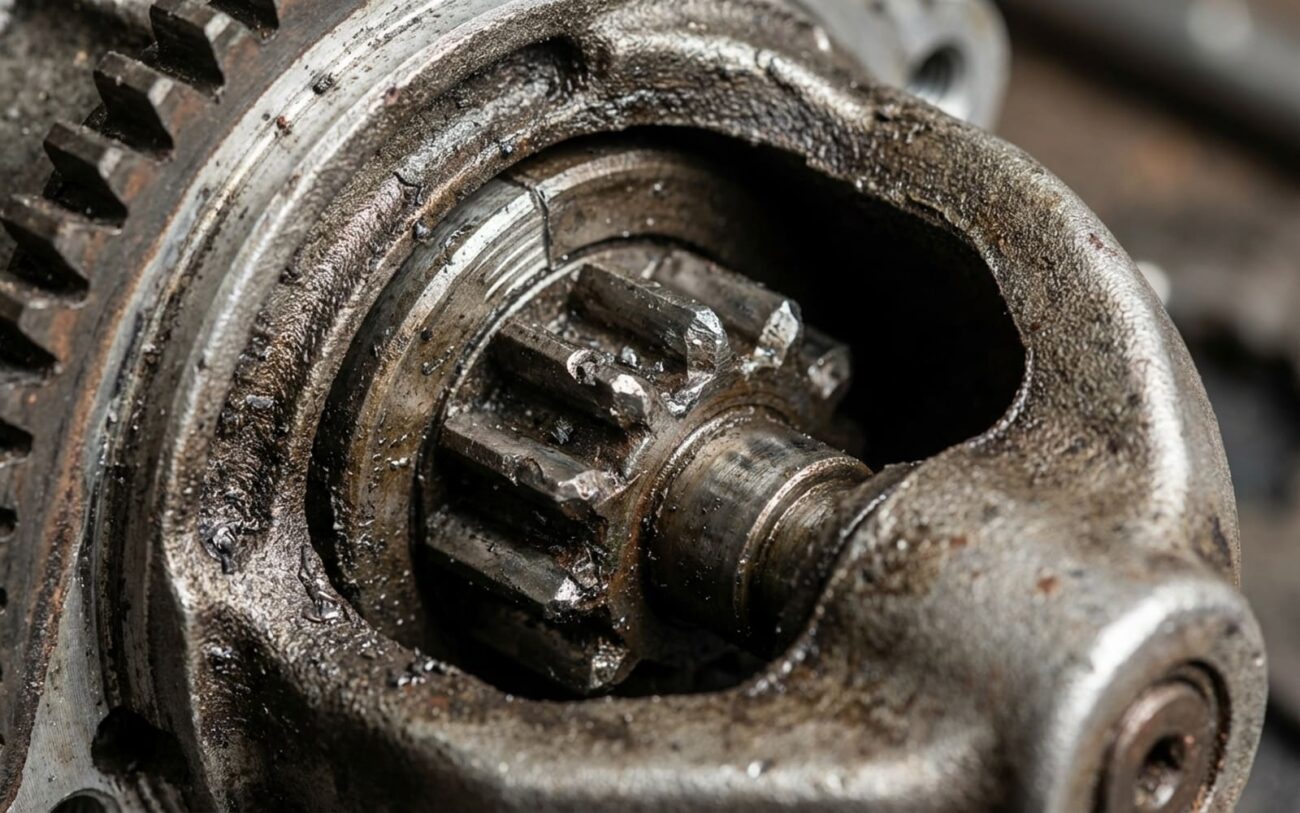
That whine after startup? You’re killing your starter
I’ve pulled starters apart where the armature looked like it had been through a woodchipper — copper windings flung out like spaghetti, insulation burned to carbon, bearings seized from overspeed. Every time, the story starts the same: engine fires, but instead of silence, there’s a high-pitched metallic whine that won’t quit. That’s not normal. That’s your starter being spun at 6,000 RPM by a running engine — twice what it’s built for.
The culprit? A stuck Bendix drive. That little pinion gear on the starter is supposed to shoot forward, engage the flywheel, spin the engine, then retract the instant the engine catches. When it doesn’t retract, the running engine keeps spinning the starter motor like a turbine. And it doesn’t take long before something gives.
I’ve seen starters explode internally. I’ve seen mounting bolts shear. I’ve seen ring gear teeth stripped clean off — and once, a cracked bellhousing on a GM 4L60E because the starter walked loose under load. That’s how a $300 repair becomes a $1,800 nightmare.
If you hear that whine, shut it off. Now. Not “in a minute.” Not “after I park.” Every second it spins adds damage. I don’t care if the car runs fine — you’re not driving it, you’re destroying it.
Is it really the starter? Here’s how I know
Not every whine is a stuck Bendix. Alternators scream when bearings go. Tensioners chirp. But those noises come and go with belt load. A stuck starter whines the second the engine fires — and it tracks RPM. Steady high pitch, no fluctuation. That’s the fingerprint.
Here’s how I confirm it:
| Symptom | Points to Stuck Bendix | Common Mimics | Definitive Test |
|---|---|---|---|
| Whine starts immediately at engine start and holds steady | Pinion locked in, starter overspinning | Failing alternator bearing, dry idler pulley |
Use a long screwdriver as a stethoscope. Touch it to the starter body while cranking. If the noise peaks there, it’s the starter. For certainty, pull it and inspect. |
| Grinding during crank, then whine after start | Bendix not retracting — mechanical bind or spring failure | Worn ring gear |
Borescope the ring gear through the starter hole. Rotate engine by hand. If teeth are intact, the fault is in the starter — not the flywheel. |
Still not sure? Remove the serpentine belt and run the engine for 15–20 seconds. No whine? Then it’s an accessory — likely alternator or tensioner. But if the noise stays, the starter’s guilty.
And here’s one more check: test the alternator for AC ripple. Set your multimeter to AC volts, probe the output terminal while running. More than 0.5V AC? Diodes are failing — that’s a whine with a different source. But if that’s clean, and the noise is at the starter, don’t guess. Pull it.
Why the Bendix gets stuck — and it’s not the solenoid
Let’s clear this up: a stuck solenoid keeps power applied — you’ll hear continuous cranking, like the key is held too long. That’s electrical. A stuck Bendix is mechanical. The solenoid has already released — but the gear won’t pull back. That’s different. That’s internal drag.
Most of the time, it’s gunk. The Bendix rides on helical splines — think of them like a threaded rod. They need to slide smoothly. But old grease, salt, moisture, and heat turn that grease into varnish. I’ve pulled starters from coastal trucks where the shaft was coated in black tar — no way the spring could pull it back.
Heat’s a killer too. Stop-and-go traffic, short trips, engine bay temps over 200°F — that bakes the lubricant. I’ve seen it happen on a 2018 Silverado with a clogged radiator. The starter wasn’t old — but the grease was cooked solid.
Other causes? A weak or broken return spring. Worn or burr’d shaft. Damaged overrunning clutch. Or previous hard engagements that cracked the internal damper. But here’s the thing: if the ring gear is chewed up, you’d hear grinding during crank — not a clean start followed by whine. If the ring gear’s intact, the problem’s in the starter.
How to fix it — and what not to do
This isn’t a DIY gamble
On older starters, you can sometimes rebuild the Bendix. On modern ones? Forget it — it’s sealed. And even if you can open it, one mistake and you’ve got a paperweight.
Clean & Lube — Only If You Know What You’re Doing
Replace the Whole Starter — The Smart Move
How to know it’s really fixed
Don’t assume the new starter works. I’ve installed brand-new remans that whined on the first start. Test it.
If you rebuilt it, bench-test: apply 12V. Pinion should shoot out, motor spin. Cut power — gear retracts instantly. Any hesitation? It’s junk.
After install: crank the engine. Engagement should be smooth — no grind. The second the engine fires, you should hear a distinct click — that’s the solenoid releasing and the Bendix retracting. Then silence. No whine. No delay.
For a pro check: clamp an inductive ammeter on the starter cable. After cranking, current should drop to zero. If you’re still drawing 2–3 amps? Something’s wrong — bad relay, wiring issue, or defective starter. Don’t ignore it.
