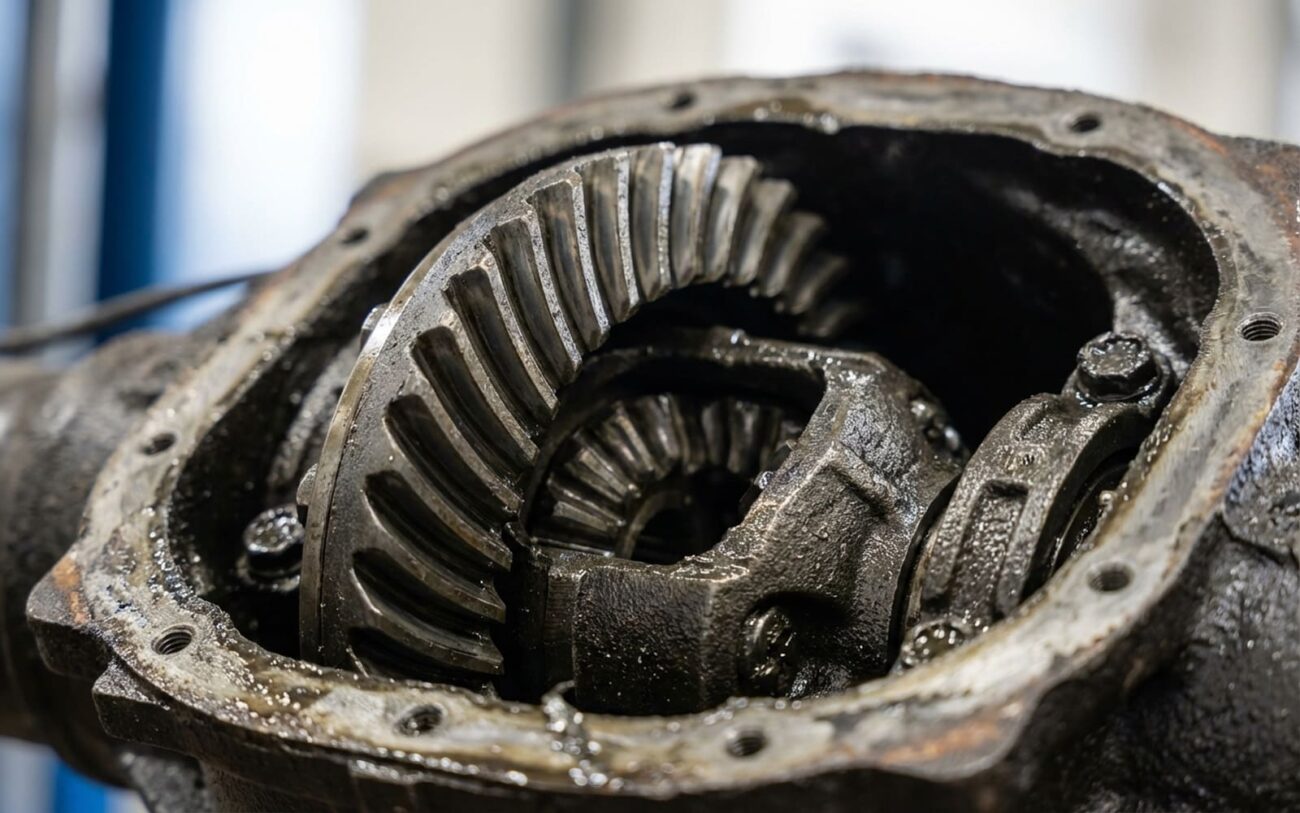
After more than 25 years turning wrenches, I can tell you this much: a failing differential doesn’t just give up quietly. It makes noise, it vibrates, and it lets you know something’s wrong. The real challenge, though, isn’t if it’s making a sound, but what that sound means. Is it actually the differential, or is it something else in the driveline trying to trick you? That’s where experience comes in.
Decoding the Signals: What a Worn Differential Sounds and Feels Like
When a rear differential – or final drive, as some call it – starts to go, it’s usually a distinct gear whine. This isn’t your engine or transmission; this noise is tied directly to road speed, not engine RPM. Here’s how I confirm it: if you’re cruising at 60 mph and hear a whine, then shift into neutral and coast, and that whine is still there, strong as ever, you can pretty much rule out the engine and transmission. That’s a differential telling you it’s unhappy.
Pay close attention to how that whine changes. Most often, it’s loudest under acceleration. But if it gets noticeably quieter when you let off the throttle and coast, or changes tone entirely, that’s a classic sign of wear on the ring and pinion gear teeth. We call that a “load-sensitive” whine, and it points straight to the differential’s guts.
Another big red flag is a sharp, metallic clunk. You’ll feel this one, usually when you suddenly hit the gas (throttle tip-in) or let off (throttle tip-out). This isn’t just normal driveline slack – it’s excessive backlash inside the differential. Think worn ring gear teeth, or loose side gears in the carrier. It’s a solid chunk that you feel right through the floorboard, especially during those acceleration-to-coast transitions.
Then there’s the vibration. If you’re feeling a rhythmic shake through the seat or the floor, and it seems to peak at a specific speed range – say, 55 to 65 mph – that could be an out-of-balance component inside the differential. We’re talking about a warped ring gear or a damaged gear tooth causing an imbalance that resonates through the vehicle.
Now, if that whine turns into a constant howl, or worse, a grinding noise that’s present under all conditions, you’re past the early warning signs. That’s usually advanced gear spalling (where chunks of metal flake off the gears) or a bearing cage that’s completely failed. At this point, you’re risking catastrophic failure. I’ve seen broken gear teeth lock up a wheel or even fracture the differential housing. That leaves you stranded, and facing thousands in additional repairs.
- A sudden loud bang followed by a loss of drive or grinding. That’s usually a major component failure.
- Visible metal flakes, or a gritty, glitter-like paste on the differential drain plug magnet. That’s active, ongoing damage, and every mile you drive multiplies the cost.
My Diagnostic Process: Differential or Something Else?
Here’s the reality: a lot of things can mimic a bad differential. A failing wheel bearing can whine, a worn U-joint can clunk, and unbalanced tires can cause speed-specific vibrations. The key, for me, is always isolating the source. A proper road test is the first step, and it’s more than just driving around the block.
For a whine proportional to vehicle speed, after that neutral coast test, I’ll try swerving slightly left and right at highway speeds. If the noise increases when you load one side of the vehicle and decreases on the other, it’s almost certainly a wheel bearing. Differential noise won’t change with that lateral weight transfer. If it’s still pointing to the diff, I’ll get the vehicle on a lift, run it in gear (carefully!), and use a mechanic’s stethoscope directly on the differential housing. That’ll tell you if the noise is truly internal.
That clunk on throttle transition is trickier. It could be U-joints, axle splines, loose engine or transmission mounts, or the diff itself. My go-to here is lifting the vehicle and inspecting the entire driveline. I’ll grab the driveshaft and twist it back and forth, looking for excessive play in the U-joints. Then, I’ll measure the rotational play at the pinion flange with a dial indicator. If I see more than 0.010″ of lash, that’s a strong indicator of internal differential wear – usually excessive ring gear backlash or worn spider/side gears. Don’t forget to check those engine and transmission mounts, too; a broken mount can cause a similar clunk.
If you’ve got a vibration at specific speeds (like 55–65 mph), I always start with the easiest stuff. Are the tires balanced and round? Are the driveshaft U-joints good? Any bent driveshaft? If those check out, then I’ll suspect the differential. Again, on the lift, I’ll spin the wheels and listen/feel. If the vibration persists and isn’t coming from the wheels or tires, it suggests an internal differential imbalance, like ring gear runout or a damaged tooth. That’s when you know you’re looking at a teardown.
What Actually Breaks Inside: The Nitty-Gritty
When I say a differential is “worn out,” I’m talking about the internal components of the carrier assembly. This is the big metal housing that holds the ring and pinion gears, the differential gears (spider and side gears), and all their bearings. The failures usually start small and then snowball quickly.
The most common culprit is gear tooth wear. We call it pitting or spalling. It starts as tiny flakes missing from the surface of the gear teeth, often at the root, where the stress is highest. This isn’t just cosmetic; it’s metal fatigue. Once it starts, it accelerates, leading to chipped or outright broken teeth. And a broken tooth in there? That’s a bad day.
Bearing failure is another frequent issue. The carrier bearings, which support the differential assembly, and the pinion bearings, which support the pinion gear, take a beating. They fail from lack of lubrication (low fluid, wrong fluid), improper preload (usually from a previous bad repair), or sudden shock loads (like hitting a massive pothole or dropping the clutch hard). I’ve seen “fretting” where the bearing’s outer race actually starts to spin in the housing bore, destroying the housing itself. And “brinelling” – those little dents in the bearing races from impact loads – that’ll kill a bearing fast.
Sometimes, though, the housing itself is the problem. I’ve seen carrier bore distortion from severe overheating or structural stress, especially in heavy-duty trucks that tow constantly. When that bore deforms, even brand-new bearings and gears won’t seat correctly and will fail prematurely. Ring gear bolt holes can also elongate under extreme load, allowing the ring gear to shift. When that happens, your gear mesh is gone, and everything eats itself. That’s not just wear; that’s a structural failure.
It’s important to distinguish what’s not a carrier failure:
- A leaking axle seal? That’s just a seal. Replace it.
- A broken axle shaft? That’s a shaft issue, not a gear problem.
- In vehicles with a limited-slip differential (LSD), worn clutch packs that cause chatter or one-wheel drive are serviceable separately. They don’t mean the ring and pinion gears are bad. These are different components sharing the same housing.
Your Repair Options: What I Recommend (and What I Don’t)
This is Professional Territory. Period.
Look, I’m all for DIY, but differential work is not for the faint of heart or the poorly equipped. Your repair path depends entirely on what’s damaged, but almost all differential repairs require specialized precision tools and high-torque equipment. There are no safe shortcuts when setting gear patterns and bearing preloads. Get it wrong, and you’ll be doing it again, or worse, buying a whole new axle.
Loose Ring Gear Bolts Professional Only
Internal Component Repair (Rebuild) Professional Only
Full Carrier Assembly Replacement
Now, let’s talk about temporary fixes – and I’ll be straight with you. Adding high-viscosity oil or a bottle of “limited-slip additive” (if it’s not already spec’d) is a TEMPORARY / LAST-RESORT measure, at best. It might quiet minor LSD chatter for a short time, but it won’t fix gear whine or bearing noise. Worse, it masks symptoms, letting you drive a failing component until it breaks catastrophically. No additive can restore missing metal or correct misalignment. I’ve seen more than one diff turn into a paperweight because someone thought “magic juice” would save it. Don’t do it.
Making Sure the Repair Actually Worked (and How to Keep It That Way)
After a major repair like a gear set replacement, you don’t just drive off the lift and call it good. There’s a break-in and validation process. The main goal? Silence. No whine, no howl, no clunking. I always recommend a 50-mile break-in drive under light to moderate load – no heavy towing or drag racing. Then, use an infrared thermometer to check the differential housing temperature. It should run no more than 50°F above ambient under normal conditions. Excessive heat means friction from incorrect preload or poor lubrication, and that’s a red flag.
The real test comes at the first fluid change, usually around 500 miles. Drain that break-in oil and inspect the drain plug magnet. It should be clean – maybe a light dusting of super fine particles is normal, but absolutely no metal chunks or shavings. If you see anything substantial, that’s a sign of ongoing wear, and you’ve got a problem. For simpler repairs like re-torquing ring gear bolts or replacing a cover gasket, validation is simpler: no leaks, and no return of noise during a test drive that includes hills and throttle transitions.
Prevention comes down to two things: fluid and driving habits. Follow the severe service maintenance schedule in your owner’s manual – differential fluid changes typically every 30,000 to 60,000 miles for most vehicles. Use the exact fluid specified, especially if you have a limited-slip differential. The wrong fluid or degraded oil loses its film strength and leads to accelerated wear. I’ve seen more differentials fail from neglected fluid than anything else.
Avoid shock loading. Don’t spin the tires on ice or gravel and then suddenly hit pavement – those abrupt transitions put massive stress on ring and pinion gears. If you tow or haul, make sure your gear ratio is appropriate for the load and that you’re not overloading the axle. For early detection, make a habit of checking the differential fluid annually or during oil changes. Remove the fill plug (the upper one) and verify the fluid is clean, at the correct level, and not milky (a sign of water intrusion). Catching a problem early – when it’s just a faint whine – can save you from a full gear replacement later. And if a new noise appears right after a tire rotation, it’s likely tire-related, not the diff. Always consider the last thing that was done to the vehicle.
Cost, Warranty, and the Hard Truth
Let’s be realistic: differential repair is not a cheap job. Costs vary widely based on vehicle type, whether it’s an open, limited-slip, or performance differential, and the specific gear ratio. Below, I’ve outlined the two primary repair approaches, their financial implications, and what you should expect.
| Repair Type | DIY Cost (Parts Only) | Shop Cost (Est. Labor + Parts) | Success Rate | Secondary Risk if Repair Fails |
|---|---|---|---|---|
| Complete ring & pinion gear and bearing kit replacement | $400 – $1,200 | $1,500 – $3,000 | 95%+ (by a qualified differential specialist) | Catastrophic gear failure, potential axle lock-up, driveshaft damage, or housing fracture during driving. This is why precision matters. |
| Replacement of entire differential carrier assembly (remanufactured) | $800 – $2,500 (unit cost) | $2,000 – $4,000 | 98%+ (with reputable remanufactured unit) | Low risk if the unit is properly built and compatible; failure usually due to installation error or mismatched components. |
My Financial Rule of Thumb
If the repair cost exceeds 60% of your vehicle’s current private-party value (check Kelley Blue Book or NADA), you need to seriously weigh your options. Dropping $3,500 into a car worth $5,000 might not make long-term sense. Sometimes, a failed differential is the first sign that a vehicle’s remaining service life isn’t worth the investment. It’s a tough call, but it’s one I’ve helped many customers make.
