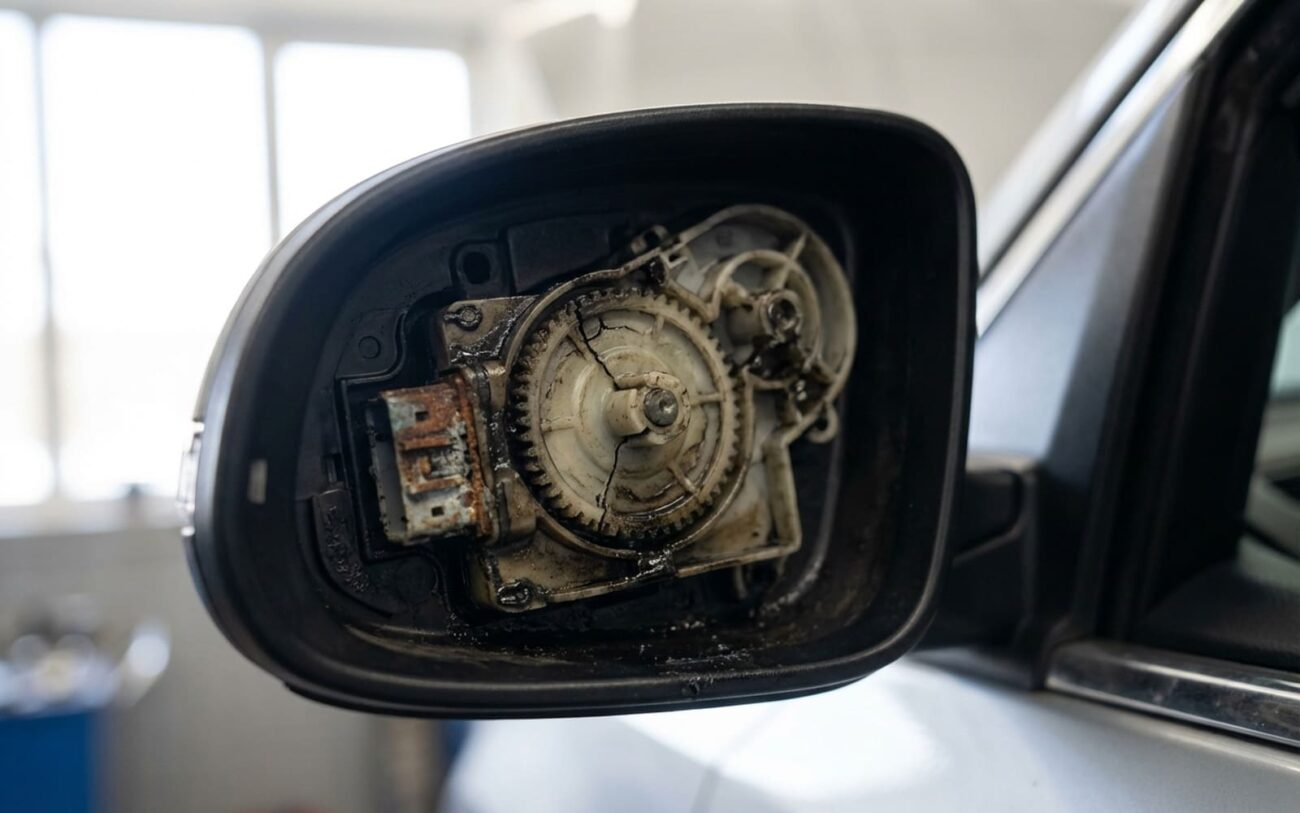
Symptoms That Tell You It’s Time to Look Closer
I’ve seen hundreds of these fail — on F-150s, Camrys, 3-Series BMWs, you name it. And they almost always give you signs before they die completely. The key is knowing what to listen for, what to watch, and when to stop pressing that fold button before you make it worse.
First red flag: silence. You hit lock, the other mirror folds in, but one just sits there. No movement. No hum. Nothing. That’s not always the actuator — could be a fuse, a broken wire in the door boot, or a dead relay. But it’s the starting point.
Sometimes you’ll hear a click from the door panel when you press the switch — that’s the door control module or relay activating. Good sign something’s trying. But if the mirror doesn’t move, the problem is downstream. Either no power is getting to the actuator, or the motor’s toast.
Then there’s the slow crawl. Mirror folds, but it takes forever. Or it starts, stutters, stops halfway. That’s not always electrical. I’ve pulled mirrors apart only to find ice jammed in the pivot, or someone backed into a pole and bent the housing just enough to bind the mechanism. Always check mechanical movement first — don’t assume it’s the motor.
Now, if you hear grinding? That’s bad. Sounds like plastic gears chewing themselves up — because that’s exactly what’s happening. A high-pitched whine or rhythmic clicking? Same story. Internal gear wear. And if you keep using it, you’ll turn a $200 repair into a $600 one.
And here’s one people miss: drift. Mirror folds in, but over time it creeps back out. Or it won’t stay tucked in when you’re driving on the highway. That means the gear train can’t hold position anymore — spring tension or wind pressure is overpowering it. Worn gears. Period.
How I Diagnose — Step by Step
Before you spend a dime on parts, rule out the simple stuff. I’ve had customers show up with a new actuator in hand — and it turns out it was just a blown fuse. Save yourself the hassle.
Start with the fuse. Check your owner’s manual or fuse box diagram. It’s usually labeled “mirror,” “power mirror,” or “door module.” If it’s blown, replace it — but don’t stop there. A blown fuse means a short somewhere. If it blows again, you’ve got a wiring issue.
Next, inspect the wiring in the door boot — that rubber accordion between the door and the A-pillar. Open and close the door a few times while watching it. Look for cracked insulation, frayed wires, or sharp bends. On older Hondas and Toyotas, this is a known failure point. I’ve seen wires break from fatigue after 8–10 years.
Now, test the switch. If both mirrors respond sometimes but not consistently, or only one side works, it could be the switch. But don’t pull it yet — use a scan tool to see if the body control module (BCM) registers the command when you press the button. If it does, the switch is fine.
Here’s where the multimeter comes in. You’ll need to access the actuator connector — usually behind the mirror glass or inside the door panel. Back-probe the pins while commanding a fold/unfold cycle. You should see 12V and a solid ground at the right terminals. If you’ve got power and ground but no movement? Actuator’s done.
If the mirror moves but struggles, check current draw. Use a low-amp clamp meter — it’s the best way. A healthy actuator pulls under 3.5A peak. If you see spikes or rising amperage over multiple cycles, something’s binding or the motor’s failing internally.
| Symptom | Likely in Actuator | External Causes That Mimic It | How I Confirm |
|---|---|---|---|
| No movement, no sound | Motor open circuit, seized gearbox | Blown fuse, broken wire in door boot, DCM fault |
Back-probe connector. Verify 12V and ground during command. If present and no movement — actuator is bad.
|
| Grinding or clicking | Stripped drive gear, damaged worm gear | Ice, debris, bent pivot arm |
Disconnect power. Manually cycle mirror. Smooth resistance = internal wear. Gritty or hard stop = external bind.
|
| Intermittent operation | Failing motor brushes, cracked PCB solder | Corroded connector, frayed wiring (common at mirror base) |
Measure current draw over 5 cycles. Erratic spikes or increasing amps = internal motor or gear wear.
|
What Actually Breaks — And Why
The actuator is a small motor driving a plastic gear train. It’s not built to last forever — especially in cold climates or if it’s forced to work against resistance.
The most common failure? Stripped plastic gears. They’re cheap to mold, lightweight, but they wear out. Once the teeth start rounding off, you get backlash, noise, and eventually no movement. I’ve pulled apart actuators where the worm gear looks like it went through a shredder.
Another issue: motor brushes. They wear down over time, especially if the motor’s been overloaded. When they get too short, you get intermittent contact — hence the stuttering or delayed response.
And on newer models? The motor’s often soldered directly to a tiny PCB inside the housing. Vibration, heat cycles, moisture — they all contribute to cracked solder joints. One day it works, the next it doesn’t. No warning.
I’ve also seen cases where the gear train binds because of misalignment after a minor door ding. Doesn’t take much — a few millimeters off, and the gears don’t mesh right. So always check the mirror housing for damage before blaming the actuator.
Repair Options — What Works, What Doesn’t
Gear Kit Repair DIY-Feasible (Skilled Only)
Sounds simple — until you realize those plastic housings are brittle. And the torque spec on the housing screws is about 2.2 Nm (20 in-lbs). Snug, not tight. Over-torque and you’ll crack the case, and now you’ve got a bigger problem.
And if the motor’s soldered to the PCB? You’ll need a decent iron, flux, and steady hands. One bad solder joint and it’s dead.
Success rate? Maybe 60% if you’re careful. But I’ve seen more people destroy the actuator trying to fix it than actually save it.
Complete Actuator Replacement Professional Only
Procedures vary. On a Mercedes, you might need a scan tool to initialize it. On a Ford F-150? Usually straightforward. But always check a factory service manual — don’t guess.
I’ve done enough of these to know that rushing leads to broken clips or scratched paint. Take your time. And test before you button it up.
Temporary Fix — When You’re Stuck
Warning: Never force the mirror by hand if it’s making grinding noises. You’ll destroy the remaining gears.
Once disconnected, it’s fixed in place. Might create wind noise or make parking tight spots harder — but it gets you home.
Did It Work? How to Test Like a Pro
Don’t just fold it once and call it good. I run it through at least 10 full cycles — fold, unfold, fold, unfold. Movement should be smooth, consistent, and complete. No hesitation. No stopping halfway.
Time both sides. They should finish within half a second of each other. If one lags, something’s still binding — maybe the housing isn’t seated right, or there’s a kink in the mechanism.
Listen. No grinding. No clicking. If you hear anything off, stop and check alignment.
For a real confidence check, measure current draw. Clamp meter on the power wire. Peak should stay under 3.5A. If it spikes or fluctuates, there’s resistance somewhere — could be a misaligned gear or damaged bearing.
And if you fixed a corroded connector? Clear any codes, then use a scan tool to confirm the door module sees the mirror. No communication faults. Command it a few times — should respond instantly every time.
Cost vs. Value — When to Walk Away
| Repair Type | DIY Cost (Parts) | Professional Shop Cost | Success Rate (Est.) | Secondary Risk |
|---|---|---|---|---|
| Gear Kit Repair | $30 – $80 | N/A | 60% | Complete actuator destruction during disassembly. |
| Complete Actuator DIY | $150 – $400 | $450 – $750 | 95% | Damaged glass, paint, or door clips during install. |
| Professional Replacement | N/A | $450 – $750 | 98% | Minimal. Warranty covers part and labor. |
Here’s my rule: if the repair costs more than 30% of the car’s value, think hard. On a 10-year-old Camry worth $6,000, a $600 mirror repair doesn’t make sense. Manually position it and disconnect the connector. You lose convenience, but you keep your money.
That’s not giving up. That’s smart maintenance.
Prevention — Because I’d Rather See You Once, Not Twice
You can’t stop wear, but you can slow it down. Most failures I see are from avoidable overload.
First: ice and snow. In winter, I tell every customer — knock the ice off before you lock the car. If the mirror’s frozen in place and the motor tries to fold it? That’s how gears strip. Takes five seconds to clear it by hand. Worth it.
Second: lubrication. I use a silicone-based spray on the pivot boot during routine checks. Keeps it moving freely. Never use grease — it attracts dirt and swells rubber over time.
Third: listen. When your mirrors fold, do they sound the same? If one’s slower, straining, taking longer — that’s the first sign. Catch it early, and you can plan the repair. Wait too long, and you’re stuck with a mirror that won’t fold when you need it.
