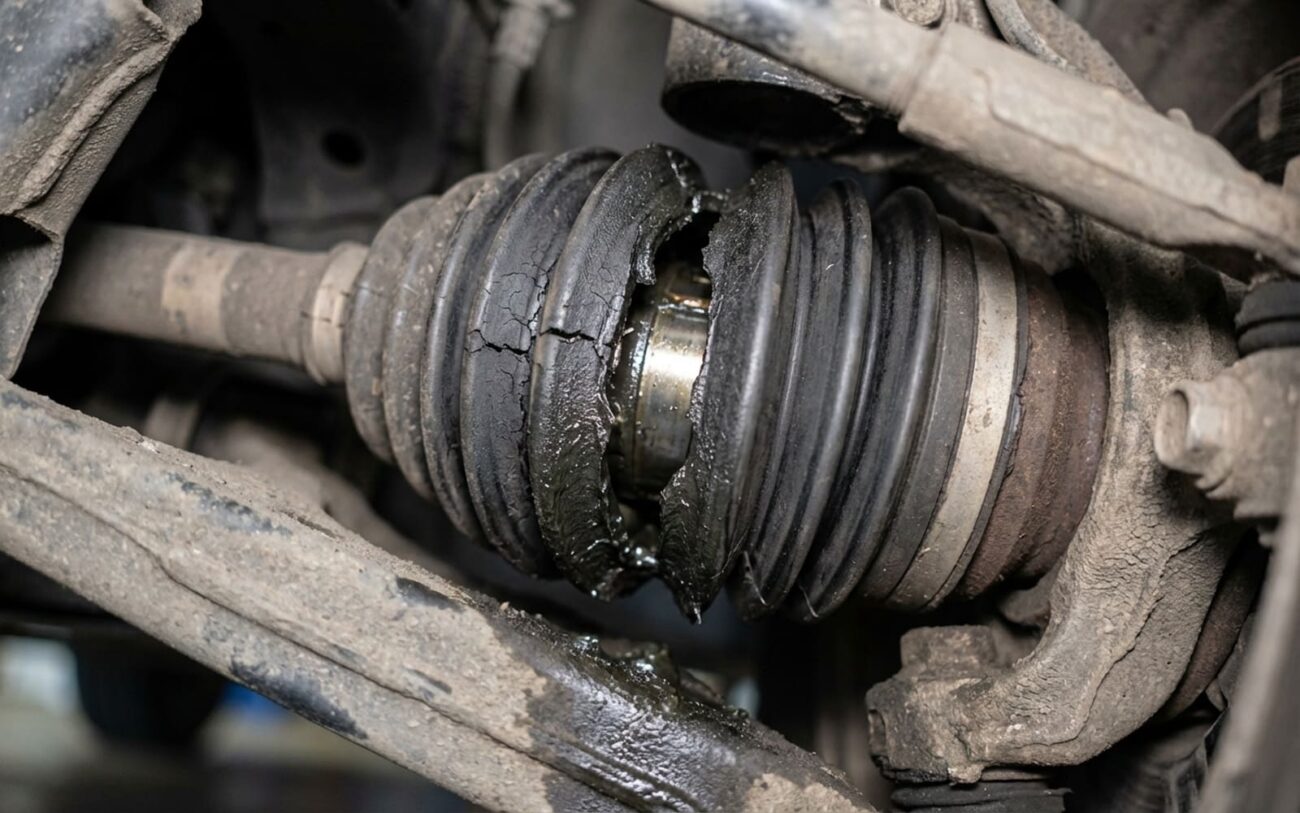
Alright, let’s talk CV axles. If you’re hearing a new noise from the front of your front-wheel-drive car – especially that rhythmic clicking when you turn, or maybe a shudder when you hit the gas – your CV axles are probably screaming for attention. After 25+ years turning wrenches, I can tell you these are some of the most common driveline problems I see. These axles are what get power from your transmission to the wheels, and they do it while the suspension bounces and you steer. That’s a tough job, and it relies on two critical components: the inner and outer CV joints.
The Classic Signs of a Failing CV Axle
The absolute classic symptom, the one I see most often, is a loud, consistent clicking or popping noise when you’re turning sharply. Think pulling into a parking spot, making a U-turn, or even just a tight corner. That’s almost always your outer CV joint, usually a ball-and-cage design, telling you it’s worn out. The steel balls inside are skipping over pitted grooves. You’ll notice it gets faster with speed and often vanishes when you straighten out – that’s your big clue it’s the joint, not a tire or wheel bearing.
The First Visual Clue: Grease
Before you even hear that clicking, you might see the problem. Get down there with a flashlight. If you spot black, greasy sludge splattered around the inside of your wheel, on the brake rotor, or dripping from the suspension, that’s a torn CV boot. That boot is supposed to keep the factory grease in and road grime out. Once it tears, that joint is on borrowed time. I always tell my customers, “Once that rubber boot tears, your precision joint becomes a rock grinder. It’s only a matter of time.”
Next up, if you feel a solid clunk or knock through the floorboard, especially when you accelerate hard or suddenly let off the gas, that’s usually the inner CV joint. Most often, it’s a tripod-style joint that allows the axle to slide in and out with suspension travel. Over time, those rollers or trunnions wear, creating slack. That slack translates to that jarring clunk you feel.
Then there’s the persistent vibration under acceleration, particularly at highway speeds. This can mean the axle shaft itself is bent – maybe from hitting a curb – or the CV joint is so worn it’s completely out of balance. Unlike a tire vibration, this one typically gets worse when the engine is under load, pushing power through that axle.
Diagnosing It Right: Is It Really the Axle?
Now, before you start ordering parts, let’s be clear: not every front-end noise means a bad CV axle. I’ve had plenty of folks swear it was an axle when it turned out to be something else entirely. Wheel bearings can mimic that clicking, especially in turns. Worn engine or transmission mounts will give you clunks under throttle. And a bent rim or unbalanced tire can feel a lot like an axle vibration. That’s why a good diagnosis is critical. You don’t want to replace parts you don’t need.
| Symptom | Likely CV Axle Problem | Common Mimics | How I Confirm It |
|---|---|---|---|
| Rhythmic Clicking in Turns | Worn outer CV joint—damaged ball bearings or raceways. | Worn front wheel bearing (especially early stages). |
Lift the vehicle, check for lateral play (bearing). Rotate the wheel by hand at full steering lock; listen for joint clicking. |
| Clunk on Acceleration/Deceleration | Excessive axial play in the inner tripod joint or worn axle splines. | Failing engine/transmission mounts, loose drivetrain components. |
“Blip” the throttle while observing engine movement (for mounts). Check the axle for rotational lash (>15° is bad). |
| Constant Vibration at Speed | Bent axle shaft or severely worn/unbalanced CV joint. | Unbalanced tires, bent wheel, out-of-round tire, failing wheel bearing. |
Road-force balance tires first. Use a dial indicator to measure axle shaft runout (>1.0mm is usually a bent shaft). |
And just a quick note: sometimes driveline vibrations can even feel like transmission or clutch issues. A shudder on take-off, for example, might feel like an axle, but if it’s tied directly to clutch engagement, you could be looking at a worn release bearing. Or if your automatic is slipping or going into limp mode, that’s a whole different beast. Make sure you’re chasing the right problem.
What Actually Fails Inside the Axle
So, what’s actually failing inside these things? Almost always, it’s the joints themselves, not the solid shaft. The outer CV joint, the one at the wheel, is typically a Rzeppa or ball-and-cage design. It uses steel balls running in precision-machined grooves, or ‘raceways.’ Under normal conditions, these are sealed and lubricated for the life of the vehicle. But when that boot tears – and that’s the key – moisture, dirt, and road grit get in. That factory grease turns into an abrasive grinding paste, and those precision surfaces just get chewed up. That’s your clicking.
The inner joint, closer to the transmission, is usually a tripod design. It has three trunnions with roller bearings that slide in and out, allowing for suspension travel. Over time, those rollers and their needle bearings wear down, creating axial play. That’s the slack that gives you the clunk when you hit the gas or let off.
The Root Cause?
Almost always a failed CV boot. It’s a simple rubber or thermoplastic cover, but it’s the first line of defense. Once it’s compromised, the joint’s lifespan shortens dramatically. Don’t confuse joint wear with wheel bearing patterns—diagnose carefully.
Your Repair Options, From Simple to Serious
Alright, you’ve diagnosed it. Now, what are your options? I generally break it down into three scenarios:
CV Boot Kit Replacement DIY-FEASIBLE to PROFESSIONAL-ONLY
Complete Axle Assembly Replacement DIY-FEASIBLE
Bent Axle Shaft NON-REPAIRABLE
Making Sure the Fix Actually Worked
So, you’ve done the work. Don’t just close the hood and call it a day. You need to make sure that fix actually worked. Here’s my post-repair checklist:
-
First, take it for a good road test. Make those sharp, slow turns, accelerate hard, and listen. All those old noises and shudders should be completely gone. If not, you’ve got more digging to do.
-
After that test drive, get back under there. Visually inspect the new boot. Make sure it’s not twisted, pinched, or showing any signs of grease seeping out. It needs to be perfectly sealed.
-
And this is important: after about 50 to 100 miles, I always recommend rechecking that axle nut torque. Components settle, and you want to make sure everything is still snug and safe.
Weighing the Cost and Making a Smart Decision
Now, let’s talk money and making a smart decision. This is where experience really comes in. Sometimes, a repair just doesn’t make financial sense.
| Repair Type | DIY Cost (Parts) | Shop Cost (Total) | Success Rate | Secondary Risk |
|---|---|---|---|---|
| CV Boot Kit | $30–$80 | $250–$400 | High (if joint is okay) | Complete axle failure if contamination remains. |
| Aftermarket Axle | $100–$250 | $400–$700 | Very High | Potential imbalance or premature boot failure. |
| OEM Axle | $400–$800 | $800–$1,500 | Highest | Minimal; built to original standards. |
Here’s my rule of thumb:
If the repair cost starts creeping up towards 40% of what your vehicle is actually worth, and you’ve got other big-ticket items looming – brakes, timing belt, struts – it’s time to seriously consider if pouring more money into it is the right move. Sometimes, it’s better to cut your losses.
How to Catch It Early
My best advice for avoiding a full axle replacement? Catch it early. Seriously, during every oil change, take an extra minute with a flashlight and inspect those CV boots. Look for any cracks, splits, or grease splatters. A $50 boot kit today can absolutely save you a $400+ axle replacement down the road. It’s cheap insurance.
And try to avoid what I call ‘power steering’ maneuvers – accelerating hard while your wheels are at full lock. That puts immense stress on those outer joints, and it’ll wear them out faster than anything. As I always tell my customers: that boot isn’t just a cover—it’s a warranty on the joint. Treat it that way, and your CV axles will likely outlast the rest of the car.
