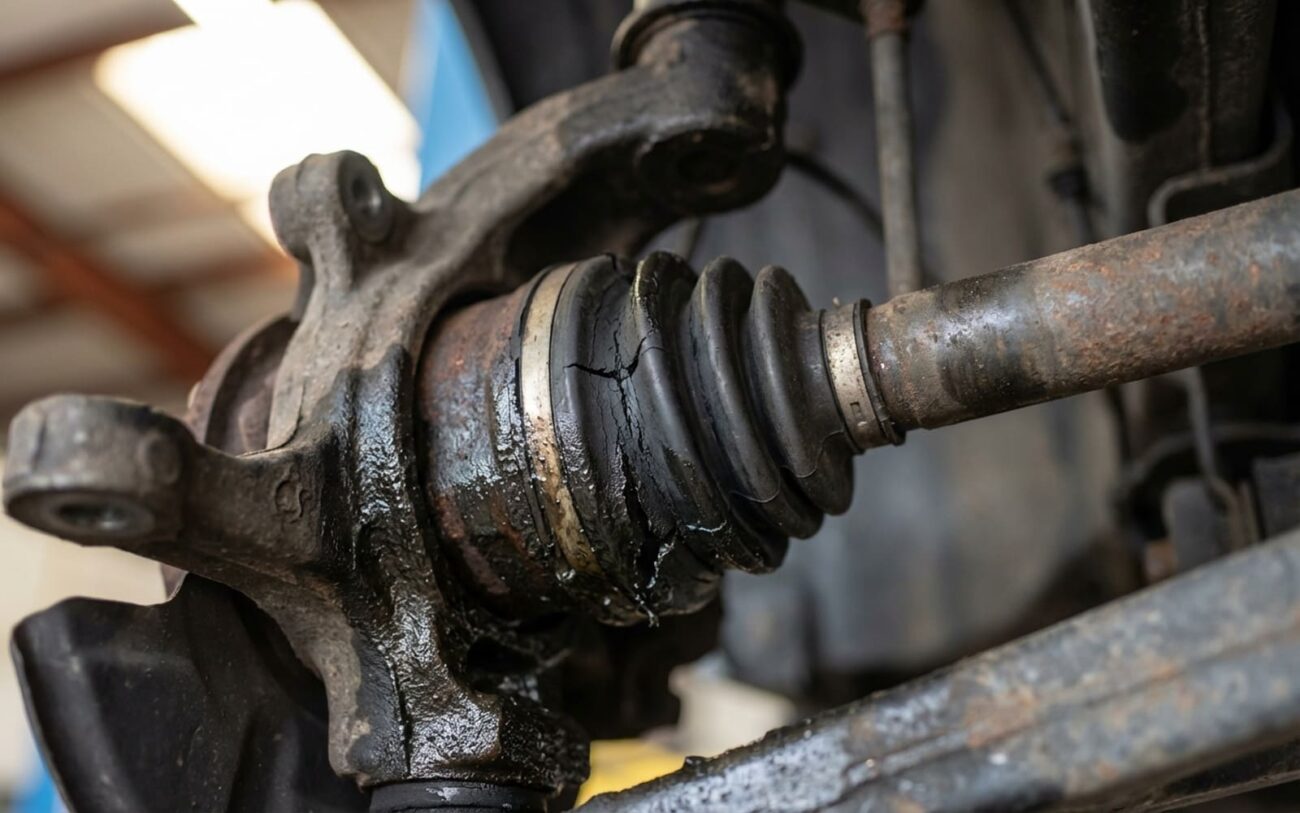
That Knocking Noise? It’s Probably Your CV Axle.
Knocking, clunking, clicking – I hear it all the time. When a front-wheel drive or all-wheel drive vehicle rolls into my shop with one of these complaints, my first suspect is almost always the CV axle. After 25 years turning wrenches, I can tell you these things fail more often than you’d think, and they rarely do it quietly.
See, your constant velocity (CV) joints are precision parts, designed to send smooth power from the transmission to your wheels, no matter if you’re turning, hitting a bump, or just cruising. But when they start to wear out, that smooth operation goes right out the window, and you get noise. The trick is figuring out what kind of noise you’re hearing, because that’ll tell you which part of the axle is actually failing.
Decoding the Noise: Inner vs. Outer Joint
The type of noise you hear, and when you hear it, tells you a lot about which part of the axle is giving up. This is key to figuring out what’s going on:
- Outer CV Joint: If you’re hearing a rhythmic click-click-click or a popping sound, especially when you’re making tight turns at low speeds – think pulling into a parking space or doing a U-turn – that’s almost certainly your outer CV joint. The noise usually gets faster as your wheel speed increases, but it doesn’t change with engine RPM. That’s a good clue it’s not an engine issue.
- Inner CV Joint: A more solid thump-thump or a distinct clunk that you can often feel in the floorboard or even the steering wheel when you accelerate hard from a stop, or shift into reverse and take off? That’s the inner CV joint talking. These joints, especially the tripod-style ones in many FWD cars, take a beating from torque. When their rollers or trunnion bearings wear out, you get that tell-tale lash and thump. Sometimes, you might even feel a vibration during acceleration, though I’ve seen that get confused with tire balance or wheel bearings more than once.
AXLE DIAGNOSTIC
Status: FAILING
The Concept
“Think of a CV boot like a Ziploc bag full of jelly: once it’s punctured, the mess starts and the protection ends.”
Why Your CV Axle Is Making Noise (The Root Cause)
In almost every case, a CV joint fails for one primary reason: it loses its lubrication. These joints are precision-engineered and packed with a special high-temperature grease, all sealed up tight by a flexible rubber boot. That boot is the first, and really, the only line of defense.
If that boot cracks or tears – and they do, from age, heat, road debris, or even a bad installation – the grease starts to leak out. And just as bad, moisture and dirt get in. Once that contamination starts, it’s a downhill slide. You get metal-on-metal wear almost immediately.
My Pro Tip on Torn Boots:
I’ve seen countless customers ignore a torn CV boot, thinking, “Well, it’s not making noise yet, so it must be fine.” But by the time you actually hear that knocking or clicking, the internal damage is already done. A torn boot isn’t just a minor leak; it’s the beginning of the end for that axle. Don’t wait.
Specifically, the outer CV joint uses a set of ball bearings that roll in precise grooves. When the grease is gone and dirt gets in, those bearings and their tracks start to pit and wear. That’s what creates the clicking sound you hear when you turn. The inner tripod joint, on the other hand, relies on roller bearings on a trunnion shaft. Once those rollers wear down, you get that characteristic clunk on acceleration. Over time, corrosion, fatigue, and continued friction just weaken the whole joint until it’s ready to completely fail.
My Process: Diagnosing That Knocking Noise
Before you jump to conclusions and start pulling axles, it’s absolutely critical to rule out other common causes of front-end noises. I’ve seen plenty of good axles replaced because someone didn’t properly diagnose a worn engine mount, bad control arm bushings, strut mounts, or even loose wheel bearings. These components can all mimic CV joint noises pretty convincingly.
Here’s how I approach it in the shop. You don’t need a fancy diagnostic computer for this; your ears, hands, and a good flashlight are your best tools. A mechanic’s stethoscope can help pinpoint a noise, but it’s not strictly necessary.
| Symptom | Likely Axle Culprit | Common Mimics | How I Test It |
|---|---|---|---|
| Knock/Clunk on Acceleration | Worn inner CV joint (spider assembly or ball bearings). | Bad engine/transmission mount, worn control arm bushings, loose wheel bearing. |
With the car safely on jack stands (or a lift), have an assistant apply light drive torque while you carefully grasp the axle shaft near the inner joint. Feel for any excessive lash or radial movement. |
| Clicking During Turns | Worn outer CV joint (pitted ball bearings and races). | Tire rubbing, loose suspension components (less common for clicking). |
In a safe, open area, drive the vehicle slowly in tight circles, both clockwise and counter-clockwise. Listen carefully for the clicking. You can also manually articulate the outer joint by hand (with the wheel off and suspension unloaded) and feel for grinding or binding. |
The key is isolating the noise. If it correlates directly to wheel speed and gets worse when you turn the steering wheel, the CV axle is definitely the prime suspect. If you feel any significant play or hear clunking when you move the axle by hand, that joint is already compromised.
Getting It Fixed: Your Repair Options
Safety First, Always.
Look, driving on a known-bad axle isn’t just risking a tow bill; it’s a serious safety hazard. That axle could separate at any time, and at speed, that’s a recipe for disaster. And don’t even think about squirting some grease into a torn boot once the knocking has started – that’s just a temporary, unsafe band-aid. The internal damage is already done.
Once you’ve confirmed it’s the axle, you generally have a couple of paths to take:
CV Boot Replacement DIY-FEASIBLE (IF CAUGHT EARLY!)
Full Axle Assembly Replacement Professional Recommended
Non-Repairable Scenarios Immediate Replacement
Don’t Just Fix It, Confirm It: Post-Repair Checks
A repair isn’t truly done until you’ve verified it. This is a step I never skip in my shop, and you shouldn’t either.
- For a Boot-Only Replacement: If you caught that torn boot early and just replaced the boot, your validation is pretty straightforward. Drive the car for about 50 miles, then get it back up and inspect the boot. There should be absolutely no fresh grease flung onto the wheel, brake components, or suspension. The boot should look smooth and untwisted, even when the steering is at full lock.
- For a Full Axle Assembly Replacement: Take the vehicle for a thorough road test under real-world driving conditions. Accelerate firmly from a dead stop – listen for any clunks. Make tight turns at low speed, both left and right – listen for any clicks. The car should track straight, and you shouldn’t feel any vibrations during acceleration. After about 50 miles, I always recommend rechecking the axle nut and the lug nuts with a torque wrench. Components can settle, and a loose axle nut is a guaranteed fast track to a failed wheel bearing.
The Bottom Line: Cost & How to Prevent the Next One
CV Boot Only
This is the shop cost for parts and labor. If you’re doing it yourself, parts typically run $40–$100. Remember, this is only if the joint isn’t making noise yet!
Axle Replacement
This is for a full assembly replacement at a reputable shop. With quality parts, you’re looking at a 98% success rate. Don’t cheap out here.
My Financial Rule
In my experience, if the repair costs start to exceed 60% of your vehicle’s current market value, it’s time to seriously evaluate if the investment is worth it.
Now, how do you keep this from happening again? It really comes down to simple, consistent checks. Prevention truly is the cheapest repair:
My Prevention Checklist
-
Inspect Those Boots: Every single time you get an oil change, or rotate your tires, take a flashlight and look at those CV boots. Check for any cracks, splits, or signs of grease leaking out. This is your earliest warning.
-
Listen for Faint Clicks: When you’re in a quiet parking lot, make some slow, full-lock turns. Try to catch any faint clicking before it gets loud.
-
Pay Attention to Takeoff: If you start feeling any thumping or clunking specifically when you accelerate from a stop, don’t ignore it. That’s your inner joint asking for help.
-
Bundle Your Labor: If you’re already in there replacing struts, control arms, or other suspension components, consider replacing aging axles at the same time. You’re already paying for the labor to get things apart, so it can save you money in the long run.
