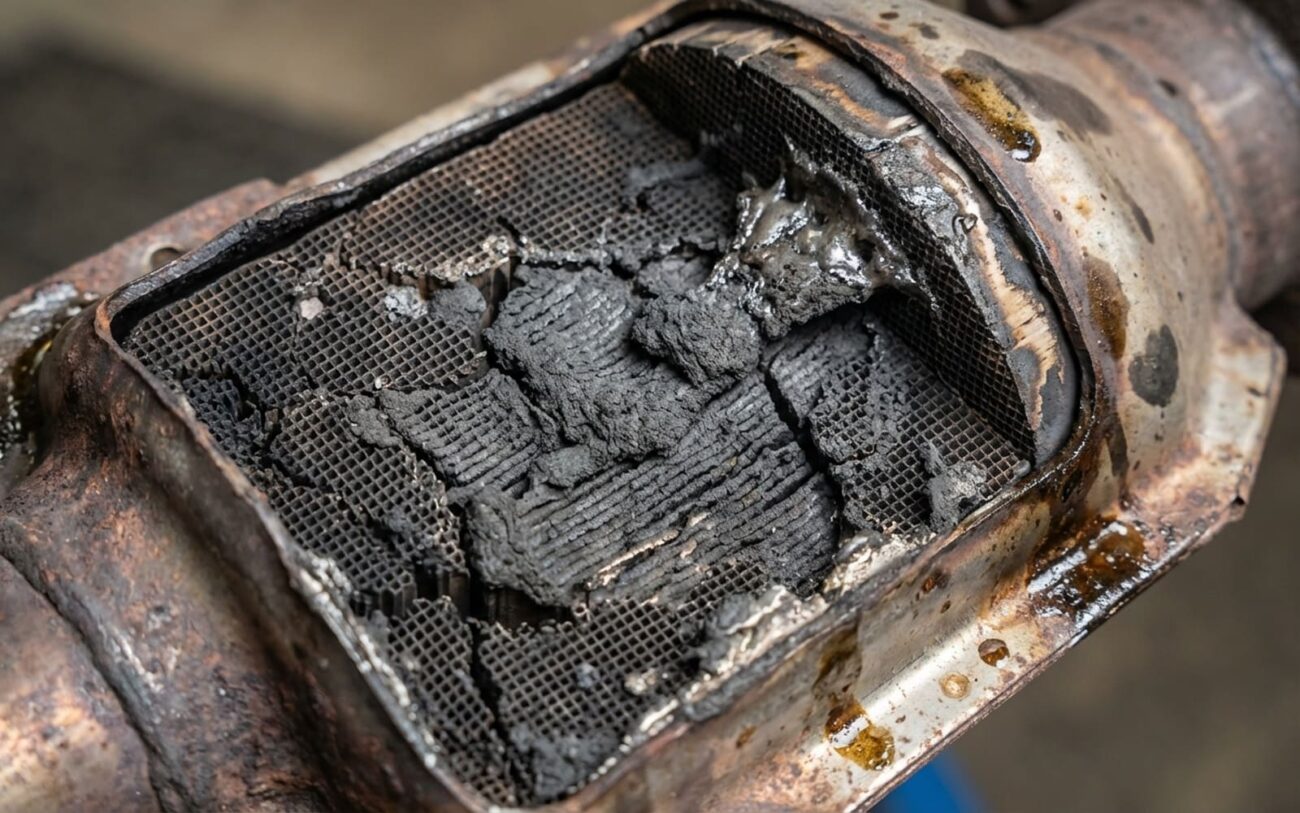
Alright, let’s talk catalytic converters. After more than two decades wrenching on everything from daily drivers to heavy-duty trucks, I can tell you a clogged cat is one of those problems that can really throw a curveball. It’s not just about a Check Engine Light; it’s about your engine fighting itself, and if you ignore it, you’re looking at some serious damage.
What a Clogged Catalytic Converter Feels Like (and What It Means)
When a cat starts to go bad, the first thing most drivers notice is a serious lack of power. It’s like the engine’s got a bad head cold. You might idle fine, but as soon as you try to accelerate, especially getting onto the highway or climbing a hill, it just falls flat. I’ve had countless customers tell me their car won’t get past 2500 or 3000 RPM, no matter how hard they push the pedal. That’s classic exhaust restriction. The engine can’t push out the spent gases fast enough, so it can’t pull in fresh air and fuel efficiently either.
The Concept
“It’s like trying to breathe through a straw.”
Another symptom I often see is the engine running hot, especially when it’s working hard—towing, climbing hills, or just under heavy acceleration. A severely restricted converter traps heat in the exhaust system, and that heat radiates right back into the engine bay. It’s not always a cooling system problem; the restriction itself is causing the engine to struggle and generate more heat, pushing temperatures into the red zone.
Now, a Check Engine Light (CEL) with codes like P0420 or P0430 often points to the catalytic system, but it doesn’t always mean a clog. These codes typically tell me the converter isn’t cleaning emissions efficiently, but exhaust flow might still be okay. It could be chemically degraded, not physically blocked. And if you hear a rattle from under the car, especially over bumps, that usually means the internal ceramic honeycomb has shattered. That’s a failed converter, no doubt, but the pieces might not be blocking flow yet. It’s only a matter of time before they do, or before they migrate downstream and clog the muffler. So, while a rattle confirms structural failure, you still need to test for a restriction.
Diagnosing a Clog: My Go-To Tests
Look, loss of power and high exhaust backpressure can come from more than just a bad cat. I’ve seen collapsed exhaust pipes, mufflers packed solid with rust or even water, or even internal damage in a turbocharger’s turbine housing that mimics the exact same symptoms. That’s why you can’t just go by feel; you need hard data.
The Exhaust Backpressure Test (My Gold Standard)
This is the most reliable way to confirm an exhaust restriction. Here’s how I do it:
- Get the engine to operating temperature.
- Locate the upstream oxygen sensor (the one before the catalytic converter). Carefully remove it.
- Install a pressure gauge adapter into the O2 sensor bung.
- Start the engine and hold it at 2500 RPM in neutral or park.
- Read the pressure. Anything over 2.0 psi indicates a restriction. If I see 4-5 psi, that cat is toast.
To pinpoint where the restriction is, I’ll sometimes test downstream of the converter as well. If the pressure is high before the cat but normal (under 1.5 psi) after it, then the blockage is definitely in the converter. If pressure is high throughout the system, the problem is further down the line—usually the muffler or a collapsed pipe.
Infrared Thermometer Check
An infrared pyrometer is another quick, useful tool. A healthy converter needs to “light off” and run hot to do its job. I typically look for the outlet temperature to be 100–200°F hotter than the inlet temperature during steady cruising. If there’s little to no temperature difference, it means exhaust isn’t flowing through it properly. On the flip side, an overheated or melting converter will often glow red-hot externally, especially at night—that’s a bad sign, a very bad sign.
Scan Tool Data
While not definitive for a clog, a good scan tool helps paint the full picture. I’ll monitor fuel trims (long and short term) for signs of a rich or lean condition that could cause converter failure. I also check for misfires (P0300 series codes) which dump raw fuel into the exhaust. And of course, watching the upstream and downstream O2 sensor signals is key for catalyst efficiency, which we’ll talk about more when verifying a repair.
Why Catalytic Converters Fail (and Why It Matters)
Here’s the deal: a catalytic converter doesn’t just fail for no reason. If you just slap a new one on without figuring out why the old one failed, you’re just throwing money away. You’ll be back in the shop with the same problem, usually sooner rather than later. I break converter failures down into three main categories:
1. Meltdown (The “Lava” Converter)
This is when too much unburned fuel gets into the exhaust. Think chronic misfires, an engine running super rich, or burning a ton of oil. When all that raw fuel hits the catalyst, the chemical reaction goes into overdrive, generating insane heat. We’re talking temperatures over 2000°F, hot enough to melt the ceramic honeycomb into a solid, glassy mass. Once that happens, it’s completely destroyed. I’ve cut open more than a few that looked like a volcano erupted inside.
2. Mechanical Breakage (The “Rattler”)
The ceramic inside these things is brittle. Hit a big pothole, smack some road debris, and you can crack or shatter it. Even minor cracks can grow over time from thermal cycling—heating up and cooling down. A broken substrate might not block flow immediately, but those loose pieces will shift around and eventually create a partial or full blockage. The metallic rattle you hear when you tap the converter or go over bumps is the giveaway here.
3. Contamination and Clogging (The “Slow Killer”)
This is a slower, more insidious failure. Oil ash, from an engine burning oil, contains metallic additives that coat the catalyst’s washcoat and clog its microscopic pores. Coolant from a leaking head gasket or a cracked block introduces silicates, which act like liquid glass when burned. These deposits build up over time, slowly choking the converter, reducing its efficiency, and eventually restricting exhaust flow. Some engines, like certain V6 designs, are notorious for oil consumption, making them prime candidates for this kind of premature converter failure. If you don’t fix that oil or coolant leak, your shiny new converter will suffer the exact same fate.
Repair Options: What Actually Works (and What Doesn’t)
Professional Territory
Your repair path depends entirely on the severity and, more importantly, the root cause. Just replacing the converter without proper diagnosis is a rookie mistake that’ll cost you twice.
Minor Issues: Diagnostics First, DIY Maybe
Clogged Converter: Replacement is the Only Fix Expert Level
Rattling Converter: No Repair, Just Replace
Verifying the Repair: Don’t Skip This Step!
After you’ve replaced the converter—or tried any fix, for that matter—you absolutely must verify the system is working correctly. Just bolting it on and calling it a day isn’t good enough. Here’s my checklist:
- Re-run the backpressure test. With a new, free-flowing converter, your pressure should now read under 1.5 psi at 2500 RPM. If it’s still high, you missed something, or the new converter is faulty (rare, but it happens).
- Monitor O2 sensors with a scan tool. The upstream oxygen sensor should show rapid voltage fluctuations as it constantly adjusts fuel trim. The downstream sensor, after a working converter, should show a much slower, dampened signal. This indicates the catalyst is effectively storing and releasing oxygen. If both sensors are mirroring each other, your new cat isn’t working, or the root cause wasn’t fixed.
- Complete a full drive cycle. The engine control module (ECM) needs to run its catalyst efficiency monitor. This isn’t always quick; it can take several days of normal driving under various conditions.
- Check readiness monitors. Once the drive cycle is complete, check your readiness monitors. Both Bank 1 and Bank 2 (if your vehicle has two converters) should show “Ready.” If a P0420 or P0430 code returns, either the converter is defective, the original root cause wasn’t properly addressed, or you haven’t completed the full drive cycle yet.
- Infrared check (if you used a cleaner). If you tried a cleaner instead of replacement, validation is trickier. Use your infrared thermometer to compare inlet and outlet temps at 2000 RPM steady cruise. A functional converter should show at least a 100°F increase. No rise? It’s likely still contaminated or damaged, and you’re back to square one.
Cost, Risk, and When to Walk Away
Repair costs for catalytic converters vary wildly, mostly depending on the vehicle’s design and how much labor is involved. Here’s a realistic breakdown based on what I see in my shop:
| Repair Type | DIY Cost (Part Only) | Shop Cost | Success Rate | Secondary Risk if Failed |
|---|---|---|---|---|
| Replace integrated manifold-catalyst | $800 – $2000 | $1500 – $3000+ | 99% | Warped manifold, damaged turbo studs, exhaust leaks, stripped threads on aluminum heads. |
| Replace underbody catalyst | $300 – $1000 | $700 – $1500 | 99% | Exhaust leaks from flange misalignment, broken exhaust hangers. |
| Use fuel additive cleaner | $20 – $50 | N/A | <30% for actual clogs | Wasted money, O2 sensor fouling, false sense of security. |
Here’s the tough reality check I give my clients: if the total cost of the repair—and that includes fixing the underlying oil consumption, chronic misfires, or coolant leaks—starts to climb past about half the vehicle’s current market value, you’re in a tough spot. Replacing a $2000 catalyst on a $4000 car that’s already burning oil or has 200,000 miles on it might not make financial sense. I always advise people to consider the long-term reliability. If the root cause is a worn-out engine, you’re likely just delaying the inevitable, and that money could be better spent elsewhere.
Prevention: Keep Your Converter Healthy
The best way to avoid a costly catalytic converter replacement is simple: keep your engine running cleanly. That means addressing small issues before they snowball into big, expensive ones.
My Maintenance Checklist for a Healthy Cat
-
Fix misfire codes (P0300 series) immediately. Raw, unburned fuel washing into the exhaust will absolutely destroy your catalyst. Don’t put it off.
-
Monitor oil consumption. If you’re adding a quart every 1,000 miles, that oil ash is coating and clogging the catalyst’s pores. Use the correct oil viscosity for your engine.
-
Investigate coolant leaks immediately. Silicates from coolant act like liquid glass when burned in the exhaust, contaminating the catalyst.
-
Pay attention to drivability changes. A gradual loss of power or increased engine temperature under load are early warning signs. Catch them early!
-
Don’t ignore that Check Engine Light. Even if the car feels fine, a P0420 or P0430 means your cat isn’t working right. Get it diagnosed.
