Seatbelt Pretensioner Fired? Here’s How to Know — and Fix It Right
I’ve pulled apart hundreds of SRS systems after minor fender benders and major collisions. More than once, I’ve seen a tech assume it’s “just a stuck belt” — only to find out later the pretensioner had already fired. That’s not just a missed diagnosis. That’s a ticking safety bomb.
If your seatbelt feels tighter than normal after a jolt — or won’t extend, or you smell something sharp like burnt matches near the B-pillar — don’t guess. The pyrotechnic charge inside that retractor only works once. Fire it, and it’s done. No reset. No workaround. Period.
Hard Evidence the Pretensioner Fired
Forget codes for a second. Look with your eyes, smell with your nose, feel with your hands. That’s where the truth is.
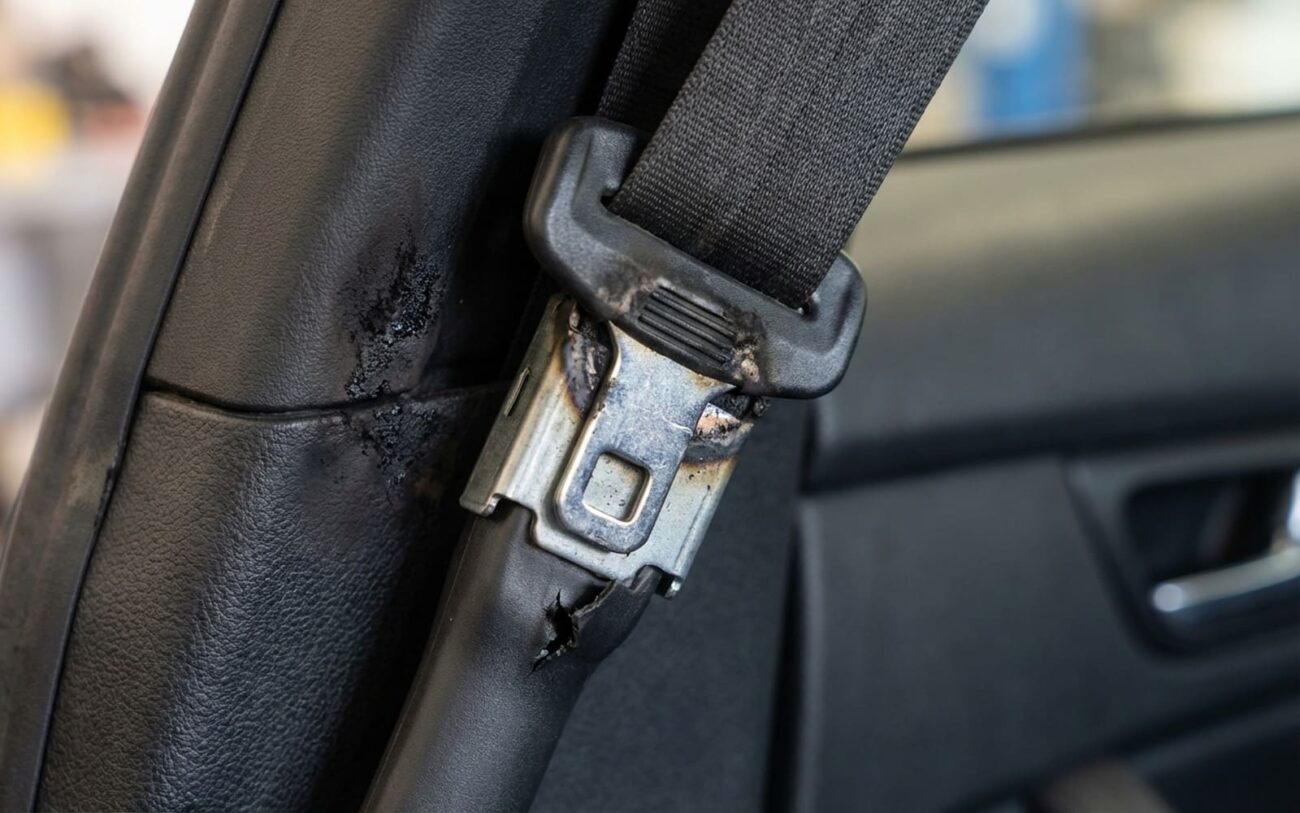
The biggest red flag? The belt is shorter. Not “feels tight” — actually retracted. You pull it, and it stops 2 to 6 inches earlier than before. It doesn’t give. It’s not sticky. It’s locked solid because the piston fired and jammed the mechanism. That’s not repairable. It’s spent.
Next, check for powder. I’m talking fine, chalky residue — white, light gray, or sometimes yellowish — around the B-pillar trim, on the webbing, or near the anchor point. And it smells like spent fireworks. Sulfur. Burnt matches. That’s the propellant. No mistaking it once you’ve seen it.
And yeah, right after deployment, the housing would’ve been warm. But unless you were there when it happened, that’s not helpful now. What matters is this: once that charge burns, the pretensioner is dead. The belt may still lock mechanically if you yank it, but the pre-crash tightening? Gone. You might as well be driving with no airbags.
Wait — Could It Be Something Else?
Not every stuck belt means the pretensioner fired. I’ve seen guys replace a $600 seatbelt assembly because they didn’t check the basics.
The retractor has its own emergency lock — kicks in if the car stops fast, or if it’s tilted (like on a tow truck), or even if the internal pawl sticks. That’ll give you a locked belt too. But it’s mechanical, not pyrotechnic. No powder. No smell. And usually, if you cycle the belt a few times, it frees up.
And that powder? Could be from an airbag. Side or curtain airbags leave the same kind of residue — but it’s everywhere. On the dash, the headliner, the door panels. Pretensioner residue is localized. If you see dust near the B-pillar and nowhere else, it’s likely the pretensioner. But don’t assume. Check the codes.
| Symptom | Points to Pretensioner | Could Be Misdiagnosed As | How to Confirm |
|---|---|---|---|
| Belt permanently shorter, won’t extend | Piston fired — retractor mechanically locked. | Stuck retractor pawl, tilt lock engaged. |
Scan for SRS codes — look for “pretensioner fired” or circuit open. Also inspect housing for split sleeve or visible piston stroke. |
| White/gray powder near B-pillar | Propellant residue from gas generator. | Airbag residue, degraded foam, insulation dust. |
Localized powder? Likely pretensioner. Widespread? Probably airbag. Confirm with SRS module codes. |
| Belt binds or retracts poorly | Internal damage from pretensioner firing. | Twisted webbing, dirt, worn spring, debris. |
Remove trim, inspect retractor. Deployed unit shows irreversible mechanical changes. Clean or worn one won’t. |
How to Replace It — And Not Get It Wrong
No Repair. No Reset. Only Replacement Professional Only
The pretensioner is a one-time-use pyrotechnic device. Full assembly replacement required. No exceptions.
I’ve had customers ask if they can “reset” the mechanism. No. That’s not how it works. You can’t un-burn the propellant. You can’t un-fire the piston. Even if you somehow got it back in place, the housing is compromised. It’s not safe. Don’t waste your time.
Here’s how I do it in the shop:
- Disconnect the negative battery terminal. No shortcuts.
- Wait 15 minutes. SRS capacitors need to drain. I’ve seen techs skip this and get a nasty surprise when they unplug the connector.
- Remove interior trim — B-pillar cover, kick panel, whatever’s in the way. Use proper trim tools. Don’t gouge the plastic.
- Unbolt the retractor (usually T40 or T50 Torx). Disconnect the electrical plug. Never probe it — you could set it off.
- Install the new unit. Match the webbing path exactly. Torque bolts to spec — typically 40–45 Nm (30–33 lb-ft), but always check the manual. I’ve seen under-torqued bolts shear in a crash.
- Reconnect the battery.
- Scan with a pro-grade SRS tool. Clear codes. Register the new unit if required. Some systems won’t arm without it.
OEM parts are best. But if you go aftermarket, make sure it’s certified to FMVSS 209 and 210. And never — ever — use a used assembly. No way to know if it’s already fired.
Did It Work? Test Like a Pro
Don’t just reconnect the battery and call it done. Test it.
First, mechanical check. Pull the belt out. Should extend smoothly. Jerk it fast — ELR should lock. If the car has tilt lock, test that too (safely, on level ground).
Then scan it. Use a real SRS tool — not a $30 OBD2 code reader. Check for active or pending codes. Some modules need the new pretensioner registered. Skip that, and the light stays on. Or worse — the system doesn’t work.
Turn the key. SRS light should come on for 6–10 seconds, then go out. If it stays on, blinks, or comes back later — stop. There’s still a fault. Don’t drive it.
In my shop, I keep a copy of the post-repair scan. Simple habit. But if the car comes back in six months with SRS issues, I’ve got proof the system was good when it left.
Cost vs. Value — The Real Talk
A full seatbelt assembly runs $200–$600. Shop labor? $400–$1,000 per belt. Yeah, it hurts.
If this is an insurance claim, once SRS repairs hit 70–75% of the car’s pre-accident value, it’s likely totaled. Makes sense. Why pour $3,000 into a $4,000 car?
But if you’re paying out of pocket — especially on an older car — think hard. Is spending $800 on one belt worth it on a $3,000 vehicle? Maybe not. But if you’re keeping it, you’re responsible for its safety.
And don’t forget liability. Drive with a known SRS fault, and if you’re in another crash, you could be on the hook — legally and morally.
Prevention — Because It’s Easier Than Repair
Prevention Tips
-
Fix floor leaks fast. Water in the B-pillar corrodes connectors — I see this on 2012–2016 Accords all the time.
-
Be careful during interior work. A hard hit to the retractor housing can set it off — yes, really.
-
Check belts after any impact — even minor. Look for powder, smell for sulfur, test retraction.
-
SRS light on? Get it scanned. Don’t ignore it. That light means the system is disabled — right now.
