That Stuck Seat Belt? It’s Not Just Annoying—It’s Dangerous
I’ve been turning wrenches for over 25 years, and if there’s one thing I’ve learned, it’s this: a seat belt that won’t retract isn’t a “quirk.” It’s a red flag. I’ve seen too many people shrug off a belt that drapes across the seat like a lazy scarf, thinking it’s just “stiff.” But here’s the reality—when that webbing doesn’t snap back, the entire safety system is compromised.
That pretensioner? It needs taut webbing to work. If there’s slack, it can’t deploy fast enough in a crash. The load limiter? It won’t function as designed. And forget about the inertia reel locking properly—most of them won’t even engage if the retractor’s already gummed up.
You’ll usually notice it after unbuckling. The belt doesn’t retract all the way. Maybe it stops halfway. Maybe it doesn’t move at all. Sometimes you’ll hear a gritty grinding or a rhythmic click from the B-pillar. That’s not “normal wear.” That’s metal parts binding, gears slipping, or a clock spring that’s finally given up.
Is It the Retractor or Just a Jammed Belt?
Before you go tearing into the B-pillar, slow down. I’ve replaced more than a few retractors only to realize the problem was a twisted belt or a buckle tongue jammed under the seat rail. Don’t make that mistake.
The belt runs through several points—the D-ring, the buckle, the lower anchor. Any of those can cause drag. A bent guide, a kink in the webbing, or even a coin stuck in the retractor housing can mimic a failed mechanism. So do this first: isolate the system.
| Symptom | Likely Internal (Retractor) | Common External Causes | How to Test & Confirm |
|---|---|---|---|
| Slow or incomplete retraction | Worn retractor spring, internal contamination on spool or gears | Twisted webbing, binding D-ring, dirty or bent buckle tongue |
Fully extend the belt and disconnect the tongue. Let it retract through the upper D-ring only. If it improves, the fault is in the buckle or lower path. If not, feed the belt directly into the retractor housing, bypassing the D-ring. Smooth retraction now? The D-ring is the culprit. Still binding? The issue is internal—retractor or webbing spool. |
| Grinding or clicking from B-pillar | Broken gears in inertia lock, damaged ratchet mechanism | Debris (coins, toys) trapped in lower anchor or inside pillar cavity |
Remove interior B-pillar trim for visual inspection. Use a borescope if access is limited. Look for foreign objects or obstructions around the retractor housing. If the noise persists with no visible debris, the fault is internal. |
| No retraction at all | Broken or overwound clock spring, internal mechanical seizure | Buckle tongue jammed under seat rail, knotted or severely twisted webbing |
Perform the isolation test above. If the belt retracts when fed directly into the retractor, the fault is external. If it’s still locked solid, the retractor is the problem. Also check that the webbing isn’t twisted multiple times—this can mimic a complete failure. |
What Actually Breaks Inside the Retractor
Once you’ve ruled out external binding, you’re looking at internal failure. And in my experience, it’s usually one of three things.
First: the clock spring. That’s the coiled torsion spring inside the retractor that pulls the belt back. After 10–15 years of daily use, it wears out. It loses tension. Sometimes it snaps. I’ve seen it happen on high-mileage Camrys and Accords—nothing dramatic, just fatigue.
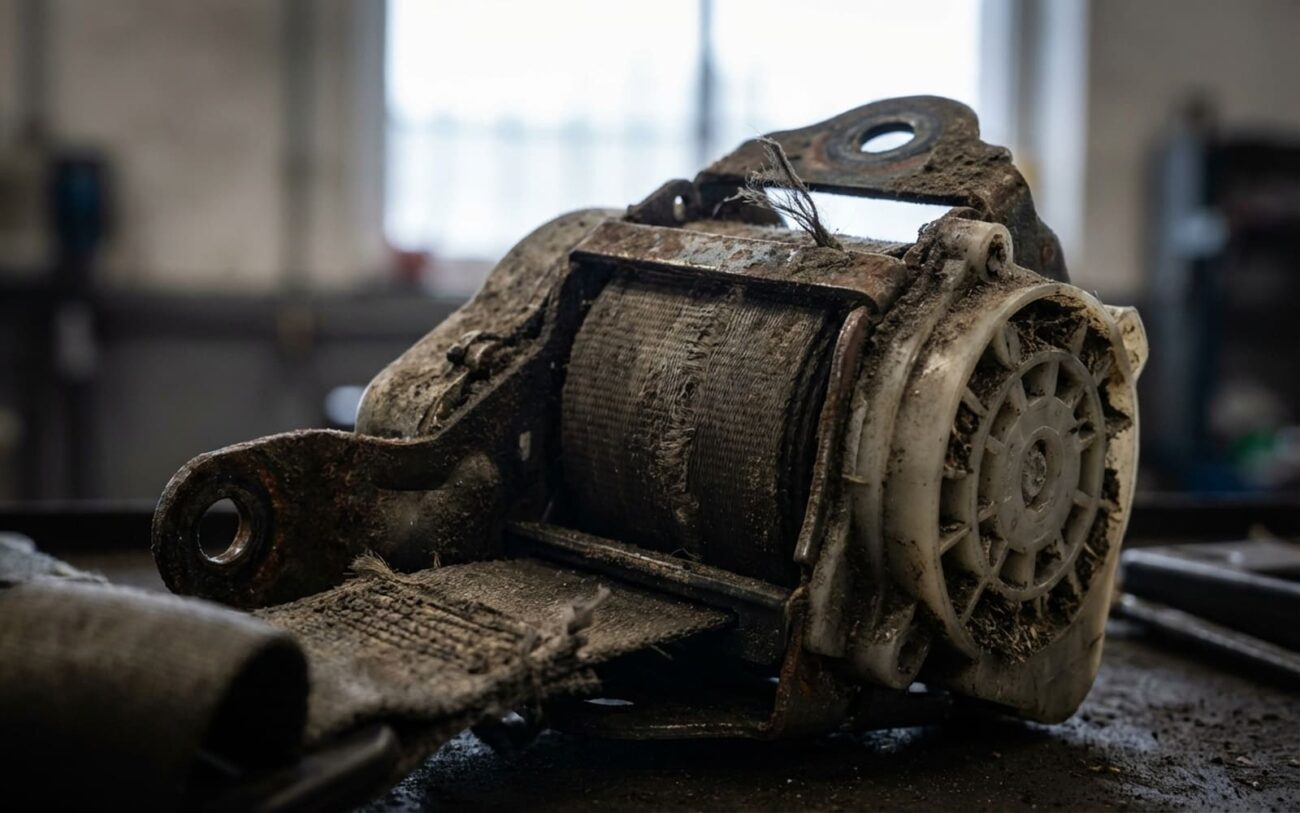
Second: contamination. Dirt, sand, food crumbs, spilled soda—anything can get sucked into the housing. Once it’s inside, it coats the gears and spool, creating drag. On vehicles from coastal areas, saltwater corrosion can turn the spring into a brittle, rusted mess. I pulled one apart last year—looked like a piece of ancient pipe.
Third: impact damage. Even a minor fender bender can knock the inertia lock mechanism out of alignment. The pendulum or ball bearing gets stuck, and now the belt thinks it’s in a crash 24/7. That’s why you get constant binding.
And yes, some models are worse than others. I see a lot of 2014–2017 Chrysler 200s and Malibus with retractor issues. There were TSBs for them—something about a misaligned sensor lever causing a clicking noise. Doesn’t matter if you can’t find the bulletin. Point is, don’t assume it’s universal wear. Check your model.
How to Fix It—Safely
Safety First: Seat Belt Repairs
Working on seat belt retractors, especially those with pyrotechnic pretensioners, requires caution. Always consult your vehicle’s Factory Service Manual (FSM) for proper SRS system disablement procedures and torque specifications. Incorrect installation can compromise safety.
Clean the Webbing First (If It’s Just Dirty)
Replace the Retractor (If It’s Internal) Professional Only
Temporary Workaround? Only in a Pinch
Did the Repair Actually Work?
After any fix, test it properly. Don’t just pull the belt and call it good.
-
Pull it out slowly—should retract smoothly without hesitation. Try it from full extension and halfway.
-
Yank it fast—should lock immediately. That’s the inertia mechanism working.
-
Check mounting bolts. Torque to spec. A loose retractor won’t function right in a crash.
Cost vs. Safety: The Hard Truth
Let’s talk money. A front retractor runs $150–$400. Labor? $300–$700. Rear ones—especially if they’re built into the seat—can hit $1,000 with labor. That’s a lot for an older car.
But here’s what I tell every customer: if the repair cost hits 40% of the car’s value, you’ve got a decision to make. Because a car with broken seat belts isn’t just “drivable.” It’s unsafe. These aren’t cup holders. They’re your last line of defense.
And don’t forget—seat belts are part of the SRS network. A CAN bus fault or a failed module can disable multiple safety systems at once. Your belt may seem mechanical, but it’s tied into the same brain.
Cost-Saving Tip
Clean the belt yourself. But for retractor replacement? Pay a pro. The risk of improper SRS handling or wrong torque isn’t worth saving a few bucks.
Prevention: 30 Seconds That Save Lives
I tell my customers: once a month, when you check oil or tire pressure, do this. Fully extend each seat belt. Watch it retract. Listen. Feel for drag. Wipe the webbing with a damp cloth if it’s dirty. Vacuum around the B-pillar base—debris collects there and gets pulled in.
And never spill liquids near the retractor. I’ve seen a spilled soda destroy a unit in a week. One drink. One mistake.
Also—check for recalls. Some manufacturers have issued safety recalls for defective retractors or pretensioners. Don’t ignore them.
