You just got tapped from behind at a stoplight. No big deal—until you go to grab the seat belt and it won’t budge. You tug, you yank, nothing. That’s not a broken part. That’s the system doing its job. I’ve seen this a thousand times in my shop: people thinking the seat belt failed when in reality, it’s the one component that actually worked exactly as designed. But now what? Do you replace it? Can you reset it? Let me walk you through how I diagnose and repair these every week—because yes, on 2018+ Camrys and Accords, this comes in weekly after even 5-mph bumps.
Stop Pulling. Seriously.
If you’re standing there wrestling with a frozen belt, stop. I don’t care how hard you pull—it won’t “unstick.” And worse, you might damage the webbing or internal gears. That belt locked for a reason: your car felt a sudden deceleration, and the retractor responded. This isn’t like an old tape measure jamming. This is a safety-critical system engaging under G-force, same as the airbags. The moment that happens, your next step isn’t force—it’s diagnosis.
Here’s what I do first: scan the SRS module. Every single time. No exceptions. You need a capable scan tool—something like Autel, Snap-On, or Techstream for Toyotas. Generic OBD2 readers won’t cut it. Why? Because the answer lives in the crash data. Did the pretensioner fire? Was there a G-sensor trigger? Is there a pending code for the retractor motor circuit? That tells me everything.
Symptom → Test → Diagnosis
Not all locked belts are the same. I’ve had guys bring in a car thinking the retractor died, only to find a pen stuck in the B-pillar guide. So I go methodical. Here’s how I break it down in the bay.
| What You Feel | Internal Cause (Retractor) | External Mimic (Not the Retractor) | How I Confirm It |
|---|---|---|---|
| Belt won’t extract at all, feels solid. | G-sensor triggered inertial lock or pretensioner fired. | Debris in guide (coin, key, plastic clip). |
Pull interior trim. Visually trace the webbing from retractor to upper anchor. If it moves freely through guides but still won’t pay out, the lock is internal. |
| Belt stuck with a ratcheting noise when pulled. | Pyrotechnic pretensioner has fired—spent charge pulled the cable. | Worn rewind spring binding during retraction. |
Scan for deployment codes (e.g., B1023, B1231). Check for gas residue or severed internal cable at retractor. If the code is there, it fired—no debate. |
| Belt locks randomly, no crash involved. | Faulty inertial (pendulum) or centrifugal lock mechanism. | Retractor mounted off-angle, causing spool drag. |
Use an inclinometer. Factory spec is usually ±2° from design angle. If it’s tilted more than that, realign before condemning the unit. |
What Actually Happened Inside the Retractor
Let’s be clear: a locked belt after a crash isn’t a failure. It’s a success. The system did its job. The question is whether it’s reusable—or if it’s toast.
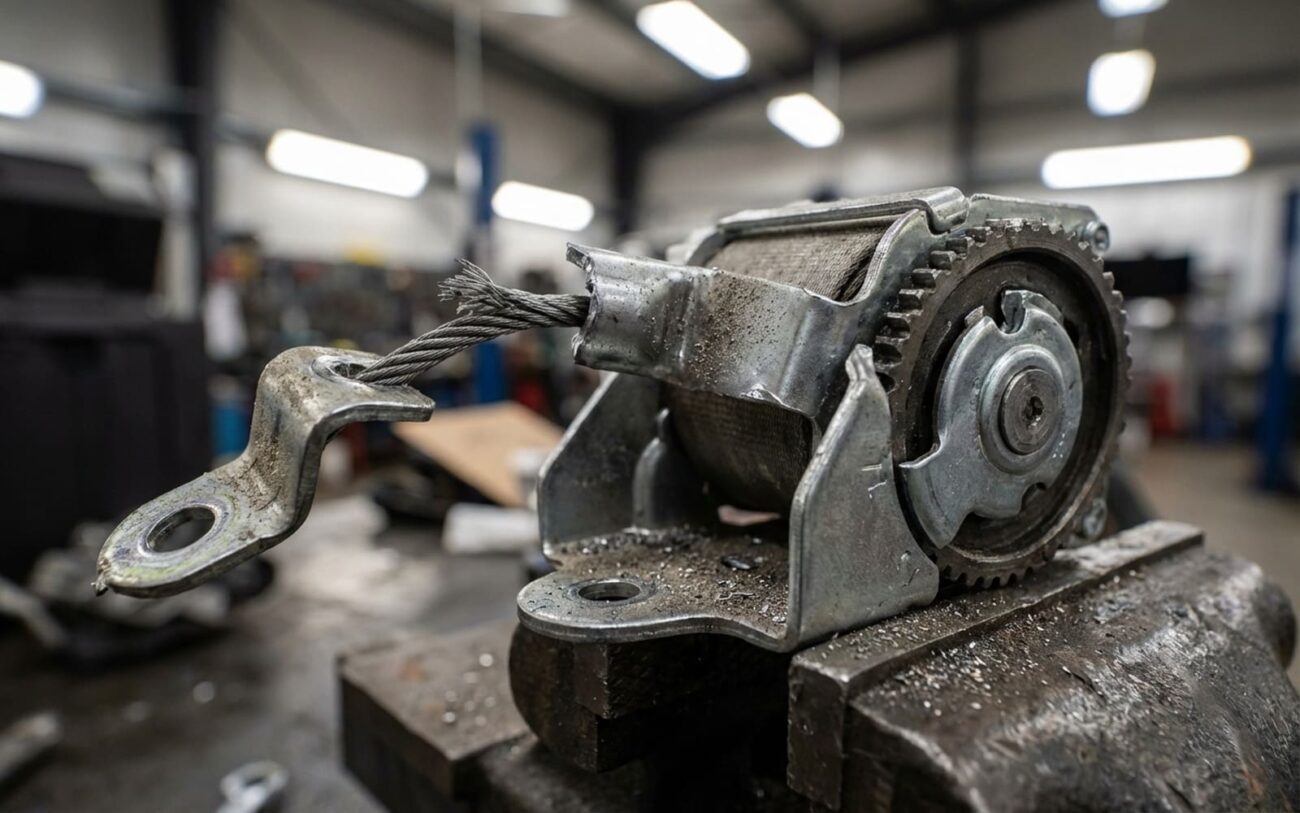
Pyrotechnic pretensioner fired? That’s a one-time event. The charge goes off, a steel cable yanks the spool, takes out 4–6 inches of slack in milliseconds. Once that happens, the retractor is done. You can’t “reset” it. I’ve seen shops try—drilling out the charge chamber, bypassing sensors. That’s not repair. That’s gambling with lives. The retractor stays locked by design. Period.
Mechanical lock stuck? Different story. The pendulum or centrifugal lock engaged during impact—that’s normal. But if it doesn’t release afterward, that’s a mechanical jam. Not supposed to happen. I’ve seen it on older Hondas where the ball-in-tube gets dented. You might get it free by fully extending the belt and tapping the housing, but I don’t trust it. NHTSA recommends replacement after any crash involvement, and I agree.
Spool or webbing damage? In hard hits, the spool can warp, gears shear, or webbing melt from friction heat. If you see fraying over 10%, discoloration, or binding when the retractor’s off the car, it’s compromised. I once had a 2016 Silverado come in where the webbing fused to the housing—looked like burnt nylon. No way that holds in another crash.
What I Actually Do in the Shop
Pretensioner fired. Replace it.
Mechanical lock stuck, no pretensioner fire. Replace it.
Debris in the guide path. Fix and inspect.
Cutting, drilling, bypassing. Never do this.
How I Know It’s Safe After Repair
Replacement isn’t the end. I test it. Every time.
If I replaced the retractor, first I clear SRS codes and verify no pending faults. Then I do two physical tests: tilt test and pull test. For the tilt test, I use an inclinometer to tip the vehicle (or retractor) to 15–20° quickly—should lock instantly. For the pull test, I yank the belt fast—like in a crash. Webbing-sensitive lock should engage immediately. If either fails, I check alignment and mounting angle. I’ve caught misinstalled units this way—bolt torqued wrong, retractor sitting crooked.
If I cleared a debris jam and kept the original belt, I still do the pull test. And I inspect the entire path again. On high-mileage cars, I’m extra cautious—even if it looks fine, age degrades nylon. Over 10 years old? I lean toward replacement.
Prevent Future Issues
-
Clean webbing with mild soap and water only. No degreasers, no alcohol wipes—those break down fibers.
-
Ensure guides are seated properly. A loose shoulder guide causes constant chafing.
-
Inspect every 3–6 months. Full extension, fast pull, smooth retraction.
-
Listen for grinding or hesitation—early signs of spool bind.
-
Look for wear near buckle and shoulder anchor—most common failure points.
When to Walk Away
Let’s talk cost. A front retractor with pretensioner? $300–$800 just for the part. Labor on top. I’ve seen repairs hit $1,200 for both front belts. If your car’s worth $4,000, is it worth it?
| Repair Type | DIY Cost (Part) | Shop Cost (Parts & Labor) | Success Rate | Risk if Failed |
|---|---|---|---|---|
| Replace retractor (non-pre-tensioner) | $150 – $400 | $300 – $600 | 100% if done right | Inadequate restraint; higher injury risk. |
| Replace retractor w/ pretensioner | $300 – $800 | $500 – $1,200 | 100% if done right | Pretensioner fails to deploy—severe injury likely. |
| Attempt internal repair | $0 (labor only) | N/A | <5% | Total failure in next crash—catastrophic risk. |
If the repair costs more than 40% of the car’s value, and you’re not relying on it daily, consider it totaled. I’ve said it before: seat belts aren’t accessories. They’re the last line of defense. I’d rather see someone drive a safe beater than a “fixed” car with compromised restraints.
Final Rule: After Any Crash, Scan the SRS
Even if the airbags didn’t deploy, the system may have signaled the pretensioner. I’ve pulled codes for partial deployment on impacts under 10 mph. The SRS light? That’s not just for airbags. It covers the whole safety net—sensors, pretensioners, seat position modules. Don’t ignore it. Don’t “reset and hope.” Scan it. Diagnose it. Fix it right. Your next crash might not be this minor.
