You’re driving down the highway and suddenly the car feels… naked. No lane keeping, no adaptive cruise, no emergency braking. The dash lights up like a Christmas tree—AEB, LKA, ACC—all dead. But the engine runs. The transmission shifts. So what the hell just happened?
Let me tell you: you just lost your CAN bus. Not a sensor. Not a fuse. The entire nervous system of the car went dark. I’ve seen this on Toyotas, Fords, BMWs—you name it. And every time, the driver thinks it’s “just a glitch.” It’s not. It’s a systemic failure, and if you don’t treat it right, you’re one rainstorm or pothole away from being stranded—or worse.
When Everything Dies at Once, It’s Not a Coincidence
If AEB, LKA, and ACC all fail together, you’re not dealing with three separate problems. That’s like saying your arms, legs, and eyes stopped working because each failed independently. Nah. They’re all fed by the same network—CAN bus—and when that goes down, everything connected to it drops offline.
I’ve had customers come in saying, “The radar must be dirty.” Or, “Maybe the camera needs cleaning.” Sure, that can kill ADAS. But if your speedometer’s glitching, your transmission’s shifting funny, or your instrument cluster is acting up? That’s not a sensor issue. That’s a network collapse.
And here’s the kicker: the car still drives. That’s dangerous. Because now you’ve got a 4,000-pound vehicle with none of the safety nets drivers rely on. It’s like flying a plane with no autopilot, no stall warning, no traffic alert—and you don’t even realize it until you need it.
Step One: Rule Out the Simple Stuff (But Don’t Waste Time)
Yeah, I check fuses. Always. A blown fuse to the ADAS module can mimic a CAN failure. So can a disconnected radar or a cracked camera lens. But those won’t take out unrelated systems. If your radio’s glitching or your door locks are delayed? That’s not a fuse. That’s the bus.
Here’s what I do: I plug in my Autel. Not a $50 OBD2 scanner. A real bidirectional tool that talks to every module. I look for U-codes—especially U0100 (lost comms with ECU), U0121 (ABS module), U0140 (instrument cluster). If I see two or more? Confirmed: the network’s down.
Then I go physical. At the OBD2 port, I measure CAN_H and CAN_L. Key on, engine off. Healthy network? CAN_H reads ~2.6V, CAN_L ~2.4V. If both are 0V, 12V, or identical? Bus is dead. Could be shorted, open, or a module dragging it down.
Next, battery off. I check resistance between CAN_H and CAN_L. Should be ~60 ohms. Why? Because there are two 120-ohm terminating resistors in parallel—one at each end of the bus. If I get 120 ohms, one resistor is gone. Infinite? Open circuit. 0? Dead short. Either way, the network can’t function.
| Symptom | Likely Cause in CAN Bus Network | Common External Mimics | Definitive Test to Confirm Source |
|---|---|---|---|
| Simultaneous loss of AEB, LKA, ACC | Fault on high-speed CAN bus shared by ADAS, engine, brake modules. | 1. Power/ground loss to ADAS module. 2. Damaged radar or camera. 3. Blown fuse or relay. |
1. Scan for multiple U-codes. 2. Measure CAN_H/CAN_L voltages at OBD2. 3. Check terminal resistance (~60Ω). |
| Intermittent system operation | Intermittent short/open in CAN wiring or failing terminating resistor. | Intermittent sensor fault (e.g., misaligned radar). |
Monitor CAN signal with oscilloscope during road test. |
| Systems fail with unrelated issues (e.g., gauges, transmission) | Global CAN bus fault affecting multiple systems. | Coincidental failures (very rare). |
Scan tool reveals U-codes clustered on one bus. |
Where the CAN Bus Actually Breaks
So the network’s down. Now what? Time to find the physical fault.
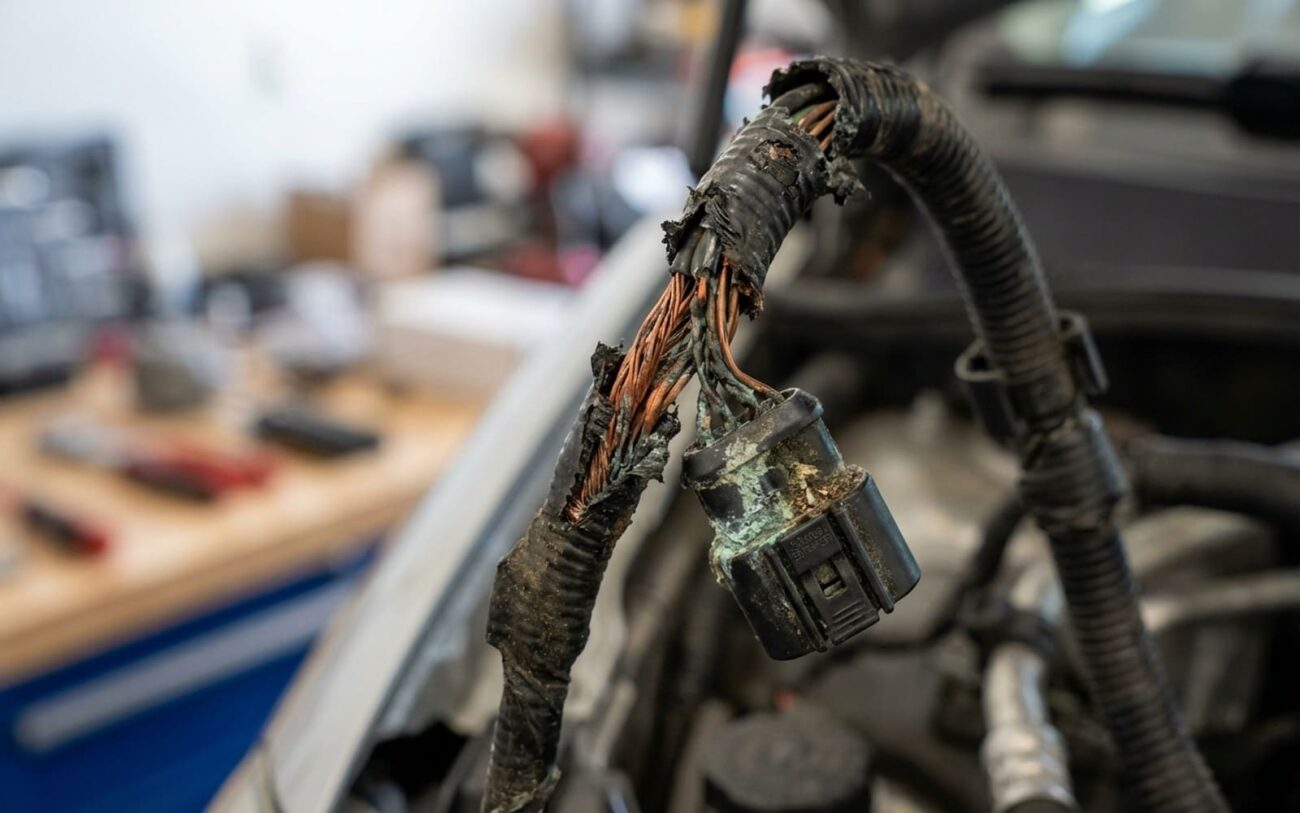
Most common: damaged wiring. CAN bus uses twisted-pair cable for a reason—it cancels out electromagnetic noise. But if that twist gets messed up? Signal integrity goes to hell. I’ve seen harnesses crushed in door boots, chafed against firewall grommets, pinched by aftermarket stereo installs. On 2018–2020 Honda Accords, the driver’s side door harness fails almost weekly in my shop—door open/close for years, wires fatigue, CAN_H or CAN_L breaks.
Corrosion? Big one. Water gets into a connector—say, behind the front bumper or in a door—and eats the pins. Even a little moisture increases resistance. I had a Subaru come in where a leaking sunroof drain soaked the A-pillar harness. Took out the entire CAN network. Didn’t show up until it rained. (Yes, this matters.)
And then there’s the module itself. Every CAN network has two 120-ohm terminating resistors—one at each end. Usually in the ECU and instrument cluster. If one fails open, resistance jumps to 120Ω or higher, and communication fails. Worse: a failed CAN transceiver inside a module can short the bus to ground or 12V. That kills the whole network. I’ve seen a bad body control module take down ABS, ADAS, and the dash—because it was shorting CAN_L to ground.
How I Fix It: From Splice to Module Swap
Professional Territory Only
CAN bus repairs aren’t like changing a bulb. One wrong move and you kill communication with the ECU or ABS. If you’re not comfortable with a wiring diagram, a multimeter, and a soldering iron—walk away. This isn’t the place to learn.
If the damage is in an accessible harness—like under the hood or behind a kick panel—I’ll repair it. But I don’t use butt connectors. Never. They don’t maintain twist integrity and they trap moisture. I use OEM-style twisted-pair wire, solder the splice, and seal it with adhesive-lined heat shrink. And I keep the twist rate tight—right up to the joint. Loose wires? That’s how you get noise and intermittent faults.
If the damage is inside a door or behind the dash? That’s shop time. Labor’s expensive, but disassembly is risky. One wrong pry and you crack a connector. Plus, you need pin extraction tools, maybe a borescope. I’ve seen techs rip out a door harness and accidentally disconnect the airbag sensor. Not worth the headache.
Module failure? Now we’re in deep. Replacing a BCM or ECU isn’t plug-and-play. You need a J2534 tool, OEM software (like Techstream or NGS), and security access to program it to the VIN. Just dropping in a used ECU won’t work. And if the CAN bus is shorted elsewhere? You’ll fry the new module the second you power it up. (Yes, I’ve seen it happen—twice last month.)
Here’s a trick I use: if I suspect a module is killing the bus, I disconnect them one by one (battery off!) and check CAN voltage at the OBD2 port. If it jumps back to 2.6V/2.4V after unplugging one, bingo. That’s your culprit. But don’t drive it like that—no ABS module means no anti-lock brakes. This is diagnostic only.
Did It Actually Work? (Spoiler: Clearing Codes Isn’t Enough)
So you fixed the wire. You replaced the module. You cleared the codes. Great. Now prove it works.
First: electrical check. Resistance between CAN_H and CAN_L should be ~60Ω. Voltages back to 2.6V and 2.4V with key on. No exceptions.
Then: scan every module. All should communicate. No U-codes. If one’s still missing, the bus isn’t fully restored.
Then: road test. Not a lap around the block. A real drive. Activate ACC. Cross a lane line. Test AEB with a dummy maneuver (safely). If any system hesitates, you’ve got noise or a weak connection.
And if the repair involved a radar or camera? You need calibration. Some systems won’t even arm without it. I’ve had customers drive off thinking they’re fixed—only to get a warning 10 miles later. Don’t skip this step.
Real Talk: Is It Worth Fixing?
Let’s be honest. These repairs aren’t cheap. And on an older car, it might not make sense.
| Repair Type | DIY Cost | Shop Cost | Success Rate | Secondary Risk if Failed |
|---|---|---|---|---|
| Simple wiring repair | $50–$150 | $200–$500 | High (>90%) if fault isolated | Intermittent return if splice fails. |
| Complex harness/connector repair | N/A | $500–$1500+ | Medium-High | Damage to adjacent circuits during disassembly. |
| Control module replacement & programming | N/A | $800–$2500+ | High | Incorrect programming can brick the module. |
If the repair costs more than 40% of the car’s value? You’ve got a decision to make. I’ve had customers spend $2,000 on a 10-year-old car because they love it. I respect that. Others trade it in. No judgment. But know this: a car without ADAS is worth less—and insures higher. And if you keep it, drive like it’s 2005. No crutches.
Keep It From Happening Again
To Prevent Recurrence
-
Keep drain plugs clear—especially in doors and sunroofs. Water is the #1 enemy of CAN connectors.
-
Use dielectric grease on every connector you unplug. Doesn’t conduct, but seals out moisture. I do it even on factory connectors during service.
-
Watch for early signs: flickering warnings, intermittent lights, brief system dropouts. Have a pro scan for pending U-codes—even if the light’s off. Catch it early, save a bundle.
