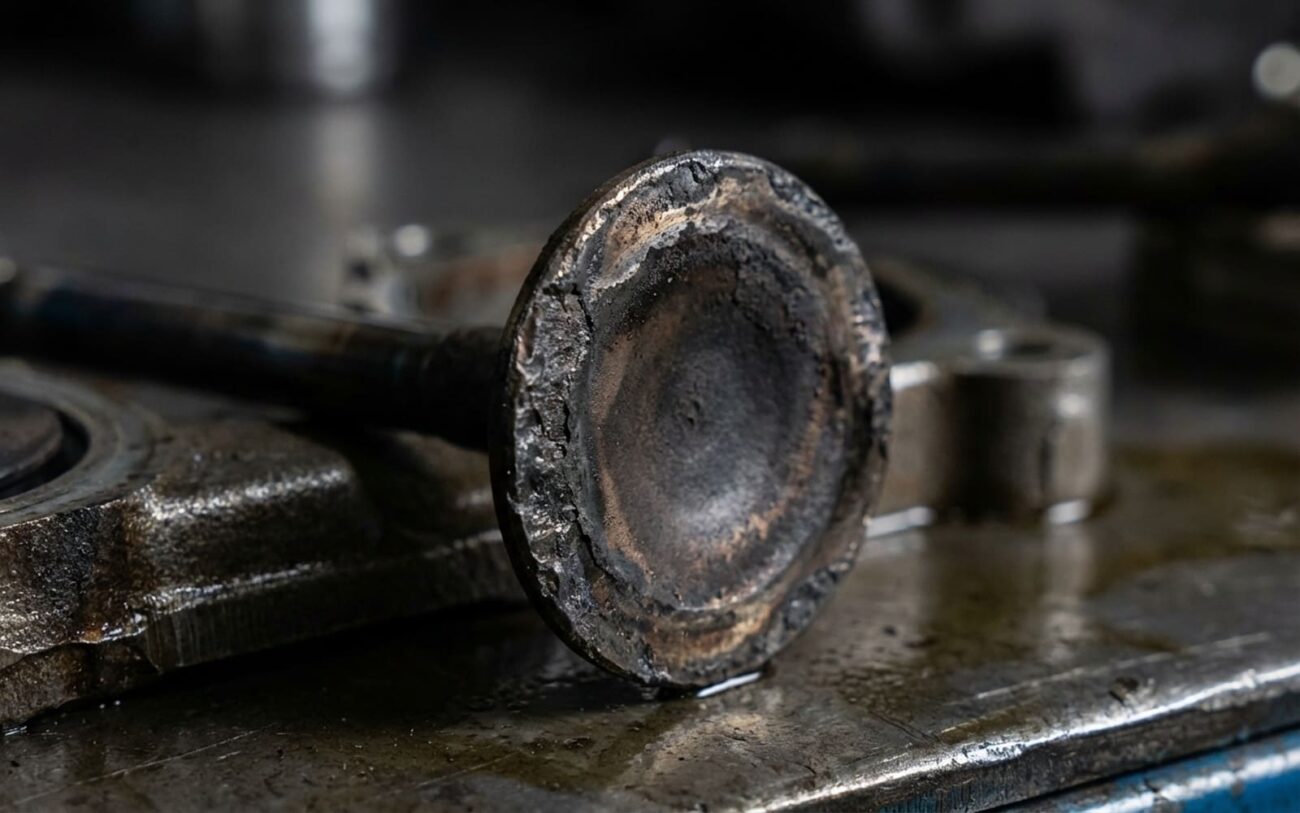
Look, a burned exhaust valve isn’t some mystery. It doesn’t sneak up on you; it announces itself pretty loud and clear. After 25 years turning wrenches, I can tell you the symptoms are distinct, and if you know what to look for, you’ll catch it early.
The first thing you’ll notice is a steady, rhythmic misfire. This isn’t just a random hiccup; it’s a consistent beat, usually tied to one specific cylinder. You’ll feel it right through the steering wheel, the floorboards, or the gearshift — that telltale loping, uneven idle that just won’t smooth out, no matter how much you try to baby it. When you hit the gas, or especially when you try to climb a hill, that misfire gets dramatically worse. Why? Because that cylinder can’t build proper compression, so the piston isn’t getting a full push. Under load, your engine will feel weak, unresponsive, and just plain gutless.
The Sound
“It’s like a tiny blowtorch firing with every combustion cycle.”
And if you pop the hood and listen closely around the exhaust manifold, you’ll probably hear a distinct “chuffing” or hissing sound. It’s perfectly in time with the engine’s firing order, almost like a tiny blowtorch firing with every combustion cycle – that’s the sound of hot combustion gases escaping past a damaged valve that should be sealed shut. When I hear that, it’s a huge red flag for exhaust valve leakage.
You’ll also get a check engine light, almost certainly a P030X code, where ‘X’ is the cylinder number. That’s the computer telling you it’s detected a misfire. And in the shop, if I hook up an emissions analyzer, I’ll see a sharp spike in hydrocarbons (HC) and oxygen (O₂) from that cylinder. That means fuel is going in, but it’s not burning completely because the compression is too low for a good ignition, especially when the engine is working hard.
How I Pin Down a Burned Valve (and Rule Out the Other Stuff)
Now, a P030X misfire code doesn’t automatically mean you’ve got a burned valve. Not by a long shot. I’ve seen plenty of misfires caused by faulty spark plugs, bad ignition coils, clogged fuel injectors, or even an intake valve issue. The trick is figuring out if the problem is truly mechanical – something wrong inside the engine – or if it’s external, like a fuel, spark, or sensor problem that’s easier to fix.
Here’s how I approach it in the shop, looking at the symptoms and the definitive tests that separate a burned valve from its common mimics.
| Symptom | Points to a Burned Exhaust Valve | Could Also Be (Common Mimics) | The Definitive Test I Use |
|---|---|---|---|
| Cylinder Misfire P030X code |
You’ve got a loss of compression because the exhaust valve isn’t sealing right against its seat. It’s letting combustion pressure escape. | Could be a dead spark plug, a failing ignition coil, a clogged fuel injector, or even an intake valve that’s not sealing. |
The Leakdown Test. This is my go-to. I pressurize the cylinder with air. If it’s a burned exhaust valve, I’ll typically see over 25-30% leakage, and you’ll hear air clearly escaping out the tailpipe. A borescope inspection through the spark plug hole can often confirm the valve face damage directly. |
| Hissing or chuffing from exhaust manifold | Hot combustion gases are blowing right past that closed exhaust valve and into the exhaust port. That’s the sound of a leak. | Could be a cracked exhaust manifold, a leaking manifold gasket, or just an exhaust leak further down the pipe near a flange. |
Stethoscope & Smoke Test. I use a mechanic’s stethoscope to really pinpoint the noise to the exhaust port of the affected cylinder. If I’m still unsure, I’ll do a controlled smoke test on the cylinder. Smoke coming out the exhaust is a dead giveaway. |
| High hydrocarbon (HC) emissions | Fuel isn’t burning completely because there’s not enough compression due to valve leakage. So, you’re dumping raw fuel out the exhaust. | A completely dead ignition coil or a clogged-open fuel injector on that specific cylinder can also cause this. |
Component Swapping. For HC issues, I’ll swap the suspected ignition coil and/or fuel injector with a known good one (or from another cylinder) and retest. If the high HC reading follows the part, then the issue is external, not the valve. |
Why These Valves Give Up the Ghost
A burned exhaust valve isn’t just “normal wear and tear.” It’s a failure, pure and simple, and it always comes down to sustained, excessive heat right where the valve face meets the valve seat. That precision-machined sealing surface gets hammered and eroded by scorching hot combustion gases. We call it thermal fatigue, and it’s almost always triggered by conditions that push combustion temperatures way beyond what the engine was designed for.
What are those conditions? Most often, it’s a lean air/fuel mixture – too much air, not enough fuel, which makes things run hotter. Chronic engine detonation, or “pinging,” is another big one. Each ping is a tiny uncontrolled explosion, spiking temperatures. And sometimes, it’s just a tiny, pre-existing leak that lets hot gases start cutting into the valve margin – that thin edge between the valve face and its stem. Once that margin starts to thin out from heat and repeated hammering, it creates a weak spot, and then it’s only a matter of time. The moment that seal is compromised, those escaping gases act like a miniature cutting torch, accelerating the damage.
I’ve also seen cases where the problem actually starts with the valve seat itself. If you’ve had a minor head gasket seep or some other coolant leak into the cylinder, that coolant can corrode or pit the hardened seat insert. A pitted seat can’t seal worth a darn, and boom – the burning process begins. I’ve had more than a few customers come in convinced it was a valve issue when the real, underlying culprit was a lingering coolant leak that nobody ever really fixed.
And yeah, some engines are just more prone to this than others. For instance, I saw a lot of exhaust valve wear on certain Ford 5.0L V8s from the late 2010s. That was often traced back to valve guide clearance problems, which could make the valve stick and overheat. While I won’t get into specific Technical Service Bulletins here, if your particular engine model has a known history of this, you absolutely can’t ignore those early warning signs.
Just to be Clear:
A “burned” valve is not the same as a bent valve, which usually happens from a timing belt breaking or jumping – that’s mechanical impact damage. And it’s definitely not worn piston rings or a cracked piston, though those also cause compression loss. We’re talking specifically about heat-induced destruction of the valve’s sealing surface. If you’re still seeing coolant in the oil after a head gasket replacement, that’s a whole different can of worms, and you can read about that here.
Fixing It Right: Your Options, From a Valve Job to a New Head
No Magic Bottles Here
Let me be absolutely clear: there is no “mechanic in a can” or quick external fix for a burned exhaust valve. If you’ve got this problem, the cylinder head has to come off the engine. Period. Don’t waste your money on those snake-oil products; they’re useless for combustion leaks and can actually cause more problems by clogging up oxygen sensors or coolant passages.
The Professional Valve Job
Valve Seat Replacement
Full Cylinder Head Replacement
Verifying the Fix: How I Know It’s Done Right
Once that head is back on and everything’s buttoned up, you can’t just cross your fingers and hope. You have to verify the repair. This is where a lot of DIYers, and even some less experienced shops, fall short.
My first step is always another cylinder leakage test. This is the gold standard. I’m looking for less than 10% leakage on any cylinder. When I pressurize the cylinder, I listen carefully: if I hear air hissing out the tailpipe, that exhaust valve isn’t sealing right, and the job isn’t done. If I hear air at the intake, that’s an intake valve leak. And if it’s coming from the oil fill cap, then we’ve got piston ring issues – a different problem entirely.
Next, I’ll hook up a vacuum gauge to the intake manifold. At idle, I want to see a steady 18–21 inches of mercury. If that needle is dancing around or consistently dropping, it tells me there’s still an internal leak, likely a valve that isn’t seating properly. A rock-solid needle means good sealing and strong intake vacuum.
Finally, with a good scan tool, I’ll run a power balance test. Every cylinder should be contributing equally to the engine’s power. If one cylinder is still lagging, it means you’ve either still got a sealing issue, or there’s a secondary problem that wasn’t addressed, like a clogged injector or a weak spark that’s now more apparent. A proper repair should bring back that smooth idle, full power, and clean emissions. If it’s still running rough, don’t just assume the head job failed. Dig deeper – sometimes the original root cause, like a lean condition, wasn’t fully fixed, and it’s still causing trouble.
The Hard Truth: Cost and When to Walk Away
Let’s be real about this: a burned exhaust valve repair is a major job, and the cost reflects that. You’re looking at extensive labor just to remove and reinstall the cylinder head, plus the machine shop work or the cost of replacement parts. The table below gives you some realistic cost ranges based on what kind of repair is needed.
| Repair Type | DIY Cost (Parts & Machine Work) | Shop Cost (Parts & Labor) | My Expected Success Rate | Secondary Risk I Watch For |
|---|---|---|---|---|
| Recondition head (single valve) | $300–$800 | $1,500–$3,000 | 95%+ | The original root cause wasn’t fixed, leading to repeat failure. |
| Replace cylinder head (new/reman) | $1,000–$2,500 | $2,500–$5,000+ | 98%+ | Unresolved engine management issues (like a persistent lean condition) could damage the new head. |
Here’s the hard truth I tell customers every week: you have to look at the vehicle’s overall value. If the repair estimate starts creeping up to, say, 50% or more of what the car is actually worth – especially on an older, high-mileage vehicle – then you really need to ask yourself if it makes financial sense. I’ve seen too many folks pour $4,000 into a $6,000 car, only to have another major issue pop up a few months later. Sometimes, the smarter, albeit tougher, move is to cut your losses, sell the car for parts or salvage, and reinvest that money into a more reliable vehicle. It stings, but it can save you a lot of headaches and cash in the long run.
How I Keep These Valves From Burning Out Again
Once you’ve gone through the trouble and expense of fixing a burned valve, the last thing you want is for it to happen again. Prevention is key, and it really comes down to good maintenance and paying attention to your engine’s signals. Here’s what I always tell my customers:
My Prevention Checklist
-
Use the Right Octane. Always, always use the octane rating your engine manufacturer specifies. Running lower octane fuel invites detonation – that “pinging” – which drastically spikes combustion temperatures and puts immense stress on your exhaust valves. Don’t cheap out here.
-
Don’t Ignore the Check Engine Light. Seriously. Especially if it’s a misfire code (P030X) or a lean fuel trim code (P0171, P0174). A lean condition means too much air, not enough fuel, and that’s a direct path to super-hot combustion and burned valves. Get it checked out immediately.
-
Regular Oil Changes. Stick to your manufacturer’s recommended oil change intervals and use the correct viscosity. Good, clean oil helps prevent carbon buildup on valve stems, which can cause valves to stick open slightly and overheat. It’s cheap insurance.
-
Consider Intake Valve Cleaning (DI Engines). If you have a direct-injection engine, carbon buildup on the intake valves is a common issue. While not directly an exhaust valve problem, it can mess with airflow and combustion, potentially leading to hot spots. Periodic intake valve cleaning (like walnut blasting) can help maintain optimal engine health.
Beyond that, just pay attention to your car. Any persistent misfire, a new exhaust noise, or a noticeable drop in power should never be ignored. And if you ever see white smoke from the exhaust that smells sweet – that’s coolant burning, probably from a head gasket or a cracked head. That’s a different, but equally serious, problem. You can learn more about that particular headache here.
