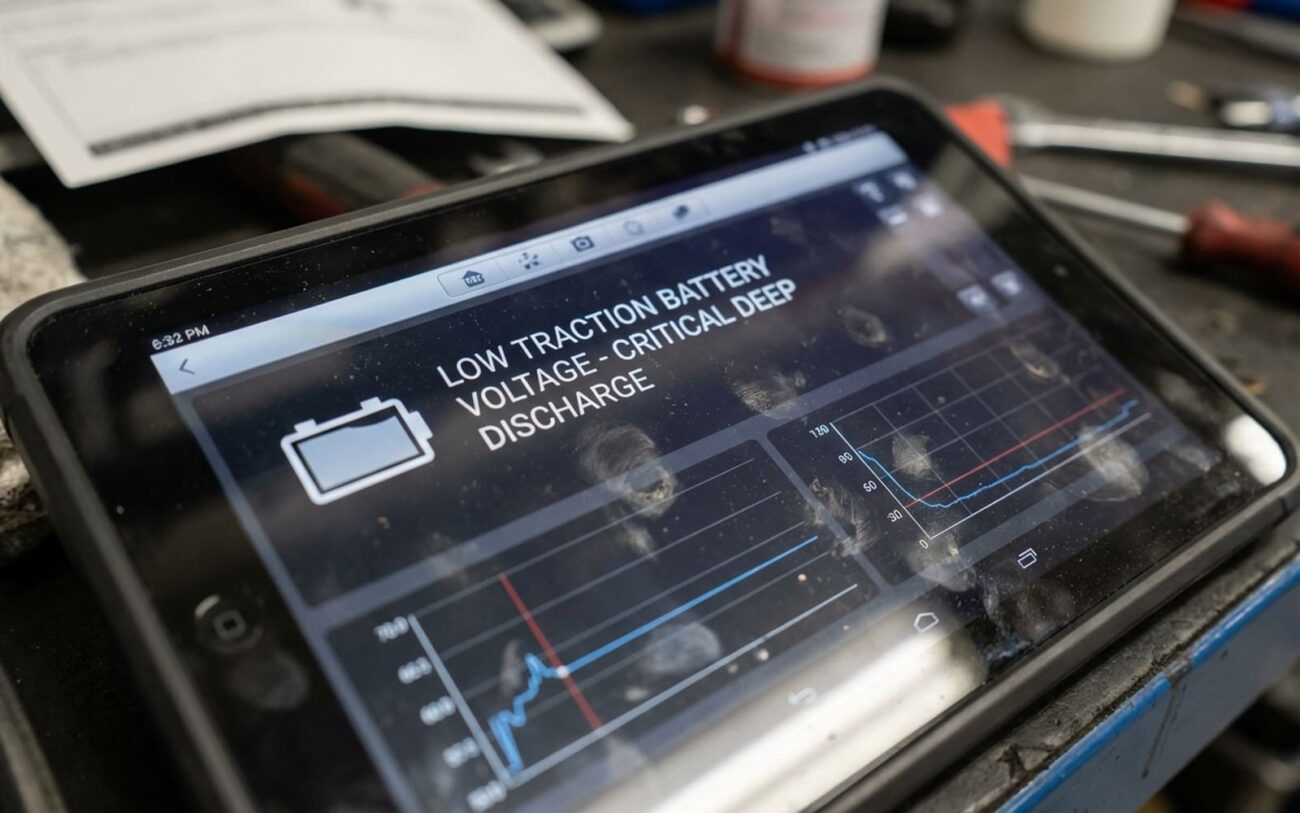
Alright, let’s talk about EV batteries, specifically when they’ve gone past just being “dead” and into what we call a deep discharge. After 25 years under the hood, I can tell you this isn’t just a low charge. It’s a fundamental breakdown inside the lithium-ion cells, and it usually means the battery’s seen its last good day. Once that chemical damage sets in, it’s physical, and it’s irreversible. You’ll start seeing weird glitches, but they’re not random; they follow a pretty predictable pattern.
Recognizing the Symptoms: What I See in the Bay
The first thing that usually tips me off is when a customer complains about no or very low charge acceptance. They plug into a Level 2 charger, one that should be pushing 6-11 kW, and they’re only pulling 1-2 kW, or the charger just won’t even kick on. Now, don’t jump to conclusions right away—this could be a bad on-board charger (OBC), a messed-up charge port, or even just a communication glitch. But if they’ve tried multiple charging methods, and all signs point back to the vehicle, then yeah, the battery itself is likely compromised.
Another big red flag is wildly inaccurate state of charge (SOC) readings or driving range. I’ve seen cars where the SOC drops from 50% to 10% after just a few miles. That’s not a software bug, folks. That’s the Battery Management System (BMS) doing its job, recalibrating based on the weakest cell group in the pack. Lithium-ion batteries are only as strong as their weakest link. When one or more cells can’t hold their voltage, the BMS has no choice but to derate the whole damn pack to protect it.
Then comes the dreaded reduced power mode, what most drivers call “turtle mode.” The car still moves, but acceleration is crippled, and speed might be capped, sometimes below 30 mph. This happens because those damaged cells develop high internal resistance. When you ask them for power, their voltage sags dramatically, and the BMS steps in to protect the inverter and prevent a thermal runaway event. It’s a safety mechanism, but it feels like the car just died.
The final stage is a complete shutdown. The car won’t power up into “Ready” mode. You’ll see hard warnings on the dash like “Service High Voltage System” or “High Voltage Battery Fault.” At this point, the BMS has initiated a critical fault lockout. Trying to charge or jump-start it now can actually make things worse, causing more internal damage like copper dissolution or further breakdown of the SEI layer. Trust me, I’ve seen techs try to force a charge and end up creating micro-shorts that make the pack unsafe, even if it briefly powers up. Don’t do it.
My Diagnostic Approach: Don’t Condemn the Battery Too Soon
The biggest mistake I see, even with experienced guys, is assuming the high-voltage pack is dead right off the bat. Sometimes it’s something way simpler and cheaper to fix—like a blown fuse, a failing 12V auxiliary battery, or a communication error. EVs are complex, and symptoms can overlap. You need a methodical approach to rule out external causes before you even think about condemning that big, expensive traction battery.
Here’s how I break it down in my shop: always check the supporting systems first. Is the 12V battery strong and holding a charge? (Yes, this matters; a weak 12V can shut down the whole HV system.) Is the OBC receiving power and sending signals correctly? Is the High Voltage Interlock Loop (HVIL) intact? These are all cheaper, more common failures that can perfectly mimic deep discharge symptoms. Skip these checks, and you’re just throwing money away.
| Symptom | What a Deep Discharge Means | Common External Mimics | How I Confirm the Source |
|---|---|---|---|
| No/Low Charge Acceptance | Individual cell voltages have dropped below the BMS’s low-voltage disconnect threshold (usually 2.5V–3.0V per cell), making it unsafe to charge. | Faulty On-Board Charger (OBC), damaged charge port pins, an open HVIL circuit, or a software freeze in the charging control module. |
First, I’ll use a manufacturer-approved scan tool to read individual cell group voltages. I’m looking for any cells consistently below the OEM minimum. Then, I verify the OBC’s output using a calibrated AC/DC clamp meter at its input and output terminals. If the OBC is sending power but the battery isn’t taking it, that points inward. |
| Sudden, Inaccurate SOC Drop | Severe cell imbalance. The weakest cell collapses under even a minor load, forcing the BMS to drastically recalculate the SOC downward. | A failed cell voltage sensor, damaged harness, a BMS software calibration fault, or an incorrect SOC reset after service. |
I’ll perform a cell voltage deviation test through the scan tool—both static and under a 20-amp load. If I see a deviation exceeding 300 mV under load, that’s a failing cell group. I’ll also cross-check sensor readings with direct voltage measurements at the service disconnect, always following HV-safe procedures, of course. |
| Propulsion Power Limited at High Displayed SOC | High internal resistance in cells, usually from a prior deep discharge, causing voltage sag under load and triggering BMS power limits. | Inverter or motor overheating, a 12V system fault, or other EV faults that trigger limp mode. |
Here, I’ll use the scan tool to command a steady power draw—say, 30kW—while logging individual cell voltages and temperatures. A failing cell group will show an excessive voltage drop and abnormal heating compared to the others. That’s the tell-tale sign of high internal resistance. |
The Real Problem: Chemical Damage Inside the Cells
Once I’ve ruled out all the external stuff, and the diagnostics confirm it’s the battery, then we’re dealing with actual electrochemical damage. This isn’t just “low power”; it’s permanent degradation at a molecular level. It’s why I say deep discharge is so much worse than just a dead 12V battery.
When a lithium-ion cell drains below its designed low-voltage threshold—typically under 2.5V, sometimes even 2.0V in older packs—the copper anode current collector actually starts to dissolve into the electrolyte. This copper doesn’t just vanish. When you try to charge it, it can plate out in the separator or on the cathode, creating internal micro-shorts. These shorts increase self-discharge, generate localized heat, and significantly raise the risk of thermal runaway. It’s a ticking time bomb, really.
At the same time, the Solid-Electrolyte Interphase (SEI) layer on the anode breaks down. This layer is supposed to be stable and protective, like a shield. When it degrades, it permanently consumes cyclable lithium ions, which directly reduces the battery’s total capacity. The cell also develops higher internal resistance, meaning it heats up faster and just can’t deliver the power it used to under load. It’s like trying to breathe through a clogged filter.
It’s important to understand this isn’t the same as a parasitic drain from a faulty 12V system, even if that’s what caused the deep discharge. If the 12V battery dies and the vehicle’s computers stay awake, slowly draining the high-voltage pack over weeks, that’s an external fault leading to the symptom. But the root issue we’re talking about here is the irreversible chemical damage within the cells themselves. This is especially true in older packs where natural cell imbalance has worsened over time. One weak module can drag the entire pack into deep discharge, even if the overall voltage looks acceptable at rest. That’s why individual cell monitoring is so critical.
What Can Be Done: Repair or Replace?
There’s no magic bullet here. What we can do depends entirely on the pack design, how bad the damage is, and whether the manufacturer even allows module-level service. Most modern EVs are built to be replaced, not repaired.
Professional Territory Only
Let me be absolutely clear: this is all Professional Only work. We’re talking about high-voltage systems here, and they demand strict safety protocols. I’m talking CAT III/IV rated tools, HV-rated gloves, and full, up-to-date training. I wouldn’t touch this without proper PPE and following every single OEM procedure. If you’re not certified, stay away.
In some rare cases, you might get lucky. Some older EVs—think certain Nissan Leaf models or commercial fleet batteries—have serviceable packs where individual modules can actually be accessed and replaced. If my diagnostics confirm only one or two modules are truly below threshold and the rest are healthy, a targeted replacement is possible. You’ll need OEM-specified parts, insulated tools, a calibrated cell balancer, and a torque wrench for those aluminum busbar connections (typically 8–12 Nm). After replacement, the entire pack has to go through a slow, controlled rebalancing and a full capacity test. Skip this, and you’re just creating new imbalances that will shorten the pack’s life and bring the customer right back.
More often than not, though, you’re facing a non-serviceable, sealed pack—like what you find in most modern Teslas, Hyundai Kias, or BMW EVs. If the damage is widespread, or if the manufacturer has designated the pack as “replace-only,” then the only real option is a full pack replacement. And this isn’t a plug-and-play job, either. You need the factory scan tool to properly pair the new pack’s BMS with the vehicle’s control modules. There are specific service procedures for this; manufacturers issue guidance on BMS initialization and anti-theft coding. Deviate from that, and the car simply won’t accept the new battery, leaving you with a very expensive paperweight.
Post-Repair Validation: Don’t Just Assume It’s Fixed
You can’t just assume a repair worked because the car powers up and moves. You need to verify performance, balance, and safety. This is where proper diagnostic tools truly pay for themselves, preventing comebacks and ensuring customer safety.
First, I always perform a static cell balance test. After a full charge, I let the pack rest for 1–2 hours to let everything stabilize. Then, I check individual cell voltages via the scan tool. A healthy, well-balanced pack should show less than 50 millivolts difference between the highest and lowest cell. If it’s more than that, you’re setting yourself up for future issues, guaranteed.
Next, I run a capacity (energy) test. I’ll discharge the pack at a standard rate—usually C/3 or similar, depending on OEM specs—and measure the total energy delivered. A successful repair should yield at least 95% of the manufacturer’s specified capacity. If it’s lower, the pack still has undiagnosed degradation, and you’re not done yet.
Finally, I conduct an internal resistance test using a specialized impedance analyzer. Each module’s AC internal resistance should be within 10% of the pack average. High resistance in one module indicates ongoing degradation, even if the voltage looks okay at rest. If any of these tests fail, the repair isn’t complete—either more modules need replacing, or the entire pack is simply unsalvageable. You have to be honest with the customer at this point.
The Bottom Line: Cost, Risk, and Making the Call
Let’s be realistic: repairing or replacing a deep-discharged EV battery is expensive. The decision isn’t just technical; it’s financial, and it’s often an emotional one for the customer.
| Repair Type | DIY Cost | Shop Cost | Success Rate (My Experience) | Secondary Risk if It Fails |
|---|---|---|---|---|
| Single Module Replacement (Serviceable Pack) | Not Applicable (HV work) | $1,500 – $4,000 | 70–85% | Increased imbalance can damage the new module or stress the inverter. You’re looking at a high risk of premature failure within 1–2 years if not done perfectly. |
| Full Pack Replacement | Not Applicable (HV work) | $8,000 – $25,000+ | 98% | Warranty claim denial if non-OEM parts or improper procedures are used. There’s also a risk of software mismatch if the BMS isn’t paired correctly to the vehicle. |
| Temporary Low-Current Recovery | $500 (for equipment) | $300 – $600 | <30% | High risk of catastrophic failure, thermal event (fire), or permanent BMS lockout. This is a desperate measure. |
Here’s how I advise customers, especially when they’re out of warranty: if the repair cost exceeds 50% of the vehicle’s current market value, it’s often not worth it. For example, putting $15,000 into a 7-year-old EV that’s only worth $10,000. You’ll have a working car, but it’ll have poor resale value and no warranty protection. In many cases, that’s a total loss decision, however painful it might be to hear.
My Advice: Prevention is Always Cheaper
The best way to handle a deep discharge? Avoid it altogether. Lithium-ion batteries degrade over time, that’s just physics, but smart usage can slow that process down significantly and keep you out of my bay.
Never store an EV at 0% or 100% SOC for extended periods. Both extremes accelerate degradation. For long-term parking—say, over a month—always follow the manufacturer’s advice. Most recommend charging to 50–60% and unplugging, or keeping it plugged in with charging limits enabled (if the car supports it). This prevents parasitic drain from pushing a borderline battery into a deep discharge state.
Keep an eye on your efficiency. Most EVs display kWh per 100 miles (or miles per kWh). If you notice a sudden, unexplained increase—say, from 30 to 38 kWh/100 mi without any changes in your driving habits—it could signal rising internal resistance from cell degradation. That’s an early warning sign that something’s not right, and it’s worth getting checked out.
Limit DC Fast Charging. While it’s convenient for road trips, frequent fast charging generates a lot of heat and stress that accelerate cell wear and imbalance. For daily use, stick to Level 1 or 2 charging whenever possible. Reserve DCFC for when you truly need it. This simple habit can genuinely extend your pack’s healthy life by years. I’ve seen it firsthand.
And if you’re seeing any of those early symptoms I talked about—reduced charge acceptance, SOC jumps, or even just a feeling that the car isn’t quite right—get it scanned early. Catching cell imbalance before it leads to a full deep discharge can save you thousands. The BMS is smart, but it can’t fix chemistry that’s already broken. Listen to your car, and it’ll tell you what’s going on.
In my 25 years, I’ve learned this: EV batteries are incredibly robust pieces of engineering, but they’re not indestructible. Treat them right, pay attention to the signs, and they’ll last you a long time. Ignore those warnings, and you’ll definitely pay the price.
