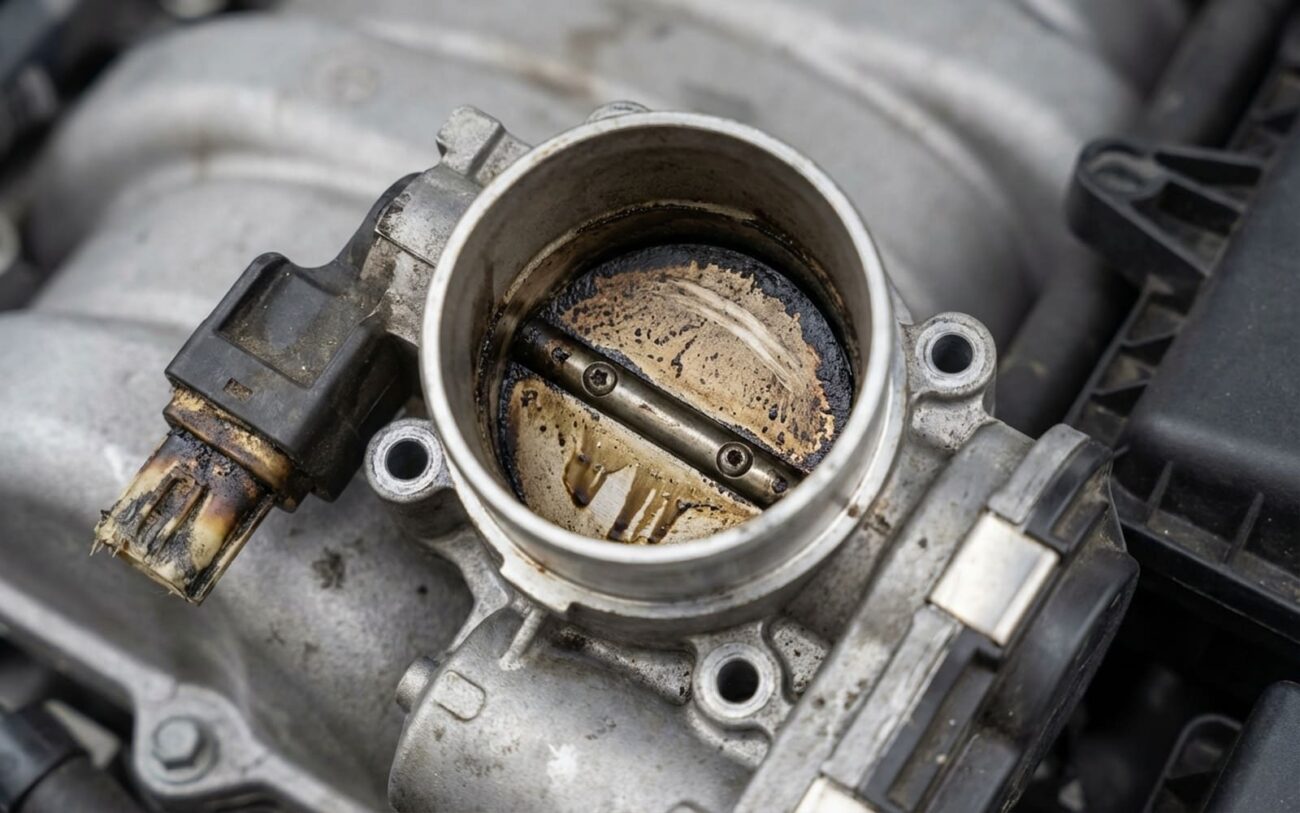
Alright, let’s talk about the Throttle Position Sensor, or TPS. I’ve seen countless vehicles come through my bay with owners convinced they have a transmission problem or a major engine issue, only for it to be this little sensor acting up. It’s sneaky because it doesn’t always throw a clear code right away, and the symptoms can really make you scratch your head. What we’re dealing with here isn’t a mechanical failure in the traditional sense, but a breakdown in the crucial electrical signals the engine computer (ECM) relies on.
What a Failing TPS Feels Like (Symptoms)
The most common complaint I hear is a hesitation or stumble under light throttle, especially when you’re just pulling away from a stop or trying to accelerate gently at low speeds. You press the gas, and instead of a smooth pickup, there’s this brief lag, like the engine forgot what it was supposed to do for a second. This happens because the TPS is essentially a potentiometer, sending a voltage signal to the ECM that tells it exactly where the throttle plate is. If that internal resistive track wears out — and they all do, eventually — the signal can momentarily drop out. Even for a few milliseconds, that’s enough to confuse the ECM, making it miscalculate fuel and spark, and you feel that hesitation.
Another classic sign is a rough or surging idle. The ECM uses the TPS as a primary reference for maintaining idle speed. If the sensor starts sending a jumpy signal — say, fluctuating between 0.5V and 1.2V when the throttle should be completely closed — the computer thinks you’re tapping the gas pedal. It then tries to constantly adjust the idle, leading to RPMs bouncing up and down while you’re sitting at a light. Customers often describe this as the engine “hunting” for an idle.
You’ll usually see a check engine light eventually, with diagnostic trouble codes (DTCs) in the P012x range. We’re talking P0121 for TPS performance issues, P0122 for a low input signal, or P0123 for a high input. These codes are pretty direct, pointing to the TPS circuit. On newer drive-by-wire systems, you might also see related codes for the accelerator pedal position (APP) sensor, because the ECM expects those two signals to agree.
TPS SIGNAL MONITOR
Variance: 0.85V Dip
Now, here’s the catch that trips up a lot of DIYers and even some younger techs: these symptoms aren’t exclusive to the TPS. A vacuum leak can make your idle surge just like a bad TPS. A dirty throttle body or a failing MAF sensor can cause hesitation. Even ignition misfires or fuel delivery problems can mimic a bad TPS. That’s why you can’t just throw parts at it based on symptoms or a code. You have to verify what’s actually happening.
How I Actually Diagnose It (The Real Work)
Guessing is for amateurs. To really nail a TPS issue, you need a methodical approach. My go-to tools are a good scan tool capable of graphing live data and a digital multimeter (DMM). We’re going to verify the signal, not just assume.
The Gold Standard Test: Graphing TPS Voltage
This is the most definitive test. With the key on, engine off (KOEO), connect your scan tool and graph the TPS voltage PID. Then, slowly, smoothly open the throttle by hand from fully closed to wide-open throttle (WOT). What you want to see on that graph is a perfectly smooth, linear rise in voltage. It should start around 0.45V to 0.55V at idle and climb steadily to around 4.5V at WOT. Any dips, flat spots, or sudden jumps in that line, and you’ve found your culprit. That’s internal wear in the sensor, plain and simple.
Tech Tip: Don’t Just Look at Numbers
A lot of folks just look at the raw voltage number. That’s fine for idle and WOT, but it’s the sweep that tells the story. You need to see that smooth, continuous line. A quick glance at a static number won’t catch those momentary dropouts that cause hesitation.
When You See a P012x Code
If you’ve got a P0121, P0122, or P0123, don’t just order a TPS. I’ve seen too many techs do this and then wonder why the problem comes back. The code tells you there’s an issue with the circuit or signal, but it doesn’t tell you where. You need to verify the wiring first.
- Back-probe the TPS connector: Use your DMM. You should see a stable 4.5V to 5.5V reference voltage, a solid ground, and the signal return wire should show the expected voltage (around 0.5V at closed throttle).
- Check for wiring damage: Look for chafed wires, corrosion in the connector terminals, or even a poor ECM ground. Corrosion, especially in areas prone to moisture (like near the intake manifold or under the bumper on some VW/Audi models, which I’ve seen a lot), can cause resistance and voltage drops that perfectly mimic a bad sensor. If the reference voltage is low, or the ground is floating, the sensor can’t send a correct signal, even if it’s perfectly good.
Ruling Out the Mimics
If your TPS voltage graph is perfectly clean, but you still have symptoms, then the TPS isn’t your problem. Time to look elsewhere:
- Rough Idle:
- Vacuum leaks: These are notorious for causing surging idle. Do a smoke test. If you see smoke escaping, you’ve found your leak.
- Dirty throttle body: Carbon buildup around the throttle plate can prevent it from fully closing or sticking slightly, messing with idle air. Clean it thoroughly.
- Failing Idle Air Control (IAC) valve: On older vehicles, this valve directly controls idle. Check its operation.
- Hesitation on Acceleration:
- Mass Air Flow (MAF) sensor: A dirty or failing MAF can send incorrect air readings, leading to poor fuel delivery and hesitation. Check MAF readings and fuel trims with your scan tool.
- Fuel delivery issues: Clogged fuel filter, weak fuel pump, or dirty injectors can all cause a lean condition and hesitation. Check fuel pressure and volume.
- Ignition problems: Failing ignition coils or worn spark plugs can cause misfires under load, which feels a lot like hesitation.
Why They Fail (Root Causes)
At its core, a TPS is a pretty simple device, but it’s constantly working. Most commonly, it’s mechanical wear of the internal conductive track. Think of it like a volume knob on an old stereo that gets scratchy when you turn it. The sliding contact, or “wiper,” wears grooves into the resistive material over time. These grooves create those “dead zones” where the signal drops out. This is especially prevalent in high-mileage cars or those that spend a lot of time in stop-and-go traffic, constantly moving that throttle plate.
Less common, but still happens, is delamination. That’s where the resistive film separates from its backing. This can be due to thermal cycling (engine heat and cooling) or just a manufacturing defect. Another factor I’ve seen is contamination from crankcase vapors. If your PCV system isn’t happy and you’re getting a lot of oil vapor and carbon blow-by into the intake, that gunk can coat the contact surfaces of the TPS, acting as an insulator and messing with the signal.
Let’s Be Clear: It’s Not Always the TPS
I’ve seen techs replace a TPS three times because they didn’t clean the throttle body first. If the throttle plate is sticking due to carbon buildup, that’s a cleaning issue, not a TPS failure. Same goes for a broken throttle cable on an older car—that’s mechanical. The TPS just reports the position; it doesn’t move the throttle itself. Always clean the throttle body first if there’s any doubt about its movement.
And always, always check for manufacturer-specific service bulletins (TSBs). For instance, certain Chrysler Group vehicles, like some Dodge Darts, had well-documented TPS failures that were addressed by replacing the entire throttle body assembly, not just the sensor. Knowing these patterns can save you a lot of time and money.
Getting It Fixed (Resolution)
Integrated Systems: A Modern Reality
On just about any modern car with drive-by-wire, the TPS isn’t a separate part you can just unbolt. It’s built right into the electronic throttle body and isn’t designed to be serviced separately. That means if the TPS fails, you’re replacing the whole throttle body assembly. And yes, that usually requires some precise electronic calibration afterward.
Integrated Throttle Body Replacement Professional Only
Separate Bolt-On TPS DIY Feasible
Contact Cleaner Workaround Temporary Only
Post-Repair Validation: Don’t Skip This!
My Verification Checklist
-
First, clear all stored DTCs and perform any necessary throttle position relearn procedure. This is non-negotiable.
-
Start the engine and observe idle quality. It should be smooth and stable, no hunting or RPM bouncing.
-
Graph the TPS voltage again while slowly opening the throttle. That line absolutely needs to be clean, continuous, and linear from idle to WOT.
-
Finally, road test the vehicle under the exact conditions that caused the original symptom (gentle acceleration from a stop, low speed cruising) to confirm the hesitation or surging is completely gone.
The Bottom Line: Cost & Decision
Separate TPS (DIY)
Sensor only. High success rate (>95%) when adjusted correctly with a multimeter. This is the cheapest fix if you can do it.
Throttle Body (DIY)
OEM or quality reman assembly. Requires a capable scan tool for the relearn procedure. Don’t skip it.
Full Shop Service
Includes diagnosis, programming, labor, and warranty. This is what I recommend for integrated drive-by-wire systems if you don’t have the tools.
My Advice Here
If you’re working on an older vehicle with a standalone TPS and you’re comfortable with a multimeter, doing it yourself is a highly cost-effective repair. But for modern cars with integrated throttle bodies, unless you own a professional-grade scan tool that can perform the necessary relearns and programming, professional service is absolutely worth the investment. Misprogramming or skipping that relearn procedure will lead to comebacks, I guarantee it.
Keeping It Healthy (Prevention)
You can’t stop normal wear and tear completely, but you can definitely extend the life of your TPS. The biggest thing I tell my customers is to maintain their PCV (positive crankcase ventilation) system. A clogged or failing PCV valve means increased crankcase pressure, which pushes oil vapor and crud into the intake. That sludge coats everything, including the throttle body and the TPS itself. Replace that PCV valve per your maintenance schedule, and check those breather hoses for blockages.
Also, use high-quality air filters and replace them on time. Dust and debris are abrasive and will accelerate wear on any moving parts inside the throttle body. And this is a big one, especially on direct-injection engines: clean the throttle bore periodically. Direct injection doesn’t get that fuel wash on the intake valves, so carbon buildup is more common. A dirty throttle plate can cause the TPS to operate outside its ideal voltage range, stressing the sensor over time.
