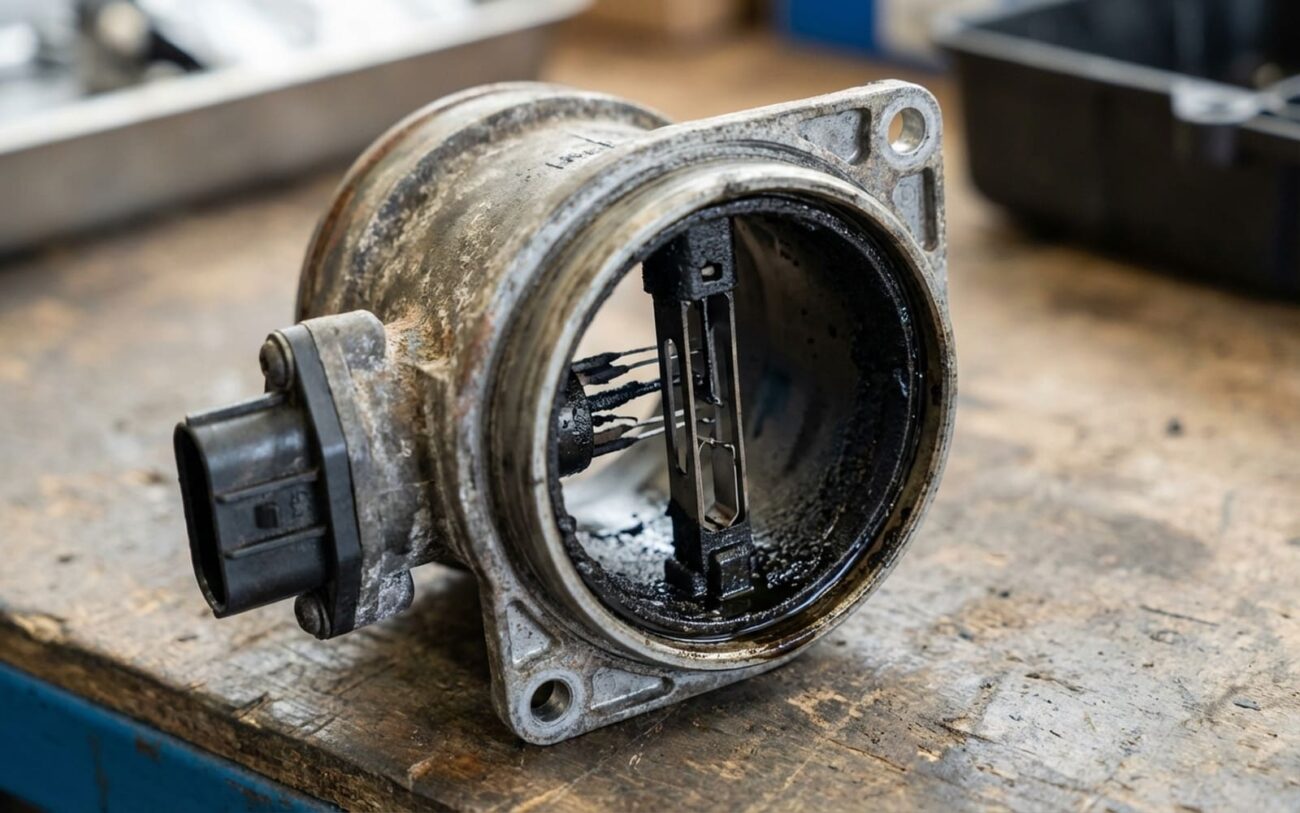
Alright, let’s talk Mass Air Flow (MAF) sensors. After more than two decades wrenching on cars, I’ve seen my share of headaches caused by these little guys. When your check engine light pops on with those familiar P0171 (system too lean, Bank 1) or P0174 (system too lean, Bank 2) codes—or even a P0172 for a rich condition—and they just won’t stay cleared, you’ve got to dig in. You’ll probably feel it too: that hesitation when you hit the gas, a rough idle, or a sudden thirst for fuel. While plenty of things can cause these symptoms, a bad MAF sensor is a top contender, especially when the problem is inside the sensor itself. That’s what we’re focusing on here: internal sensor failure, not external stuff like vacuum leaks or dirty air filters.
What a Bad MAF Sensor Really Looks Like (and What It Does)
Forget just reading codes; the clearest sign of a failing MAF sensor, in my experience, is in the live data on your scan tool. A healthy engine, idling smoothly, typically pulls somewhere between 2 and 7 grams per second (g/s) of air. That number varies, of course, depending on the engine’s size and what accessories are running. But if your scanner shows 0 g/s, or something wildly high like 300 g/s, or if the reading just doesn’t change smoothly when you rev the engine, that sensor is probably shot.
Another big tell is calculated engine load. If you mash the gas pedal and that load reading barely budges—say, it only hits 15% when it should be climbing towards 90%—the powertrain control module (PCM) isn’t getting accurate airflow info. And when the PCM is flying blind like that, it can’t mix fuel properly.
Now, this isn’t just about poor performance. A bad MAF can seriously damage your engine. If the sensor underreports airflow, the PCM injects too little fuel, creating a lean condition. Lean mixtures burn super hot, which can lead to detonation—that’s the pinging or knocking you hear—and that’ll destroy pistons and spark plugs over time. On the flip side, if it overreports airflow, the engine runs rich. Too much fuel can wash down the cylinder walls, diluting your engine oil and accelerating wear on bearings and rings. And in the worst cases, all that unburned fuel can overload and melt your catalytic converter. Trust me, you don’t want to replace a cat; it’s a five-figure repair on some vehicles.
How I Pinpoint a Bad MAF (and Rule Out the Fakes)
Diagnosing a MAF sensor isn’t always straightforward because a bunch of other issues can throw the exact same codes and symptoms. I’m talking about vacuum leaks, clogged fuel injectors, low fuel pressure, or even a lazy oxygen sensor. That’s why you need a methodical approach. Don’t just swap the MAF; you’ll likely be back to square one.
| Symptom I’m Seeing | Why I Suspect the MAF | Other Common Culprits (The Mimics) | My Go-To Test to Confirm |
|---|---|---|---|
| Persistent lean codes (P0171/P0174) | MAF is under-reporting air, so the PCM leans out the fuel. You’ll see negative long-term fuel trims trying to compensate. | Vacuum leak, low fuel pressure, dirty injectors, exhaust leak before the upstream O2 sensor. |
First, check your Long Term Fuel Trim (LTFT) at idle. Then, with the engine running, spray some propane or unlit carb cleaner around the intake gaskets and vacuum lines. If the LTFT numbers suddenly improve (move closer to zero or even negative), you’ve found a vacuum leak. If no change, next I’d test fuel pressure and volume. If those are good, then—and only then—I’d consider swapping in a known-good OEM MAF to confirm.
|
| MAF data is illogical (0 g/s, frozen, super erratic) | The sensing element is dead, the internal chip (ASIC) is fried, or there’s an open circuit inside the sensor itself. | Open or short in the wiring harness, bad connector contact, or contamination from silicone or oil (especially from those “performance” oiled air filters). |
Grab your digital multimeter. Check for proper 12V reference voltage and a good ground at the MAF connector with the key on. Then, back-probe the signal wire and watch the voltage output as you slowly rev the engine. It should rise smoothly and predictably. Also, visually inspect the sensing element for any debris or damage. I’ve seen countless cheap aftermarket sensors fail these basic electrical checks right out of the box.
|
| Poor driveability (hesitation, surging) directly tied to throttle input | The sensor’s output isn’t linear across the airflow range, meaning its internal calibration or element response is faulty. | Ignition misfire, dirty throttle body, a wonky crankshaft position sensor, or even an inaccurate intake air temperature (IAT) sensor. |
This is where graphing comes in handy. Graph the MAF sensor output (g/s or voltage) alongside your upstream O2 sensor voltage during a slow, steady acceleration. A healthy system will show smooth, proportional changes. A failing or counterfeit sensor, however, will often show “steps,” “flat spots,” or erratic jumps in its output, clearly indicating it’s not reporting air mass correctly.
|
Tech Tip: Don’t overlook wiring! I’ve wasted hours chasing phantom MAF issues only to find a corroded pin or a chafed wire. If you’ve had recent engine work, or if the car lives in a salty climate, always give the MAF harness a thorough visual inspection. Sometimes a frayed wire inside the conduit can cause intermittent problems that drive you nuts.
Why Those Cheap Aftermarket Sensors Are a Trap
Look, I get it. OEM parts are expensive. But when you buy a cheap aftermarket MAF sensor, you’re not just saving a few bucks—you’re often buying a component with fundamental design and manufacturing flaws. The sensing element, whether it’s a thin platinum wire or a heated film, relies on super precise thermal conductivity to accurately measure air mass. Counterfeit units frequently use inferior alloys that simply don’t respond correctly to temperature changes, giving you bad readings right out of the box.
But the biggest problem, the one that really gets me, is calibration. Inside that sensor is a tiny chip (an ASIC) that contains a lookup table, mapping airflow to voltage output. OEM sensors are painstakingly calibrated to match the specific airflow characteristics of your engine. Cheap knock-offs? They often use generic or just plain wrong calibration curves. This means they send the PCM data that doesn’t reflect what’s actually happening in the engine. Even if the physical hardware somehow worked, the wrong map dooms it to failure. I’ve seen brand new aftermarket MAFs throw P0171 codes immediately after installation—not because of contamination, but because the calibration was so far off it was useless.
Component quality is another huge weak point. Low-grade resistors, capacitors, or shoddy solder joints can fail quickly under the heat and vibration of an engine bay. Many also lack proper sealing, letting moisture creep in and corrode the internal electronics. This leads to those frustrating intermittent faults that come and go, making diagnosis a nightmare. Even major manufacturers like General Motors have issued service bulletins warning that aftermarket MAF sensors are a known cause of persistent lean codes due to these calibration inaccuracies. They specifically state to use only genuine GM parts. It’s not just a sales pitch, it’s real-world experience.
The Only Real Fix (and Why Cleaning is Usually a Waste of Time)
Once you’ve done your due diligence and confirmed the MAF sensor is the actual problem, your repair choice should be crystal clear. There’s really only one reliable long-term solution, and that’s replacing it with a genuine OEM unit.
Replace with a Genuine OEM MAF Sensor DIY-Feasible
Cleaning the Sensor Professional-Only – High Risk
How I Confirm the Repair Actually Worked
Just swapping the part isn’t the end of the job; verification is crucial. A proper repair means the engine is running within factory specs, and the PCM has confirmed it through its internal monitors. I never let a car leave the shop without this step.
After installation, start the engine and let it warm up completely. Then, pull out your scan tool and check the live data. Both Long Term Fuel Trim (LTFT) and Short Term Fuel Trim (STFT) should be within ±5% at idle. That’s the PCM telling you the air/fuel ratio is spot-on. Next, check the MAF sensor’s g/s reading at idle and again at a steady 2500 RPM. Compare these to the OEM specifications for your engine—you can find this data in service manuals or good technical databases. If you see a deviation of more than 10% from the expected values, you’ve still got a problem, either with the new sensor or your installation.
The final hurdle is completing an OBD-II drive cycle. You need to drive the vehicle under various conditions—idle, steady cruise, acceleration, deceleration—to allow the PCM to run all its self-diagnostics. Confirm that all fuel system monitors show “Ready” status and, most importantly, that those P0171, P0172, P0174, or similar codes don’t come back. You absolutely need an advanced OBD2 scanner that can display MAF g/s, STFT, LTFT, and upstream O2 sensor voltage. Without that data, you’re just guessing, and that’s not how I diagnose.
The Real Cost: Doing It Right vs. Rolling the Dice
Let’s be honest: OEM MAF sensors aren’t cheap. That’s why so many folks try to save a buck with aftermarket alternatives. But that upfront “saving” can blind you to the much bigger risks down the road.
| Repair Strategy | DIY Part Cost | Shop Cost (Parts & Labor) | My Observed Success Rate | Hidden Risks if It Fails |
|---|---|---|---|---|
| Replace with OEM MAF sensor | $150 – $400 | $300 – $600 | >95% (for resolving MAF-related faults) | Minimal, assuming a correct initial diagnosis. |
| Install another aftermarket/counterfeit sensor | $50 – $150 | $200 – $400 | <50% (high chance of recurring issues or new problems) | High. Engine damage from incorrect fueling, endless diagnostic loops, and potential catalytic converter meltdown. |
Those numbers tell the real story. While the cheap option looks good on paper, its failure rate makes it a total gamble. In my shop, I see far more comebacks from cheap sensors than from proper OEM replacements. And yes, if the repair cost starts creeping up towards 25% of the vehicle’s market value—like dropping a grand on a $4,000 car—you have to think about the financial sense of the repair. But even then, installing a known-unreliable part is a technical compromise that almost always leads to worse outcomes. Those minor upfront savings? They’re just not worth the risk of engine damage or being stranded on the side of the road.
How to Avoid This Headache Next Time
Prevention starts with smart maintenance. Always, and I mean always, use an OEM or OEM-specified dry air filter. Those aftermarket oiled filters, while they promise performance, are a well-documented cause of MAF sensor contamination. The oil migrates to the sensing element, coating it and insulating the wire or film. That leads to inaccurate readings and premature failure, every time.
Also, get into the habit of checking live data early. The next time you get a check engine light related to fuel or air, connect your scan tool and review the MAF sensor output. Compare it to known-good values for your engine—you can usually find these in service information or trusted technical databases. If you see a deviation of more than 10% from the expected g/s at a given RPM, that should be a red flag. Catch it early, before it causes bigger problems.
