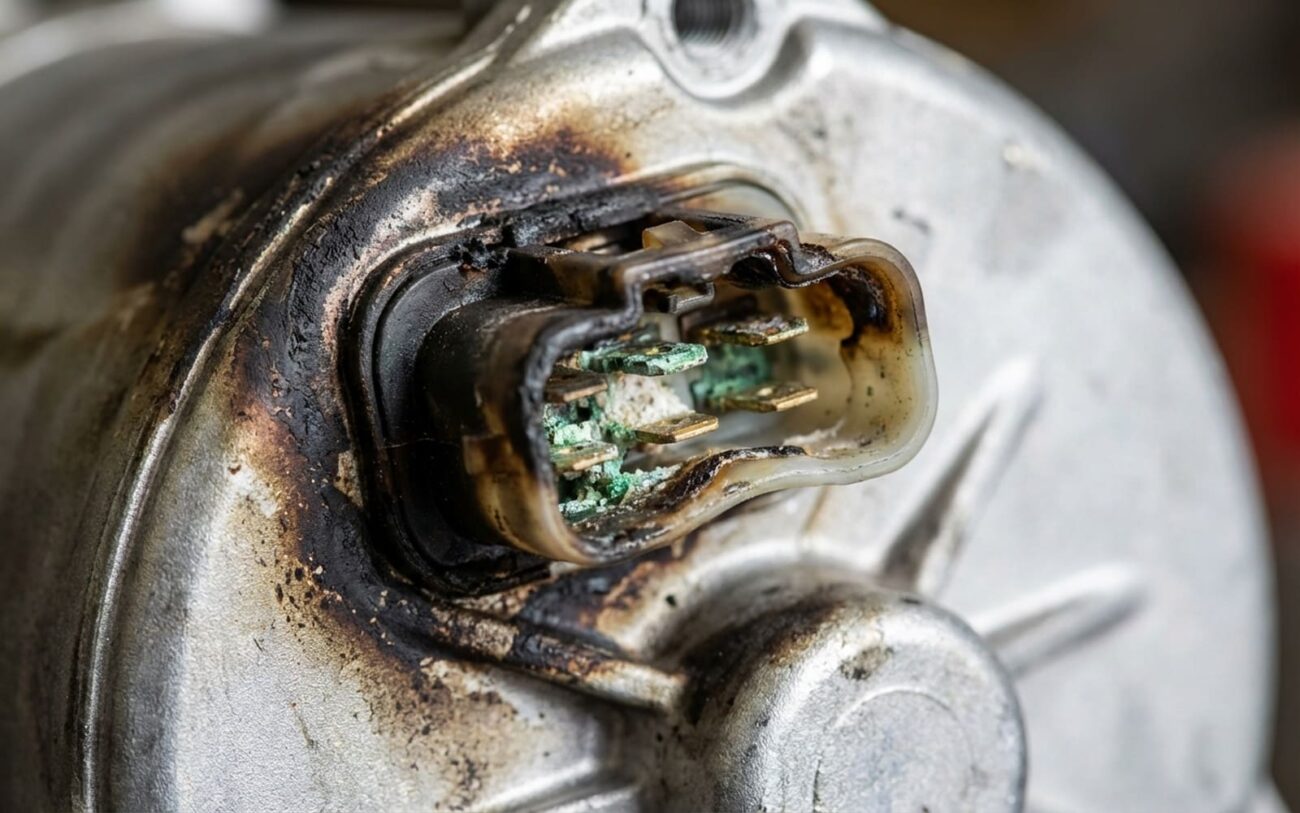
When Your Electric Power Steering Motor Gives Up the Ghost
Alright, let’s talk about electric power steering (EPS) motors. These aren’t just about making parking easier; they’re a critical safety system that gives you precise control over the vehicle. When one of these motors starts to fail, it’s not usually a sudden, catastrophic event—it’s more like a slow, annoying deterioration. But don’t let that fool you; it can go from “annoying” to “dangerous” in a heartbeat.
In my 25+ years turning wrenches, I’ve seen a lot of EPS issues. The symptoms are often gradual, but they’re unmistakable if you know what you’re looking for. And trust me, you want to catch this early.
The First Clues
“The most common first sign? A consistent humming or whining noise. It’s a mechanical-electrical tone that usually rises in pitch when you’re turning the wheel, especially during tight maneuvers or parking.”
That noise is often the sound of worn internal bearings, an armature imbalance, or shorted windings inside the motor. It’s trying to work, but it’s fighting itself. And fighting means heat.
Another big telltale sign is heat. After just a few minutes of driving, especially if you’ve been doing a lot of turning (think city driving or parking lots), reach down and touch the steering column shroud. If it’s noticeably hot—I mean, more than just warm, almost uncomfortable to touch—you’re likely dealing with an overworked or failing motor. The EPS system is designed to manage heat, but when those internal resistances kick in, the motor starts drawing more current, and that generates excess heat. In extreme cases, the system recognizes this and triggers a thermal shutdown. That’s when your EPS warning light illuminates, and all steering assist cuts out completely.
Is It Really the EPS Motor? Don’t Guess, Diagnose.
Before you jump to conclusions and condemn the motor, you absolutely have to rule out other things. I’ve seen more than a few perfectly good EPS motors replaced because the real problem was something else entirely. Alternator whine, control module glitches, or even mechanical binding in the steering system can all mimic EPS motor failure. On some Fords, for example, a seized intermediate shaft is a common culprit that makes the EPS motor work overtime and appear to be failing.
The key here is targeted diagnostics. Don’t just throw parts at it. Grab a mechanic’s stethoscope, or even a long screwdriver, and use it as a sound probe. Listen carefully. If that hum or whine is clearly coming from the EPS motor housing itself—and not from, say, the firewall, the fuse box, or the alternator—then you’ve got a strong indicator. But sound alone isn’t enough; you need to verify it with actual testing.
| Symptom | Likely EPS Motor Cause | Common External Mimics | My Go-To Test |
|---|---|---|---|
| Humming/Whining Noise | Worn internal bearings, armature imbalance, or shorted windings. | Alternator whine, power steering pump (if hydraulic assist also present), or PWM noise from the EPS control module. |
With the engine on, disconnect the EPS motor’s main power connector. If the noise stops when turning the wheel (and steering gets heavy), the motor is the source. |
| Overheating | Increased internal resistance from winding shorts, brush wear, or bearing friction. | High system voltage (>15V), severe mechanical binding in the rack, or a failing control module. |
Measure current draw on the main motor feed (expect 30–80A peak during turns). An IR thermometer reading over 100°C (212°F) on the motor housing after 5 minutes of low-speed turning confirms internal failure. |
| System Shutdown / No Assist | Thermal cutoff, phase-to-phase short, or rotor position sensor failure. | Faulty torque sensor, low battery voltage, CAN bus communication errors, or EPS control module failure. |
Scan for EPS-specific codes (e.g., “Motor Circuit Malfunction,” “Motor Position Sensor Error”). If the code returns immediately after clearing, it’s a hard fault, likely internal to the motor or its immediate sensors. |
Always, and I mean always, check the basics first. It’s surprising how many times a simple fix gets overlooked. Inspect the EPS fuse and relay—they’re common failure points. Use a multimeter to verify your battery voltage is steady, typically between 13.8 and 14.8 volts, with the engine running. A weak battery or a failing alternator can cause all sorts of erratic EPS behavior, making it seem like the motor is bad when it’s just not getting enough juice.
And here’s another trick: disconnect the steering column from the rack (if it’s a column-assist unit) or the rack from the tie rods (if it’s a rack-assist). Then, try to turn the steering wheel by hand. If it binds or feels notchy, the issue might be mechanical—like a worn tie rod end, a seized intermediate shaft, or even a bad steering rack. In those cases, the EPS motor is just overworking itself trying to compensate, and replacing the motor won’t fix the root cause.
Why These Motors Fail: What’s Happening Inside
Once you’ve confirmed the EPS motor is the actual problem, it’s good to understand why it’s failing. Most EPS motors are sealed, non-serviceable units, meaning you can’t just pop them open and replace a brush. So, failure usually comes down to internal wear, contamination, or sometimes, just a design flaw that shows up after years of use.
Heat is the Silent Killer
In my experience, heat is the number one enemy of these electric motors. Repeated thermal cycling—especially in stop-and-go traffic, during frequent parking maneuvers, or if you’re constantly turning the wheel at low speeds—causes internal components to expand and contract. Over time, this leads to micro-cracks in solder joints, insulation breakdown in the motor windings, and accelerated bearing wear. That’s why those overheating symptoms are so critical.
On older brushed motors, the carbon brushes simply wear down over time. As they degrade, contact with the commutator becomes inconsistent, leading to arcing, more heat, and eventually, total failure. Newer brushless motors avoid the brush issue but introduce other potential failure points, primarily the Hall-effect sensors. These tiny sensors monitor the rotor’s position. If they fail, the control module can’t synchronize power delivery to the motor, resulting in poor assist or complete shutdowns.
Contamination is another major factor. Water intrusion, often from a clogged plenum drain (I’ve seen this on countless vehicles where water drips right onto the steering column) or driving through deep puddles, can seep into the motor housing. Once inside, moisture causes corrosion on bearings and windings, leading to increased friction and electrical shorts. Physical damage also plays a role. A hard impact from a pothole or curb can misalign the steering column or damage motor mounts, creating internal binding that the motor just can’t overcome.
Your Repair Options: What Actually Works (and What Doesn’t)
Safety First, Always
If you’re going to tackle this yourself, especially if it involves lowering the steering column, you absolutely MUST follow factory torque specs (usually around 15–25 ft-lbs for column bolts). And whatever you do, be extremely careful around any SRS (airbag) wiring. Those systems are unforgiving of mistakes and can be dangerous.
External Connector & Wiring DIY-FEASIBLE
Internal Component Failure PROFESSIONAL-ONLY
Calibration & Initialization
Emergency Mobility LAST-RESORT
How to Confirm the Repair Was Successful
Replacing the motor or fixing a connection isn’t the finish line; it’s just the start of the validation process. A proper repair isn’t just about installation; it’s about thorough testing to ensure everything is working as it should. For a simple connector repair, it’s straightforward: no warning lights after key-on, and smooth, consistent assist during full lock-to-lock turns.
My Post-Replacement Checklist (Don’t Skip This!)
-
First thing’s first: perform all necessary initialization procedures. That means steering angle sensor zero-point calibration and torque sensor calibration with a capable scan tool.
-
Clear all EPS and chassis fault codes. If any return immediately, you’ve got another problem or missed a step.
-
Take the vehicle for a good 10-minute test drive. Make sure to include low-speed, full-lock turns (parking lot maneuvers) and some highway cruising. You’re looking for consistent assist and no abnormal noises or stiffness.
-
While on the test drive (or immediately after), use your scan tool to verify live data. Check steering angle, torque input, and motor current. They should all respond smoothly and logically to your steering inputs.
-
Finally, use a DC clamp meter to verify the current draw matches factory specifications during tight turns. This confirms the motor isn’t overworking.
Cost vs. Value: Is This Repair Worth It?
This is where the rubber meets the road, financially speaking. The decision to repair or replace often comes down to the vehicle’s overall value and condition. Here’s a quick breakdown of what you’re looking at:
| Repair Type | DIY Cost | Shop Cost | Success Rate | Secondary Risk |
|---|---|---|---|---|
| Clean Connectors | < $20 | $100–$200 | High (if root cause) | Minimal |
| Replace EPS Assembly | $500–$1,500 | $1,200–$2,500+ | Very High | Potential ESC/SRS light triggers if not calibrated correctly |
As a general rule of thumb, if the repair cost is going to exceed 50% of the car’s current market value—especially if it’s an older vehicle with high mileage and other aging components—then replacement might be the more economical choice. Putting $2,500 into a 15-year-old compact car with 180,000 miles is usually a tough pill to swallow, and frankly, it’s often not worth it in the long run. I’ve had to tell customers this more times than I can count, and it’s never an easy conversation.
How to Keep Your EPS Motor Healthy
Prevention is always better than a costly repair, right? While you can’t completely prevent every failure, you can definitely extend the life of your EPS motor and catch problems early. Here’s what I recommend:
My Top Maintenance Tips:
- Keep your charging system in top shape: Make sure your alternator is consistently putting out between 13.8–14.8V. Fluctuations or low voltage stress the EPS motor.
- Inspect wiring regularly: Rodents love to chew on wires, and chafing can happen over time. A quick visual check under the hood and around the steering column can save you a headache.
- Address mechanical binding early: If you feel any stiffness or notching in the steering, get it checked out. That binding in the rack or tie rod ends makes the EPS motor work harder, leading to premature failure.
- Listen to your car: Any new whines or hums coming from the steering column, especially when turning, are red flags. Don’t ignore them.
